
Odin
The Allfather. God of war, poetry and the dead who traded an eye for wisdom and hanged himself on the world tree to win the runes.
Odin, SAM 66 (Edda oblongata), Iceland, 1765-66 (Arni Magnusson Institute, Reykjavik) · Public domain · source
Chief of the Aesir
Odin is the head of the Aesir and the god of war, poetry, sovereignty, sorcery and the dead — an unusually wide portfolio that resolves into a single obsession. He is the son of Bor and the giantess Bestla, and with his brothers Vili and Ve he killed the primordial being Ymir and built the world out of the body: the earth from flesh, the sea from blood, the sky from the skull 2.
He is not a comfortable god. The literature gives him well over a hundred names — Grimnir the masked one, Bolverkr the evil-worker, Yggr the terrible, Gangleri the wanderer — and the sheer accumulation is the characterisation 3,6. Odin arrives disguised, asks questions, takes what he needs, and leaves. Warriors who trusted him found that his favour ran out precisely when their luck did, which is a theme the sagas return to often enough to count as doctrine 5,7.
The Price of Wisdom
Two acts of self-mutilation define him. At Mimir's well, the spring of knowledge beneath a root of Yggdrasil, he pledged an eye for a single drink; Voluspa says the eye is still hidden there 1,2. And in Havamal he describes hanging nine nights on a windswept tree, wounded with his own spear, "given to himself" — a sacrifice with no recipient but Odin — until he saw the runes below him, screamed, and took them up 1.
The tree's name reads as a memorial of that ordeal: Yggdrasil is most plausibly "Yggr's horse", and a gallows is a rider's horse in the grim shorthand of skaldic verse 5,6. Odin also seizes the mead of poetry, brewed from the blood of the murdered wise being Kvasir, by boring through a mountain in the shape of a snake, spending three nights with the giant's daughter Gunnlod, and flying back to Asgard as an eagle with the mead in his throat 3.
His magic is seidr, the shape-shifting, fate-bending sorcery associated primarily with women and taught to him, in one tradition, by Freyja. In Lokasenna, Loki throws exactly this in his face as unmanly — a genuine tension in the sources rather than a slander, and one modern archaeology has taken seriously in reading ritual burials of staff-carrying women 1,8.
Lord of the Slain
From the high seat Hlidskjalf, Odin looks out over every world at once. Two ravens, Huginn and Muninn — Thought and Memory — fly out each dawn and return with news, and he admits in Grimnismal that he fears for both, most of all for Memory 1. Two wolves, Geri and Freki, take the meat he does not eat; he lives on wine alone. He rides the eight-legged horse Sleipnir, the strangest of all his possessions and the offspring of Loki, and carries the spear Gungnir, which never misses.
He is also, functionally, a collector. Half of those who fall in battle are carried to Valhalla by the Valkyries to become Einherjar, feasting and fighting until they are needed; the other half go to Freyja's field of Folkvangr 1,2. The hoard is not sentimental. Odin gathers an army because he knows what is coming, and he knows it in more detail than anyone.
The Fated End
Odin's wisdom is precisely what makes him tragic. He has heard the prophecy from a seeress in Voluspa and interrogated the giant Vafthrudnir for the rest of it, and he has learned that no amount of preparation changes the outcome. At Ragnarok he rides out at the head of the Einherjar against Fenrir, and the wolf swallows him. His son Vidarr avenges him a moment later, tearing the wolf apart with a reinforced boot — the avenger, not the strategist, is what finally works 1,2.
Worship and Reception
Roman writers using their own pantheon as a lens matched Odin to Mercury, and Tacitus reports that the Germanic peoples honoured that god above all others, with human sacrifice among the rites 4. The identification is why Mercury's day, dies Mercurii, became Woden's day in the Germanic languages — English Wednesday 6.
How widespread his cult actually was remains debated. Place-name evidence and the aristocratic bias of skaldic poetry suggest Odin belonged particularly to kings, war-bands and poets, while Thor held the broader popular devotion 5,7. That distribution suits him. Odin is the god of people who have decided that knowing the ending is worth the price of it.
Continue Exploring
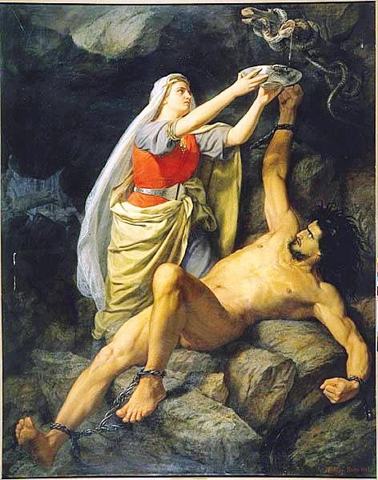
The Trickster. Shape-shifter of giant blood counted among the gods — their cleverest ally, the father of monsters, and the spark of Ragnarok.
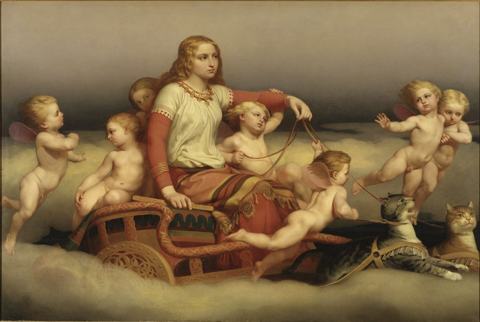
Lady of the Vanir. Goddess of love, war, gold and seidr magic — often spelled Freya — who claims half of the battle-slain for her own hall.
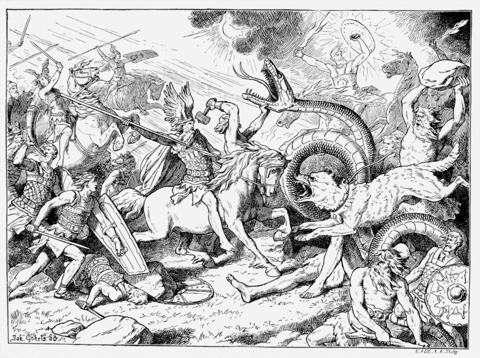
The Twilight of the Gods. The prophesied end: a killing winter, the breaking of every bond, a battle no one survives — and an earth that rises again.
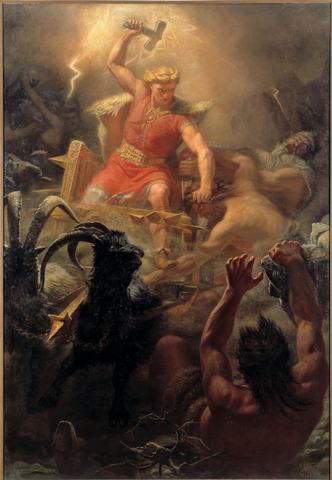
God of Thunder. Son of Odin and the earth, wielder of Mjolnir, and the gods' front line against the giants — fated to fall with the World Serpent.
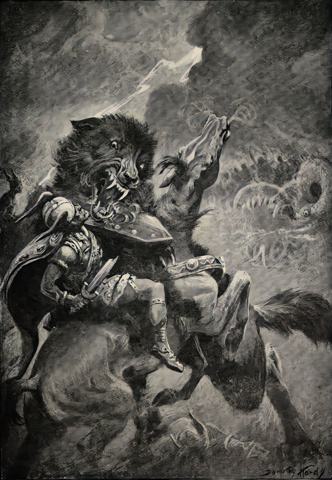
The Bound Wolf. Loki's son, raised among the gods and chained by a trick that cost Tyr his hand — until Ragnarok, when he devours Odin.
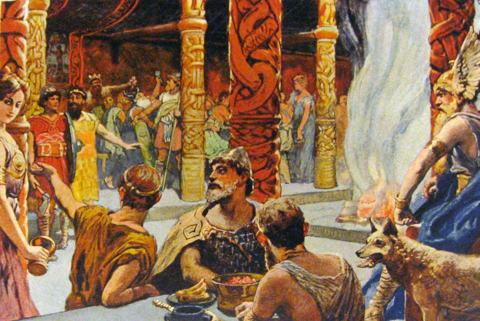
Hall of the Slain. Odin's roof of shields where the chosen dead feast, fight, and are healed each night — an army kept in reserve for Ragnarok.
Also mentioned inAegir and RanBaldrBifrost (The Rainbow Bridge)Blot (Norse Sacrifice)BragiDraupnirFafnirFriggGleipnirGungnirHeimdall (Heimdallr)HelHelheimHodr (Hod)Huginn and MuninnIdunn (Idun)JormungandrKing ArthurMidgardMimirMjolnirNjord (Njörðr)Seidr (Norse Magic)Sigurd (Siegfried)SleipnirSurtrThe Aesir-Vanir WarThe Death of BaldrThe Nine RealmsThe NornsThe Poetic EddaThe Prose EddaThe RunesThe Temple at UppsalaTyrUllrValkyriesVidarVolsunga SagaWyrdYggdrasilYmir (the Primordial Giant)
Sources & Further Reading
- 1.Poetic Edda — Voluspa, Havamal, Grimnismal, Vafthrudnismal and Lokasenna (Codex Regius, 13th century).
- 2.Snorri Sturluson, Prose Edda — Gylfaginning (c. 1220).
- 3.Snorri Sturluson, Prose Edda — Skaldskaparmal (c. 1220).
- 4.Tacitus, Germania (c. 98 CE).
- 5.Lindow, John. Norse Mythology — A Guide to the Gods, Heroes, Rituals, and Beliefs. Oxford University Press, 2001.
- 6.Simek, Rudolf. Dictionary of Northern Mythology. Trans. Angela Hall. D.S. Brewer, 1993.
- 7.Turville-Petre, E.O.G. Myth and Religion of the North — The Religion of Ancient Scandinavia. Weidenfeld & Nicolson, 1964.
- 8.Price, Neil. The Viking Way — Magic and Mind in Late Iron Age Scandinavia. 2nd ed., Oxbow Books, 2019.
Spot an error or have a source to suggest? Write to info@viseterna.com. We cite primary sources and modern scholarship, and we correct fast.