
Mjolnir
Hammer of Thor. Dwarf-forged, short in the handle, it strikes like lightning, hallows oaths and the dead, and always returns to the hand that throws it.
Thor und die Midgardsschlange, Emil Doepler, c. 1905 · Public domain · source
The Forging
Mjolnir exists because of a practical joke that got out of hand. Loki cut off the golden hair of Thor's wife Sif and, threatened with dismemberment, went to the dwarves to buy a replacement. The sons of Ivaldi made new hair that would grow, the ship Skidbladnir, and Odin's spear Gungnir — at which point Loki, unable to leave a success alone, wagered his own head that the dwarf brothers Brokkr and Eitri could not do better 1.
They could. From their forge came the ring Draupnir, the golden boar Gullinbursti, and a hammer. Loki, working the sabotage himself as a biting fly, distracted Brokkr at the bellows just long enough to matter — and the hammer came out with a handle noticeably too short. It was the only flaw, and the gods judged it the greatest treasure regardless 1,4.
The name's etymology is debated but suggestive. The most common readings connect it either to a root meaning "to grind or crush", or to a Slavic and Baltic family of words for lightning — Russian molnija, Welsh mellt — which would make the hammer and the thunderbolt the same word 5,6.
What It Does
In Thor's hand Mjolnir will strike anything he aims at, however hard, and never fail; it returns to him when thrown; and it can be made small enough to carry inside his shirt 1,2. Thor cannot grip it bare — he needs the iron gloves Jarngreipr — and its effect is amplified by the belt Megingjord that doubles his strength 2.
Its more interesting property is consecration. Thor kills and eats his own chariot goats at night and restores them in the morning by hallowing the hides and bones with the hammer 2. He uses it to sanctify Baldr's funeral pyre 2. And Thrymskvida shows it laid in a bride's lap to hallow a wedding, which is evidently a ritual the poem's audience recognised 3.
That ritual detail is the key to the whole object. Mjolnir is not simply a weapon; it is the instrument that makes things legitimate — marriages, funerals, boundaries, oaths — and it happens also to be the single greatest defence the gods possess against the giants 4,6.
Stolen
The one full myth in which Mjolnir is the protagonist is Thrymskvida, and it turns on the hammer's absence. Thor wakes to find it gone; Loki, borrowing Freyja's falcon cloak, flies to Jotunheim and learns that the giant Thrym has buried it eight leagues underground and will return it for one price — Freyja as his wife 3.
Freyja's refusal is emphatic enough to break Brisingamen off her neck, so Heimdall proposes the alternative: dress Thor as the bride. The poem gets considerable mileage out of the disguise. Thrym is unsettled by a bride who eats an entire ox, eight salmon and three casks of mead at the wedding feast, and by eyes that burn like fire under the veil; Loki, playing the maidservant, explains that the lady has not eaten or slept for eight nights out of longing 3.
Then the hammer is carried in and laid in the bride's lap to hallow the marriage, and the joke ends. Thor takes it, kills Thrym, kills his sister who had been asking for a bridal gift, and kills everyone else in the hall 3.
The comedy conceals a serious point about the object. Mjolnir is not merely Thor's weapon — the gods have no defence at all while it is missing, and their only recourse is a deception at Loki's suggestion. The hammer is the load-bearing element of the entire divine order 4,7.
The Hammer in the Real World
Mjolnir is the best-attested Norse mythological object in the archaeological record. Well over a thousand small hammer-shaped pendants have been recovered from Viking Age contexts across Scandinavia, England, Iceland and the Baltic, most in silver or iron, worn at the throat 4,5,6. They are grave goods and everyday jewellery at once, and a few carry runic inscriptions.
Their distribution and their timing are both meaningful. Hammer pendants become markedly more common in the tenth century, exactly as cross pendants spread through the same regions, and the two are sometimes made in the same workshops and even the same moulds. The usual reading is that the hammer became a deliberate marker of identity for people who were not converting — a symbol that acquired a confessional edge because it now had a rival 4,6.
Hammer signs also appear on memorial runestones, carved beside inscriptions that ask Thor to hallow the runes or protect the monument — the same consecrating function the myths describe, applied to stone 5,6.
After Ragnarok
Vafthrudnismal asks who will survive the world's end, and answers with a short list that includes Thor's sons Modi and Magni, who will possess Mjolnir when the fighting is over 3. Thor himself kills Jormungandr at Ragnarok and dies of its venom nine paces later, so the hammer outlives its owner 3,2.
It is a quietly optimistic note in an apocalypse. The thing that gets carried into the reborn world is not a weapon of victory — nobody won — but the instrument that hallows, blesses and rebuilds 4,7.
Continue Exploring
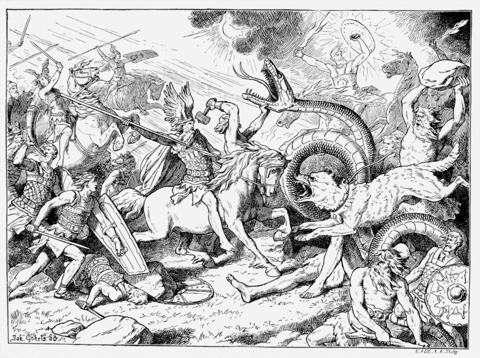
The Twilight of the Gods. The prophesied end: a killing winter, the breaking of every bond, a battle no one survives — and an earth that rises again.
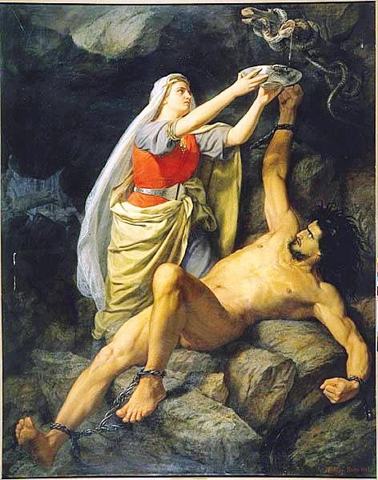
The Trickster. Shape-shifter of giant blood counted among the gods — their cleverest ally, the father of monsters, and the spark of Ragnarok.
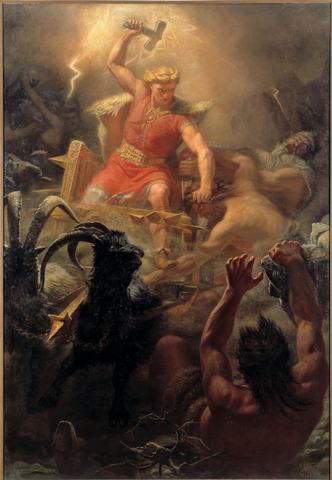
God of Thunder. Son of Odin and the earth, wielder of Mjolnir, and the gods' front line against the giants — fated to fall with the World Serpent.
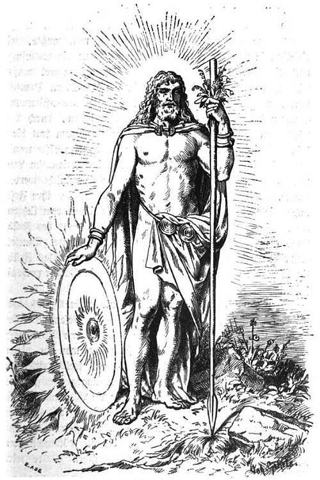
God of Light. The most beloved of the Aesir, made immune to all harm but one plant — and killed by it, which set the world's ending in motion.
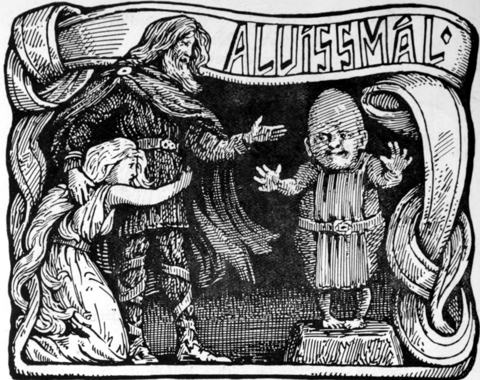
The Norse dvergar: earth-born craftsmen who forged Mjolnir and Draupnir, turn to stone in sunlight, and resist every tidy definition scholars give them.
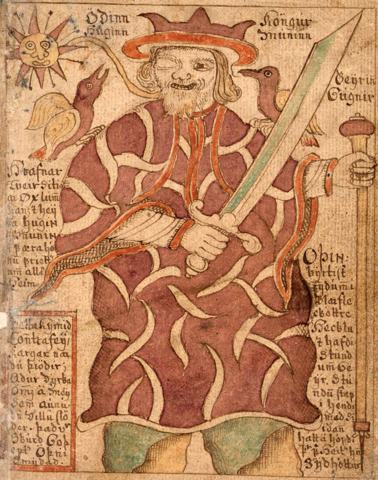
The Allfather. God of war, poetry and the dead who traded an eye for wisdom and hanged himself on the world tree to win the runes.
Also mentioned inBrisingamenDraupnirFreyr (Frey)GungnirJotunheimSifSvartalfheimThe Death of BaldrThe Prose Edda
Sources & Further Reading
- 1.Snorri Sturluson, Prose Edda — Skaldskaparmal (c. 1220).
- 2.Snorri Sturluson, Prose Edda — Gylfaginning (c. 1220).
- 3.Poetic Edda — Thrymskvida, Vafthrudnismal and Hymiskvida (Codex Regius, 13th century).
- 4.Lindow, John. Norse Mythology — A Guide to the Gods, Heroes, Rituals, and Beliefs. Oxford University Press, 2001.
- 5.Simek, Rudolf. Dictionary of Northern Mythology. Trans. Angela Hall. D.S. Brewer, 1993.
- 6.Turville-Petre, E.O.G. Myth and Religion of the North — The Religion of Ancient Scandinavia. Weidenfeld & Nicolson, 1964.
- 7.Orchard, Andy. Cassell's Dictionary of Norse Myth and Legend. Cassell, 1997.
Spot an error or have a source to suggest? Write to info@viseterna.com. We cite primary sources and modern scholarship, and we correct fast.