
Fenrir
The Bound Wolf. Loki's son, raised among the gods and chained by a trick that cost Tyr his hand — until Ragnarok, when he devours Odin.
Odin and Fenris, Dorothy Hardy, 1909 · Public domain · source
The Wolf Raised by Gods
Fenrir — also Fenrisulfr, "the wolf of Fen", and in the poems Hrodvitnir and Vanargandr — is the eldest of the three children Loki fathered on the giantess Angrboda, brother to Jormungandr and Hel 1,5. Where Odin exiled the other two, the wolf was brought home. The Aesir raised him inside Asgard.
That decision is the hinge of the story. Snorri says the gods kept Fenrir among them and watched him grow, and that only Tyr had the courage to go near enough to feed him. He grew fast, and the prophecies about what he would do to Odin grew more specific in step with him 1,4.
The Binding
The gods decided to chain him, and — because they could not simply attack a guest in their own hall — they made it a game. They brought out a heavy fetter called Leyding and suggested he test his strength; Fenrir let them bind him and broke it at the first kick. They made a second, Dromi, twice as strong, and flattered him into trying again. He broke that too, and the phrase "to loose oneself from Leyding" or "to strike out of Dromi" entered Norse idiom as a way of saying a hard thing was done 1.
Then Odin sent to the dwarves of Svartalfheim, who forged Gleipnir — a ribbon as soft as silk and no thicker than a hair, made from six things that do not exist: the sound of a cat's footfall, a woman's beard, the roots of a mountain, the sinews of a bear, the breath of a fish, and the spittle of a bird. Snorri adds the dry aside that this is why none of those things can be found any more 1,4.
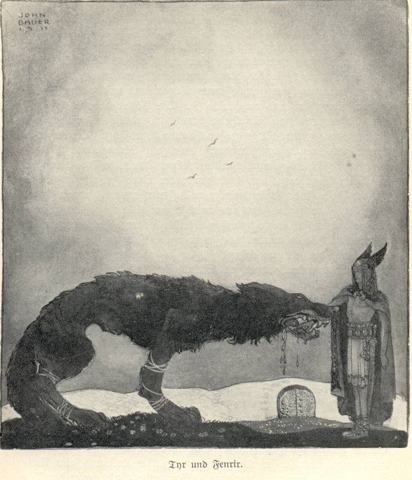
Fenrir looked at it and was not fooled. There was no glory in snapping a ribbon and every reason to suspect a ribbon that thin, so he set a condition: one of them must put a hand in his mouth as a pledge of good faith. The gods looked at each other. Tyr put in his right hand. When the wolf found he could not break free, he bit it off at the wrist, and the gods laughed — all except Tyr 1,2.
They ran a cord from the fetter through a stone slab called Gjoll, drove it into the ground, and hammered a second rock, Thviti, on top. When Fenrir gaped at them they jammed a sword upright in his jaws, hilt in the lower gum and point in the palate. He has howled ever since, and the foam running from his mouth makes a river 1.
What the Binding Cost
The episode is one of the clearest moral statements in Norse mythology, and it is not flattering to the gods. Fenrir has done nothing yet. He is bound for what he is prophesied to become, by a deception that required one of them to swear falsely, and the god who paid for it is specifically the god of oaths and legal order 4,6. The universe is arranged so that keeping the world safe requires breaking the rules that make it worth keeping.
Scholars have noted how closely the pattern resembles the binding of other cosmic adversaries, and how consistently Norse myth pairs Fenrir with fate rather than with evil — he is a scheduled event, not a villain with motives 4,5,6.
The wound also became a permanent label. Snorri's handbook for poets lists the acceptable ways to name Tyr in verse, and among them are "the one-handed god" and "the feeder of the wolf" — a god whose entire poetic identity is the day he lost an argument with Fenrir 3.
Wolves in the Sky
Norse tradition also fills the sky with wolves. Skoll chases the sun and Hati Hrodvitnisson the moon, and both will catch what they are chasing at the world's end; the patronymic makes Hati Fenrir's son, and Snorri places a whole brood of wolf-kin in the Ironwood east of Midgard, born to an old giantess 2,1. The relationships are not perfectly consistent across sources, but the effect is: wolves are the timekeepers of the apocalypse, and every night that passes brings them closer 4,5.
The Devourer
At Ragnarok every bond in the cosmos snaps, and Fenrir is the first thing through. Voluspa and Snorri agree on the picture: he comes with his mouth wide open, the lower jaw against the earth and the upper against the sky, fire in his eyes and nostrils 2,1.
Odin rides out to meet him in front of the whole host of Valhalla, and the wolf swallows him. It is the death the Allfather has been preparing against since the beginning and has never once been able to avert. His son Vidarr steps in immediately, sets a foot on the lower jaw — wearing a boot made from every scrap of leather ever trimmed off a shoe and discarded — takes hold of the upper, and tears the wolf apart 1,2.
Tenth-century sculpture already knew the sequence. The Gosforth Cross in Cumbria and Thorwald's Cross on the Isle of Man both show a bound or open-jawed beast with a man's leg in its mouth, carved on Christian monuments by people who evidently expected viewers to recognise the wolf 4,6,7.
Continue Exploring
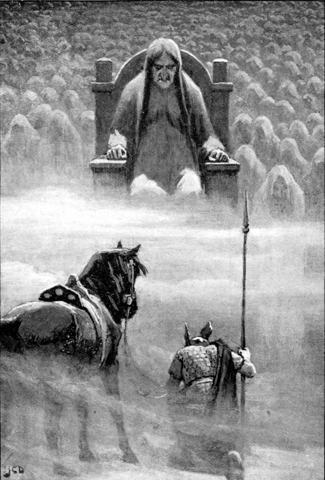
Queen of the Dead. Half living woman and half corpse, Loki's daughter rules the cold realm where those who die of sickness and age must go.
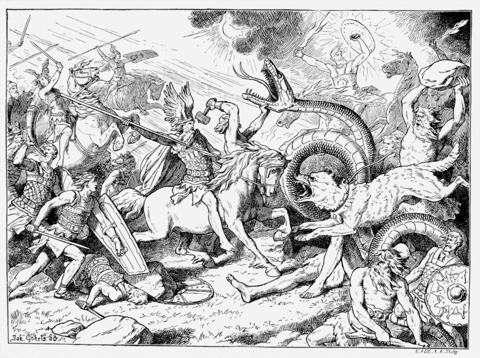
The Twilight of the Gods. The prophesied end: a killing winter, the breaking of every bond, a battle no one survives — and an earth that rises again.
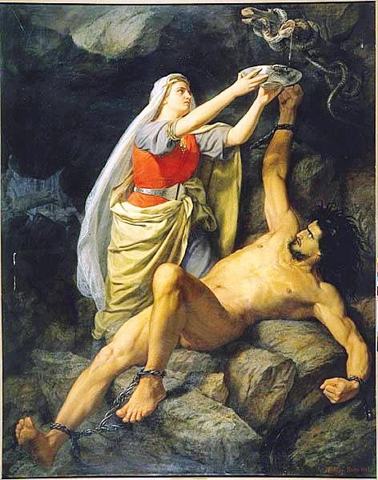
The Trickster. Shape-shifter of giant blood counted among the gods — their cleverest ally, the father of monsters, and the spark of Ragnarok.
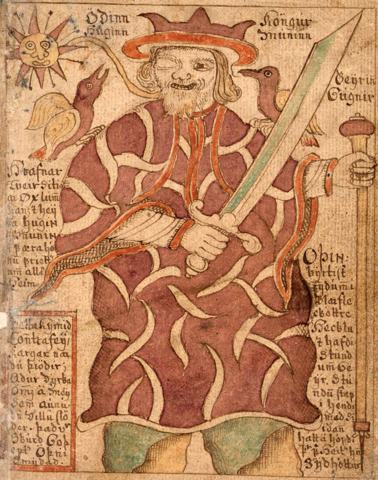
The Allfather. God of war, poetry and the dead who traded an eye for wisdom and hanged himself on the world tree to win the runes.
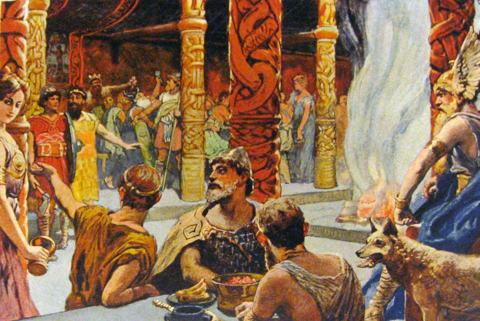
Hall of the Slain. Odin's roof of shields where the chosen dead feast, fight, and are healed each night — an army kept in reserve for Ragnarok.
God of Sacred Law. Once perhaps the sky-father of the north, remembered chiefly for putting his sword hand into a wolf's mouth and losing it.
Also mentioned inBifrost (The Rainbow Bridge)Dwarves (Dvergar)GleipnirGungnirSurtrSvartalfheimThe Poetic EddaThe Prose EddaVidar
Sources & Further Reading
- 1.Snorri Sturluson, Prose Edda — Gylfaginning (c. 1220).
- 2.Poetic Edda — Voluspa, Vafthrudnismal, Grimnismal and Lokasenna (Codex Regius, 13th century).
- 3.Snorri Sturluson, Prose Edda — Skaldskaparmal (c. 1220).
- 4.Lindow, John. Norse Mythology — A Guide to the Gods, Heroes, Rituals, and Beliefs. Oxford University Press, 2001.
- 5.Simek, Rudolf. Dictionary of Northern Mythology. Trans. Angela Hall. D.S. Brewer, 1993.
- 6.Turville-Petre, E.O.G. Myth and Religion of the North — The Religion of Ancient Scandinavia. Weidenfeld & Nicolson, 1964.
- 7.Orchard, Andy. Cassell's Dictionary of Norse Myth and Legend. Cassell, 1997.
Spot an error or have a source to suggest? Write to info@viseterna.com. We cite primary sources and modern scholarship, and we correct fast.