
Fafnir
The dwarf-born son who murdered his father for cursed gold, turned into a dragon to guard it alone, and was killed from a pit by Sigurd.
Sigurd Kills Fafnir, Arthur Rackham, 1911, from Siegfried and the Twilight of the Gods · Public domain · source
A Family Undone by a Ransom
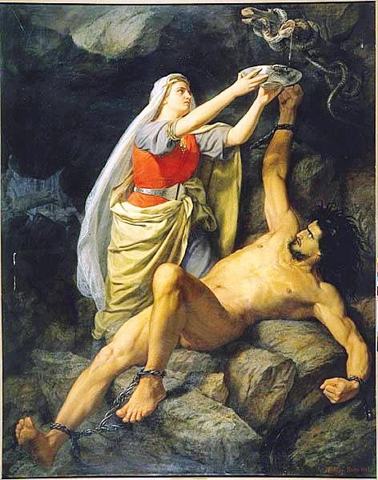
Fafnir starts the story as a person, not a monster. He is the eldest son of the sorcerer-farmer Hreidmar, brother to Regin and to Otr, who has the habit of taking otter shape to fish. When Loki kills Otr in that shape without recognising him, Hreidmar demands weregild: enough gold to cover the otter skin completely, inside and out. Loki extorts it from the dwarf Andvari, stripping him of his last ring as well — and Andvari curses the whole hoard as he loses it, swearing it will be the death of every owner to come 1,2,6. Hreidmar accepts the payment and is dead within the same story, because Fafnir will not share it.
Kinslayer, Then Dragon
Reginsmal is blunt about what happens next: Fafnir kills his own father in his sleep for the gold and refuses his brother Regin any part of it, driving him out. He then does something none of the human characters in the cycle do — he leaves his own shape behind. Fafnir goes to the heath called Gnitaheath and turns into a serpent, described in the poems as an ormr, to lie on the hoard himself rather than trust anyone else to guard it 1,3. Norse sources are not fussy about the line between a great snake and a proper dragon, and Fafnir is called both; what matters is that he no longer has hands, a face, or kin, only gold and a body built to keep it 3,6.
Waiting on the Gold
Fafnir names the source of his own menace: dying, in Fafnismal, he boasts that he wore the Aegishjalmr, the "helm of terror," over every other creature while he lay on the gold, and the prose preface to Reginsmal backs him up, saying all living things feared it 1. The saga tradition adds what the poems leave out: that his breath alone was poisonous to anything that came near his crawling-path 2,4. He does nothing with the treasure except sit on it. That inertia is the point — later medieval commentary on dragon-hoards generally, including the Old English poet who wrote Beowulf, treats a dragon's gold as wealth taken permanently out of the world, useless to everyone, which is exactly the fate Fafnir chose for it rather than divide it with his brother 3,6.
Death in a Pit
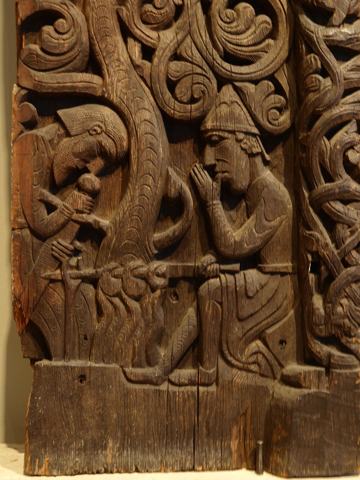
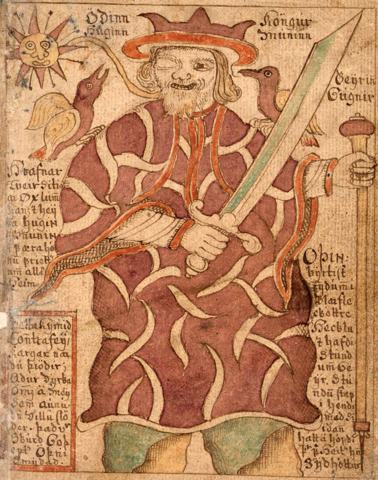
Regin, still wanting the gold, raises the orphaned hero Sigurd and steers him toward Gnitaheath. On Odin's advice, delivered in disguise, Sigurd digs a trench across the path Fafnir uses to reach water and hides in it rather than meeting the dragon in the open; when Fafnir's belly passes overhead, Sigurd drives the sword Gram up into his heart 1,3. It is not a duel of equals, and none of the sources pretend otherwise — Fafnir is killed by patience and geography, the same way Regin plans to use Sigurd and then discard him 1,2.
Dying Words
Fafnismal gives the dragon a long death scene rather than a quick one, and it is the richest thing in the poem. Fafnir asks who has killed him and why, warns Sigurd that the gold will be his ruin exactly as it was everyone else's, and answers questions about the Norns and the coming doom of the gods before he finally dies 1,5. Sigurd, tellingly, does not gloat over him — he listens, which the poem frames as the correct response to a monster's last words rather than weakness 1.
Remembered in Stone
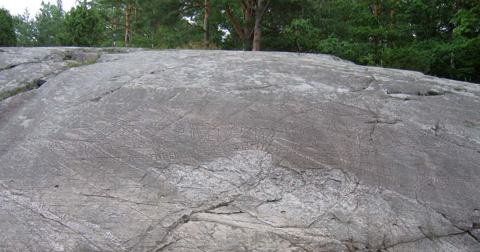
Fafnir's death was famous well before Volsunga Saga fixed it in prose. The Viking Age Ramsund carving in Sweden and the medieval doorway of the Hylestad stave church in Norway both show the pit, the sword-thrust, and the dragon's death in roughly the same sequence the eddic poems describe, evidence the story's shape was already fixed by the Middle Ages across a wide swath of the Norse world 2,6,7. The Volsunga Saga carried it further still, into German epic and eventually into modern fantasy's stock image of the hoarding dragon — a figure whose danger, in the original telling, was never simply its size or its fire, but what holding cursed wealth alone had already made of him before Sigurd ever found the pit 2,6.
Continue Exploring
The Volsung hero who slew the dragon Fafnir, tasted its heart-blood, and rode straight into the tragedy of Brynhild and the Niflungs.
The 13th-century Icelandic saga that turns scattered eddic poems about Sigurd, Brynhild and cursed gold into one continuous, doom-laden family history.
The Allfather. God of war, poetry and the dead who traded an eye for wisdom and hanged himself on the world tree to win the runes.
The Trickster. Shape-shifter of giant blood counted among the gods — their cleverest ally, the father of monsters, and the spark of Ragnarok.
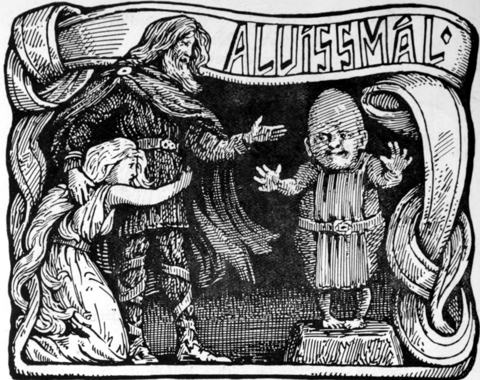
The Norse dvergar: earth-born craftsmen who forged Mjolnir and Draupnir, turn to stone in sunlight, and resist every tidy definition scholars give them.
Anonymous Old Norse poems on gods and heroes, preserved in one 13th-century manuscript — the primary source for most of what survives of Norse myth.
Sources & Further Reading
- 1.Poetic Edda — Reginsmal and Fafnismal (Codex Regius, 13th century).
- 2.Volsunga Saga (13th century).
- 3.Snorri Sturluson, Prose Edda — Skaldskaparmal (c. 1220).
- 4.Byock, Jesse L., trans. The Saga of the Volsungs: The Norse Epic of Sigurd the Dragon Slayer. University of California Press, 1990.
- 5.Larrington, Carolyne (trans.). The Poetic Edda. Rev. ed., Oxford World's Classics, 2014.
- 6.Lindow, John. Norse Mythology — A Guide to the Gods, Heroes, Rituals, and Beliefs. Oxford University Press, 2001.
- 7.Simek, Rudolf. Dictionary of Northern Mythology. Trans. Angela Hall. D.S. Brewer, 1993.
Spot an error or have a source to suggest? Write to info@viseterna.com. We cite primary sources and modern scholarship, and we correct fast.