
Heimdall (Heimdallr)
Watchman of the Gods. Born of nine mothers, he guards the rainbow bridge, hears wool grow on sheep, and will sound the horn that begins the end.
Heimdallr and Gulltoppr, Dorothy Hardy, 1908 · Public domain · source
The Watchman
Heimdall — Old Norse Heimdallr, a name whose meaning has never been satisfactorily explained — lives at Himinbjorg, "heaven-cliffs", where the rainbow bridge Bifrost meets the sky, and his single job is to see what is coming 1,2,5. Snorri's description of his senses is the detail everyone remembers: he needs less sleep than a bird, sees a hundred leagues by night as easily as by day, and hears grass growing on the earth and wool growing on sheep 2.
He is called the white god, the brightest of the Aesir, and Gullintanni, "golden-toothed"; his horse is Gulltoppr, "golden-mane" 2,3. And he owns the Gjallarhorn, the resounding horn, which is kept under a root of Yggdrasil beside Mimir's well and will be blown exactly once 1,2.
Nine Mothers
Heimdall's birth is the strangest thing about him. A stanza in Hyndluljod says he was born of nine mothers, all sisters, at the edge of the world, and a lost poem called Heimdalargaldr — surviving only in the single line Snorri quotes — has the god himself say "I am the son of nine mothers" 1,2.
The sources do not explain it. The most common scholarly guess connects the nine sisters to the nine daughters of the sea-giant Aegir, which would make Heimdall a child of the waves — a reading that fits the way skaldic verse calls him the son of nine mothers and the sea "the mothers of Heimdall" 4,5,6. It remains a guess. What the detail unmistakably does is mark him as belonging to an older, stranger layer of tradition than the family relations of most of the Aesir 4,5.
Rig and the Origin of Classes
The Eddic poem Rigsthula tells of a god who walks the roads under the name Rig, lodges three nights with three households in turn — a poor couple, a working couple and a wealthy couple — sleeping between the husband and wife each time, and fathers the ancestors of the enslaved, the free farmers and the nobility. The last of these, Jarl, he takes as his own and teaches the runes.
A short prose note in the manuscript identifies Rig as Heimdall, and the identification is supported by the opening of Voluspa, which addresses humankind as "the greater and lesser children of Heimdall" 1,4. Whether the note is old tradition or a medieval scribe's inference is debated, but if it is right, the guardian of Asgard is also the ancestor of everyone he is guarding it from 4,5,7.
The Enmity with Loki
Heimdall and Loki hate each other, and the sources give the enmity without ever quite giving its cause. In Lokasenna, Heimdall is the one who tells Loki he is drunk and should stop, and gets an insult about a boring watchman's life for it 1.
Skaldic verse preserves a stranger encounter. The poet Ulfr Uggason, describing carvings in a hall, refers to the two of them fighting in the shape of seals over the Brisingamen — Freyja's necklace — at a sea-rock called Singasteinn. Snorri quotes the passage and evidently expects it to be understood; nothing else about the episode survives 3,4,5.
The Horn
At Ragnarok it is Heimdall who registers the beginning, because registering things is what he is for. Voluspa has him raise the Gjallarhorn and blow, and the sound goes into every world at once, and Odin turns to speak with Mimir's head one last time 1,2.
Then the bridge he has guarded breaks under the weight of the fire-riders crossing it, and Heimdall goes down to the plain with everyone else. He and Loki find each other there and kill each other, ending a quarrel about a necklace, or about something the poems have lost 1,2.
Little Worship, Long Memory
There is almost no evidence that Heimdall was worshipped. No place-names are securely built on his name, no cult sites are attested, and he does not appear in the personal-name record the way Thor does 5,6. Yet the mythology gives him a first line in Voluspa, a lost poem of his own, an origin nobody else has, and the most consequential single action at the end of the world.
That imbalance is a useful reminder about the Norse material generally: what survived is what interested poets and a thirteenth-century Icelandic scholar, and it is not the same thing as what people prayed to 4,6,7.
Continue Exploring
The Trickster. Shape-shifter of giant blood counted among the gods — their cleverest ally, the father of monsters, and the spark of Ragnarok.
The Twilight of the Gods. The prophesied end: a killing winter, the breaking of every bond, a battle no one survives — and an earth that rises again.
Lady of the Vanir. Goddess of love, war, gold and seidr magic — often spelled Freya — who claims half of the battle-slain for her own hall.
The Allfather. God of war, poetry and the dead who traded an eye for wisdom and hanged himself on the world tree to win the runes.
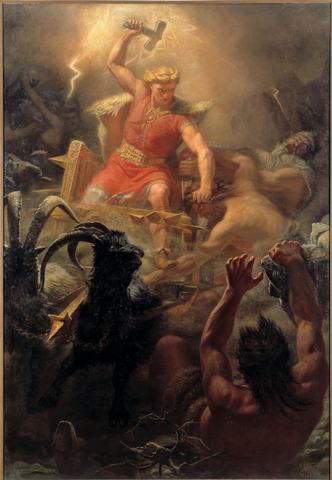
God of Thunder. Son of Odin and the earth, wielder of Mjolnir, and the gods' front line against the giants — fated to fall with the World Serpent.
The stronghold of the AEsir. A walled citadel of halls at the top of the world tree, reached by the rainbow bridge and built on a bargain the gods broke.
Also mentioned inAegir and RanBifrost (The Rainbow Bridge)BrisingamenMjolnirSurtrThe Aesir-Vanir War
Sources & Further Reading
- 1.Poetic Edda — Voluspa, Grimnismal, Lokasenna, Hyndluljod and Rigsthula (Codex Regius and related manuscripts, 13th century).
- 2.Snorri Sturluson, Prose Edda — Gylfaginning (c. 1220).
- 3.Snorri Sturluson, Prose Edda — Skaldskaparmal (c. 1220), citing Ulfr Uggason's Husdrapa.
- 4.Lindow, John. Norse Mythology — A Guide to the Gods, Heroes, Rituals, and Beliefs. Oxford University Press, 2001.
- 5.Simek, Rudolf. Dictionary of Northern Mythology. Trans. Angela Hall. D.S. Brewer, 1993.
- 6.Turville-Petre, E.O.G. Myth and Religion of the North — The Religion of Ancient Scandinavia. Weidenfeld & Nicolson, 1964.
- 7.Orchard, Andy. Cassell's Dictionary of Norse Myth and Legend. Cassell, 1997.
Spot an error or have a source to suggest? Write to info@viseterna.com. We cite primary sources and modern scholarship, and we correct fast.