
Valkyries
Choosers of the Slain. Odin's riders who decide who dies in battle and carry the chosen to Valhalla — battlefield spirits before they were shieldmaidens.
Valkyrjen (The Valkyrie), Peter Nicolai Arbo, 1869 (Nasjonalmuseet, Oslo) · Public domain · source
What the Name Means
Valkyrja is a compound of valr, the slain lying on a battlefield, and a verb meaning to choose: a valkyrie is literally a chooser of the slain 5. The name states a job, and the job is the disturbing part. Valkyries do not collect the dead after the fighting; they decide who the dead will be, and then they collect them 4,5,6.
They serve Odin, and their function is his in miniature. He is the god who grants victory and withdraws it, and the valkyries are how the withdrawal arrives 4,6.
Two Faces in the Sources
The surviving material preserves two quite different pictures, and reading them as one figure is a mistake worth avoiding.
The older and grimmer image is of battlefield spirits — inhuman, plural, allied with carrion birds and the terror of combat, with names to match: Hild ("battle"), Gunnr ("war"), Skogul ("shaker"), Herfjotur ("war-fetter", who binds a warrior's limbs so he cannot defend himself), Hlokk ("noise"), Goll ("scream") 1,5,6. Grimnismal simply lists thirteen of them and the ale they carry 1. There is nothing courtly about this; these are personified forces of a violent death.
The second image is heroic and individual: the valkyrie as a named woman with a will of her own, often a king's daughter, who takes a mortal lover. The Helgi poems give Sigrun and Svava, who ride through air and sea to protect the men they have chosen. Sigrdrifumal gives the most famous case — a valkyrie who awarded victory to the wrong king against Odin's orders, and was punished with a sleep-thorn and a marriage she did not want. She is the ancestor of Brynhild in the Volsung material and, through Wagner, of Brünnhilde 1,4,7.
Scholars generally read the second type as a literary development of the first, as heroic poetry humanised what had been an impersonal force 5,6,7.
The Loom of Darradarljod
The single most vivid valkyrie text is not in the Eddas at all. In Njals saga, a man in Caithness looks through the window of a hut on the morning of the Battle of Clontarf in 1014 and sees twelve women working a loom. The warp is made of men's intestines, weighted with severed heads; the shuttles are arrows and the beater is a sword. They sing while they weave, naming who will fall, and when the cloth is finished they tear it apart, each keeps her piece, and they ride away — six north, six south 3.
The poem they sing, the Darradarljod, is generally accepted as considerably older than the saga that preserves it 4,5. It states the theology plainly: the battle's outcome is being manufactured, not observed, and the weaving of fate and the killing of men are the same activity 4,6.
Valkyries in Valhalla
Snorri gives them a second, gentler duty. In Valhalla the valkyries serve ale to the Einherjar and set the tables, and he names them alongside the ones Odin sends out to every battle 1,2. The two roles are less contradictory than they look: the same figures recruit the army and then keep it.
The boundaries with other female powers are porous. Valkyries shade into the disir, protective family spirits; into the norns who set fate at a person's birth; and into Freyja, who takes half the battle-slain in her own right and whom some scholars read as a valkyrie-figure at a divine scale 5,6,8. The sources never draw firm lines, and it is likely that nobody in the Viking Age did either.
The Evidence on the Ground
Small silver and bronze figures of women holding drinking horns, sometimes flanked by armed riders, turn up across Scandinavia and are conventionally labelled "valkyrie pendants" — though the label is an interpretation, and the same objects would sit equally well as generic images of a woman greeting a warrior 5,8. Gotland picture stones show a similar scene: a rider arriving at a hall where a woman waits with a horn.
The wider question of whether real women fought has been reopened in recent decades, most publicly by the reanalysis of the richly furnished Birka warrior grave Bj.581, whose occupant was identified as biologically female. The find is genuine and the debate over what it means — a warrior, a ritual specialist, a status burial, a mismatch of bones and goods — is active and unresolved 7,8. What is clear is that the mythological valkyrie is not evidence for the historical shieldmaiden, and vice versa; they are separate arguments that popular writing tends to fuse 7.
Afterlife of the Image
The valkyrie has had a longer second life than almost any Norse figure. Nineteenth-century painting and Wagner's Ring turned the carrion-spirits into winged, armoured heroines, fixing the image that comics, games and film still use 4,7. The medieval material underneath is stranger and better: not warrior-angels escorting the deserving upward, but the choosers, deciding at the edge of a shield-wall which men will be needed at Ragnarok and taking them at once.
Continue Exploring
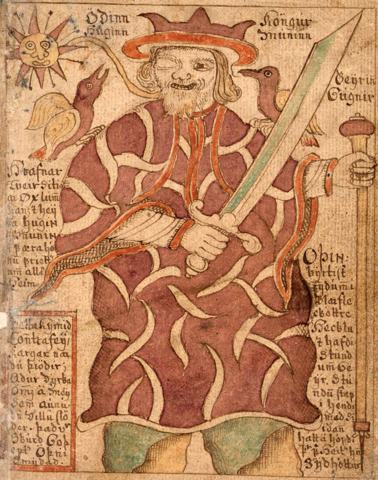
The Allfather. God of war, poetry and the dead who traded an eye for wisdom and hanged himself on the world tree to win the runes.
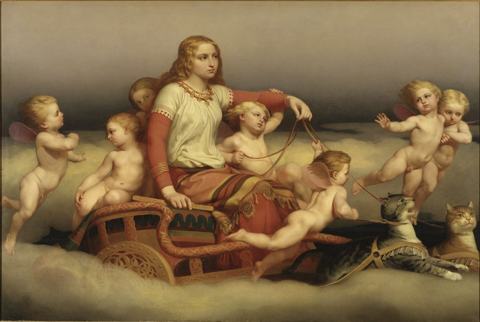
Lady of the Vanir. Goddess of love, war, gold and seidr magic — often spelled Freya — who claims half of the battle-slain for her own hall.
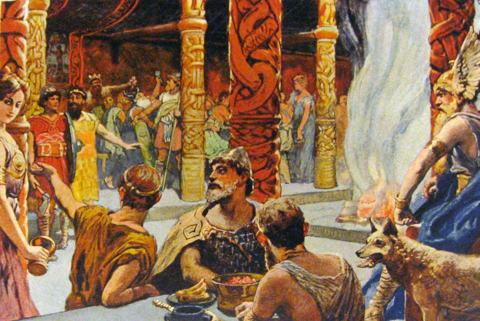
Hall of the Slain. Odin's roof of shields where the chosen dead feast, fight, and are healed each night — an army kept in reserve for Ragnarok.
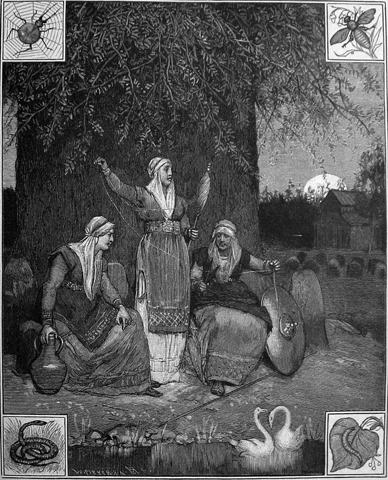
Urd, Verdandi and Skuld, the three women who tend Yggdrasil's well and lay down the fates of gods and men — plus the lesser norns who visit every birth.
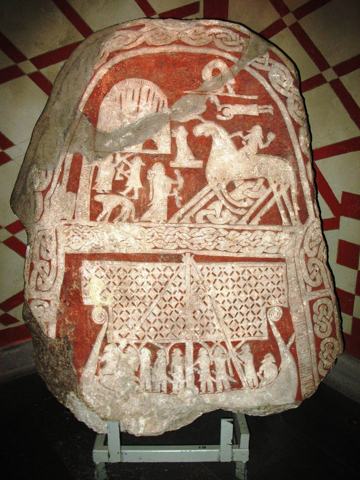
The grey eight-legged horse Loki bore as a mare. Best of all steeds, Odin's mount between the worlds, and the only horse to jump the gate of Hel.
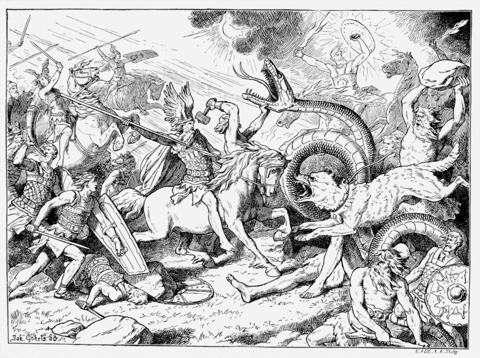
The Twilight of the Gods. The prophesied end: a killing winter, the breaking of every bond, a battle no one survives — and an earth that rises again.
Also mentioned inHuginn and MuninnThe Poetic EddaWyrd
Sources & Further Reading
- 1.Poetic Edda — Grimnismal, Voluspa, Sigrdrifumal and the Helgi poems (Codex Regius, 13th century).
- 2.Snorri Sturluson, Prose Edda — Gylfaginning (c. 1220).
- 3.Njals saga — the Darradarljod (Iceland, late 13th century).
- 4.Lindow, John. Norse Mythology — A Guide to the Gods, Heroes, Rituals, and Beliefs. Oxford University Press, 2001.
- 5.Simek, Rudolf. Dictionary of Northern Mythology. Trans. Angela Hall. D.S. Brewer, 1993.
- 6.Davidson, H.R. Ellis. Gods and Myths of Northern Europe. Penguin, 1964.
- 7.Friðriksdóttir, Jóhanna Katrín. Valkyrie — The Women of the Viking World. Bloomsbury Academic, 2020.
- 8.Price, Neil. The Viking Way — Magic and Mind in Late Iron Age Scandinavia. 2nd ed., Oxbow Books, 2019.
Spot an error or have a source to suggest? Write to info@viseterna.com. We cite primary sources and modern scholarship, and we correct fast.