
Bragi
Norse god of poetry and eloquence, husband of Idunn, who greets fallen kings at Valhalla's door and may have begun as a real ninth-century skald.
Bragi with a harp, Carl Wahlbom (1810-1858) · Public domain · source
The God of the Word
Bragi is the Norse god of poetry, and Snorri's introduction of him in Gylfaginning is almost a definition: he is renowned for wisdom and above all for eloquence and command of language; he knows most about skaldship, and after him poetry itself is called bragr, as are those men and women who are more accomplished in words than others 3. His wife is Idunn, the keeper of the apples that hold off the gods' old age 3.
Grimnismal places him in the same top rank as the best of everything else in the world: as Odin is foremost of the Aesir and Yggdrasil of trees, so Bragi is foremost of poets 1. Sigrdrifumal, listing where the great runes were carved, names Bragi's tongue among the surfaces they were cut on — an image that makes speech itself a piece of inscribed magic 1.
The Skald Behind the God?
Bragi is the one Norse deity for whom a plausible human original can be named. Bragi Boddason inn gamli — "Bragi the Old" — was a ninth-century Norwegian court poet, the earliest skald whose verse survives in any quantity, credited with the Ragnarsdrapa that describes scenes painted on a shield. Whether the god is a deified poet or the poet simply bore a divine name is one of the standing arguments of the field 6,7.
The case for deification rests on the near-total absence of Bragi from anything resembling cult: no place names, no votive material, no role in any myth of consequence 6,7. The case against rests on the common noun bragr, "poetry, the best of something", which would supply the name without any need for a real man; some scholars also point out that Snorri's Skaldskaparmal frame — where a figure explicitly called "Bragi the old" instructs the sea-giant Aegir in the art of poetry — may be the very moment the human and the divine names collapsed into one 4,6,8. The safest statement is the one most handbooks make: the two Bragis are connected, and the direction of the connection is unproven.
Lokasenna: The Guardian of the Bench
Bragi's fullest appearance is in Lokasenna, and he does not come out of it well. When Loki forces his way into Aegir's hall after killing a servant, Bragi is the first god to speak against him, telling him plainly that the gods will never give him a seat there 1.
Loki reminds Odin of their blood-brotherhood and drinks anyway, then turns on Bragi. Bragi offers him a horse, a sword and a ring to keep the peace; Loki throws the offer back as proof of cowardice, calling him the most cautious in a fight and the shyest of shooting, and dismissing him as a "bench-ornament" — bold at the drinking benches and nowhere else 1,8. Idunn takes her husband by the arm and asks him not to answer, and Bragi says he would twist Loki's head from his shoulders if they were outside the hall — which is to say, he does not 1.
The exchange is often read as the poem's joke about eloquence: the god of words is the god who cannot make his words into deeds 6. It may also preserve a real cultural tension between the skald's prestige and the warrior's, since skalds at court held rank without necessarily earning it in battle 8.
The Doorkeeper of Valhalla
The other genuinely old attestation is Eiriksmal, composed around 954 for the widow of Eirik Bloodaxe. Odin wakes in Valhalla and hears a great noise; Bragi asks what it is, and Odin sends him and the hero Sigmund out to meet the arriving king, because "a king is coming" 2. The scene assigns Bragi a settled ceremonial job: he is the one who greets the distinguished dead at the door and speaks the words of welcome, which is precisely what a court poet does for a living 2,6.
Snorri echoes the arrangement, and the two together give the clearest picture of the god's actual place in the imagined afterlife — not among the warriors of the einherjar, but at the threshold with the right phrase ready 3,6.
Bragarfull, the Cup of Promises
At funeral feasts and at Yule the Norse drank a cup called bragarfull, over which the heir swore what he would accomplish before taking his father's high seat. Snorri describes the custom in Ynglinga saga 5. Whether the name means "the cup of Bragi" or "the cup of the best" — the manuscripts vary between bragarfull and bragafull — is unresolved, and scholars have used the ambiguity as evidence on both sides of the god-versus-skald question 5,6,7.
What can be said is that the ceremony ties poetry to binding speech. In a society without writing to hold people to their word, the oath and the verse are the same technology, and the god who governs one plausibly governs the other 7,8.
What Survives
Bragi has no death scene, no part in Ragnarok, and no myth of his own. He is a name at the head of a craft, a doorkeeper in one great poem, and a target in another — which, for a god of poetry in a literature that survived only because poets memorised it, is a reasonable monument 6,8.
Continue Exploring
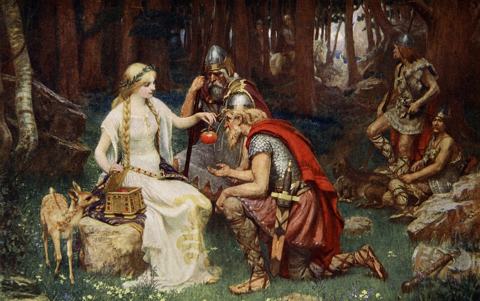
Norse goddess who guards the apples that keep the gods young. Her abduction by the giant Thjazi ages the whole pantheon and forces Loki to fetch her back.
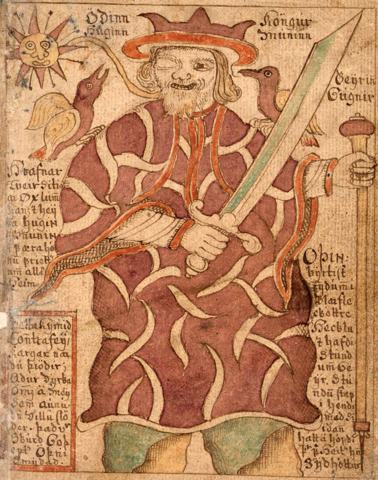
The Allfather. God of war, poetry and the dead who traded an eye for wisdom and hanged himself on the world tree to win the runes.
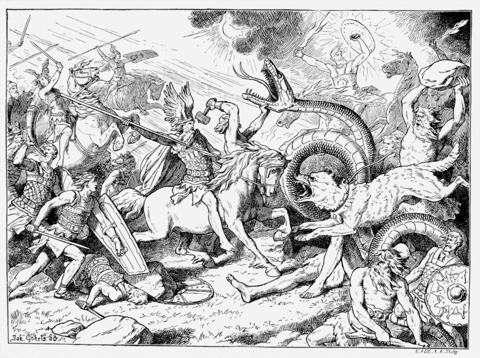
The Twilight of the Gods. The prophesied end: a killing winter, the breaking of every bond, a battle no one survives — and an earth that rises again.
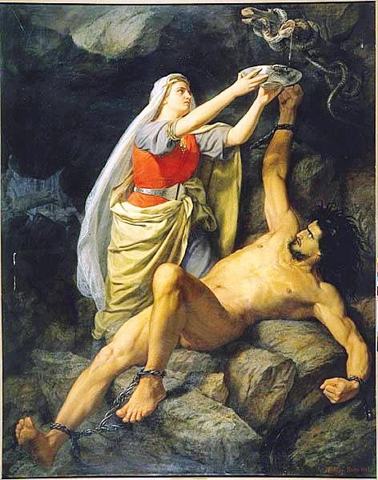
The Trickster. Shape-shifter of giant blood counted among the gods — their cleverest ally, the father of monsters, and the spark of Ragnarok.
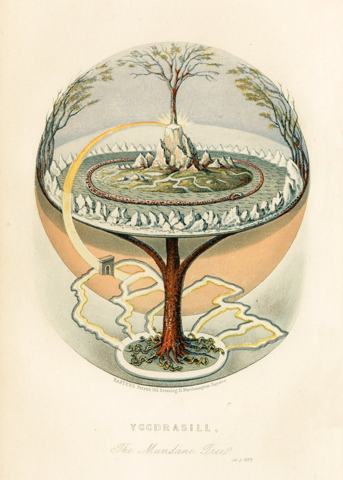
The World Tree. The great ash whose roots reach three wells and nine worlds, tended by the norns, eaten from every side, and still standing when the sky burns.
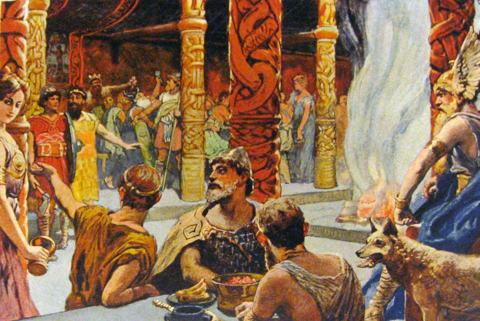
Hall of the Slain. Odin's roof of shields where the chosen dead feast, fight, and are healed each night — an army kept in reserve for Ragnarok.
Also mentioned inThe Prose EddaThe Runes
Sources & Further Reading
- 1.Poetic Edda — Lokasenna, Grimnismal and Sigrdrifumal (Codex Regius, 13th century).
- 2.Eiriksmal (anonymous, c. 954), preserved in Fagrskinna.
- 3.Snorri Sturluson, Prose Edda — Gylfaginning (c. 1220).
- 4.Snorri Sturluson, Prose Edda — Skaldskaparmal (c. 1220).
- 5.Snorri Sturluson, Ynglinga saga, in Heimskringla (c. 1230).
- 6.Lindow, John. Norse Mythology — A Guide to the Gods, Heroes, Rituals, and Beliefs. Oxford University Press, 2001.
- 7.Simek, Rudolf. Dictionary of Northern Mythology. Trans. Angela Hall. D.S. Brewer, 1993.
- 8.Turville-Petre, E.O.G. Myth and Religion of the North. Weidenfeld & Nicolson, 1964.
Spot an error or have a source to suggest? Write to info@viseterna.com. We cite primary sources and modern scholarship, and we correct fast.