
Ymir (the Primordial Giant)
The frost-giant who came first, out of the meeting of fire and ice — killed by Odin and his brothers, his body split apart to build the world.
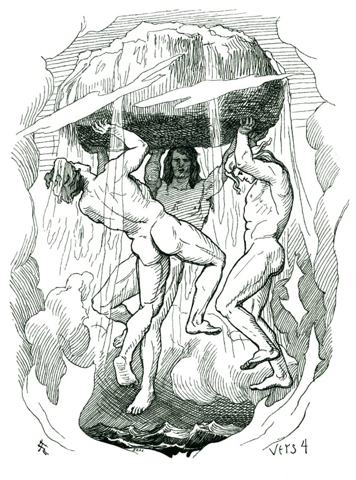
Ymir gets killed, 19th-century engraving · Public domain · source
Out of the Gap
Before the world, the sources agree, there was Ginnungagap — a yawning emptiness with Niflheim's cold and mist to the north and Muspelheim's fire to the south. Where the heat met the rime, the ice began to drip and quicken, and from that meltwater the first living thing took shape: the giant Ymir, called also Aurgelmir by the frost-giants who trace their own line back to him 1,3. Snorri is explicit that nothing existed before this — no earth, no sky, only the gap and the two opposed realms feeding into it — which makes Ymir not simply an early being but, in the Gylfaginning account, the very first 3,4.
Born from Sweat, and from a Cow's Tongue
Ymir's own reproduction is one of the stranger passages in the corpus. Vafthrudnismal has the giant Vafthrudnir tell Odin, in disguise, that while Ymir slept he began to sweat, and under his left arm grew a man and a woman together, and one of his legs got a son on the other — the ancestors of all frost-giants 2. Snorri repeats this almost verbatim and adds a second figure to the story: the cow Audhumla, who came into being alongside Ymir and fed him with the four rivers of milk that ran from her udders. Audhumla herself lived by licking the salty rime-stones, and over three days of licking she uncovered first a man's hair, then his head, and on the third day the whole man — Buri, ancestor of the gods 3. Two lines of descent, giant and divine, both trace back to the same primordial ice, one through sweat and one through a tongue on stone.
The Sons of Bor
Buri's grandsons are Odin and his brothers Vili and Ve, sons of Bor and the giantess Bestla, and it is they who end Ymir. Snorri states the killing plainly and without ceremony: the sons of Bor slew the giant Ymir, and so much blood ran from his wounds that it drowned the entire race of frost-giants, all but one — Bergelmir — who escaped with his household aboard a lur, a hollowed-out log or ark, and became the ancestor of every giant who came after, the founding household of Jotunheim 3. Voluspa alludes to the same flood of blood as part of the earliest history the seeress recites to Odin, treating it as common knowledge rather than something requiring explanation 1. The killing of Ymir is, in the sources as they survive, the founding act of the cosmos and also the first war between kin.
The Body Becomes the World
What happens to the corpse is the part most often retold. Snorri lays it out as a kind of inventory: from Ymir's flesh the sons of Bor made the earth, from his blood the sea and the lakes, from his bones the mountains, from his teeth and broken bone-fragments the rocks and scree, from his hair the trees, and from his skull the sky, raised up and set on four corners each held by a dwarf named for a compass point — Nordri, Sudri, Austri, Vestri. His brains, thrown into the air, became the clouds 3. From his eyebrows, in a final and comparatively small-scale act of carpentry, the gods built a fortification against the giants and gave the enclosed land within to the race of men: Midgard 3. Grimnismal gives an independent, poetic version of the same inventory — sea from blood, earth from flesh, mountains from bones, sky from a dead man's skull, "a hard bargain the gods struck with the giants" — confirming that the tradition of a body-built cosmos predates Snorri's prose synthesis rather than being his invention 2.
A Giant Among Giants Elsewhere
The pattern of a primordial being killed and dismembered to build the world is not unique to Scandinavia, and comparative mythologists have long set Ymir beside the Vedic Purusha, sacrificed and divided by the gods into the parts of the cosmos and of human society in the Rigveda, and the Zoroastrian Gayomart 7 — a pattern echoed outside the Indo-European family too, in the much later Chinese giant Pangu, whose own dead body becomes sky, earth, rivers and mountains. Bruce Lincoln's comparative study of the Indo-European creation myths treats the Ymir/Purusha/Gayomart parallels as too structurally close to be coincidence, while stressing that the Norse, Vedic and Iranian versions each adapt the shared pattern to different theological ends, and that resemblance is evidence of inheritance, not proof that any one version is the "original" 7. Ymir's own name has been connected to words for a twin or hermaphrodite being, which would put him in the same family as Yama, the Vedic god of death who is also, by name, a twin — a comparison scholars treat as suggestive rather than certain 5,6,7,8.
Reading the Myth
Ymir gets no worship, no cult, and no story in which he acts with intent; every source that mentions him treats him as a resource to be measured, drained and repurposed. Turville-Petre reads the dismemberment cosmogony as characteristically Norse in its bluntness — the world is not sung or spoken into being, as in some other traditions, but built, the way a hall is built, out of materials on hand 6. What survives of Ymir afterward is negative space: the sea that is his blood, the mountains that are his bones, and the single line of giants descended from Bergelmir who remember, in every later confrontation between gods and giants, that the gods' world was built by killing the giants' own ancestor 1,3,6.
Continue Exploring
The middle enclosure. The human world, built from a murdered giant's body, fenced by his eyebrows, and ringed by a serpent that will one day let go of its tail.
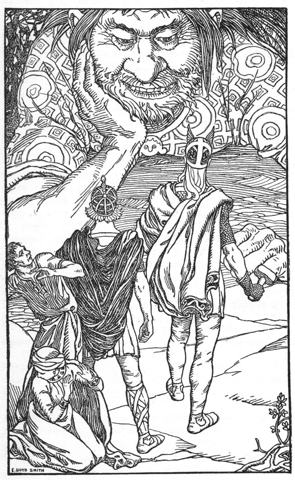
Land of the giants. The wild country east of the fence, older than the gods, holding the wisdom and the brides the AEsir keep going out to take.
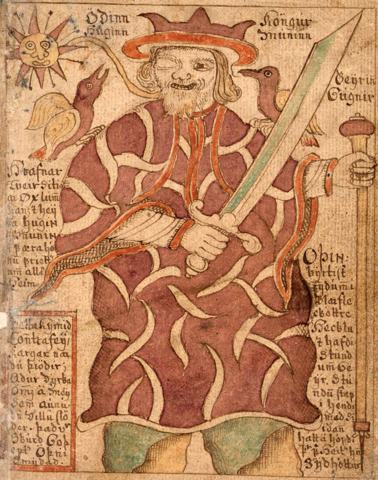
The Allfather. God of war, poetry and the dead who traded an eye for wisdom and hanged himself on the world tree to win the runes.
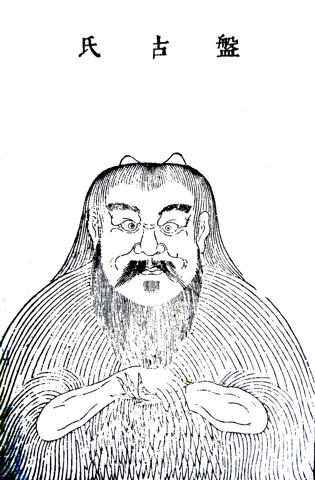
The primordial giant who split chaos into heaven and earth, and whose body at death became the mountains, rivers, winds, and stars of the world.
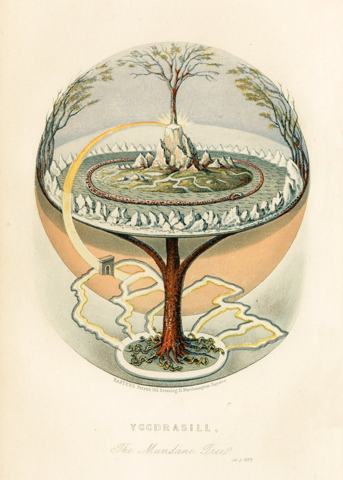
The World Tree. The great ash whose roots reach three wells and nine worlds, tended by the norns, eaten from every side, and still standing when the sky burns.
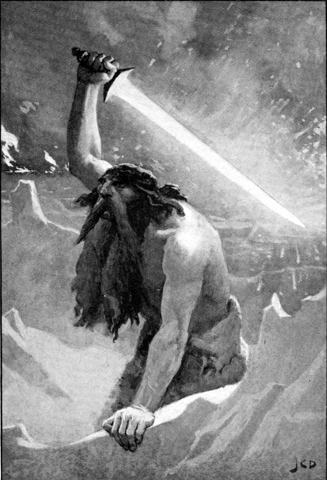
The Black One. The fire-giant who comes from the south at Ragnarok with a sword brighter than the sun, and burns the whole world to the ground behind him.
Sources & Further Reading
- 1.Poetic Edda — Voluspa (Codex Regius, 13th century).
- 2.Poetic Edda — Vafthrudnismal and Grimnismal (Codex Regius, 13th century).
- 3.Snorri Sturluson, Prose Edda — Gylfaginning (c. 1220).
- 4.Lindow, John. Norse Mythology — A Guide to the Gods, Heroes, Rituals, and Beliefs. Oxford University Press, 2001.
- 5.Simek, Rudolf. Dictionary of Northern Mythology. Trans. Angela Hall. D.S. Brewer, 1993.
- 6.Turville-Petre, E.O.G. Myth and Religion of the North — The Religion of Ancient Scandinavia. Weidenfeld & Nicolson, 1964.
- 7.Lincoln, Bruce. Myth, Cosmos, and Society — Indo-European Themes of Creation and Destruction. Harvard University Press, 1986.
- 8.Orchard, Andy. Dictionary of Norse Myth and Legend. Cassell, 1997.
Spot an error or have a source to suggest? Write to info@viseterna.com. We cite primary sources and modern scholarship, and we correct fast.