
The Norns
Urd, Verdandi and Skuld, the three women who tend Yggdrasil's well and lay down the fates of gods and men — plus the lesser norns who visit every birth.
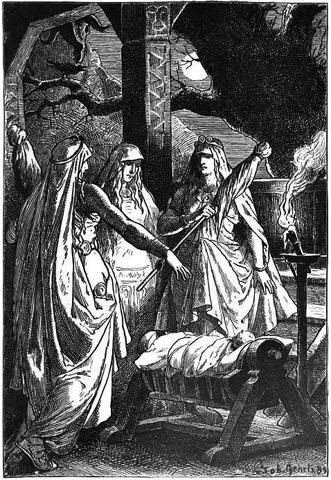
Nornorna spinner odets tradar vid Yggdrasil, L. B. Hansen, 1893 · Public domain · source
Three at the Well
Voluspa's seeress places the norns at the root of everything: three maidens, deeply wise, come out from the lake beneath Yggdrasil — Urd, Verdandi and Skuld — who carve on wooden slips, lay down laws, choose the lives of the children of men, and speak their fates 1. Snorri locates their hall precisely, at Urd's well under one of the tree's three roots, the most sacred site in the cosmos: it is where the Aesir hold their daily assembly, riding across Bifrost to reach it, and the norns' own work there is to draw water and white clay from the well each day and pour it over Yggdrasil's branches so that they will not rot or decay before their time 2. Their names are conventionally glossed as past, present and future — Urdr built from the past tense of a verb meaning "to become," Verdandi a present participle of the same verb, Skuld from "shall," closer to obligation or debt than to prophecy — though Karen Bek-Pedersen's study of the sources treats this tidy scheme as a modern convenience laid over harder, older material about law and water rather than time as such 5,7. The concept these three preside over, wyrd, is bigger than the three of them; the norns are its personification, not the whole of it.
Not Only Three
The sources are equally clear that Urd, Verdandi and Skuld are not alone. Fafnismal has the dying dragon Fafnir tell Sigurd that the norns are of many kindreds, and not all of one race — some descend from the gods, some from elves, and some are daughters of the dwarf Dvalin 1. Snorri agrees and extends the claim to ordinary life: good norns of noble birth shape good lives, while a person born to misfortune has been shaped by a norn of a different kind, and a norn of some description comes to every child at its birth 2. The three at Urd's well are the great, cosmic norns who set the fate of the world itself; everyone else, gods included, gets a personal norn whose quality is a matter of luck 2,6.
Law and Water, Not Thread
Popular retellings routinely show the norns spinning and cutting the threads of fate, on the model of the Greek Moirai, and Bek-Pedersen's book-length study of the Old Norse evidence is largely an argument against that image. What the primary sources actually associate with norns is carving — runes and wooden slips — and law-making vocabulary: they "laid down laws" (log logdu), the same phrase used of human lawmaking assemblies, and they are tied insistently to wells and springs rather than looms 5. Where the thread imagery does appear authentically in Old Norse verse, it belongs to a different set of women entirely.
The Valkyrie Weavers
Njals saga preserves, in the poem Darradarljod, a scene often mistaken for the norns at work: on the morning of the Battle of Clontarf in 1014, a man looks through a window and sees twelve women at a loom, weaving with a warp of human entrails and heads for weights, a sword for a shuttle and arrows for beaters, singing as they set the pattern for the coming slaughter 3. These weavers are valkyries, not norns, and Bek-Pedersen argues the distinction matters: the valkyries' weaving makes a specific battle happen in real time, while the true norns' work — carving, judging, laying down law at a well outside ordinary time — is a different kind of power altogether, even though later readers, working backward from the striking image, have often blurred the two into one 5,7.
Norna-Gest and the Candle
Late medieval saga literature keeps the belief in personal norns alive as folk custom long after conversion. Norna-Gests thattr, embedded in the fourteenth-century Flateyjarbok, tells of a three-hundred-year-old guest at King Olaf Tryggvason's court who explains his impossible age: at his birth, three norns visited the house, two blessing him with good fortune, and the youngest — feeling slighted and jostled by the crowd — declared he would live only as long as the candle burning beside him. The eldest norn snatched the candle and gave it to his mother to keep unburned, and it is Gest's own decision, centuries later, to have it lit again that ends his life at the story's close 4. It is fiction rather than religion, composed well into the Christian period, but it shows the norn-belief functioning exactly as Snorri describes it — a fate fixed at birth by visitors who can be generous, petty, or overruled by nothing except the object they leave behind.
Kin or Masters of the Gods
Nothing in the corpus makes the norns subordinate to Odin or any other god; if anything, Voluspa's narrative implies the reverse, since the gods' own hall-assembly happens at the norns' well and Odin's foreknowledge of Ragnarok changes nothing about its outcome 1,6. Norse myth supplies no figure above fate who can be appealed to, and the norns are the closest thing it has to that absent authority — not rulers issuing commands, but recorders whose record cannot be argued with once made 6,7.
Continue Exploring
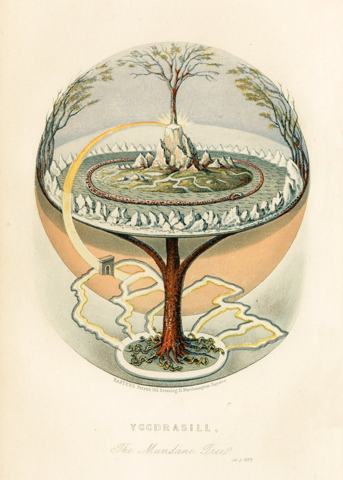
The World Tree. The great ash whose roots reach three wells and nine worlds, tended by the norns, eaten from every side, and still standing when the sky burns.
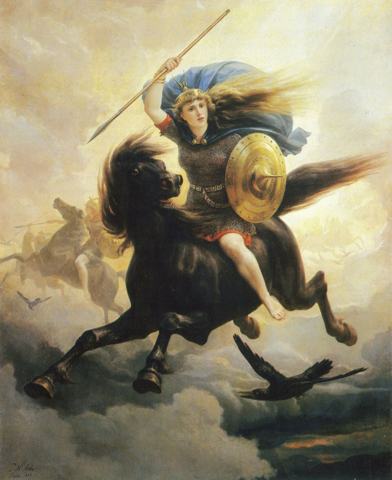
Choosers of the Slain. Odin's riders who decide who dies in battle and carry the chosen to Valhalla — battlefield spirits before they were shieldmaidens.
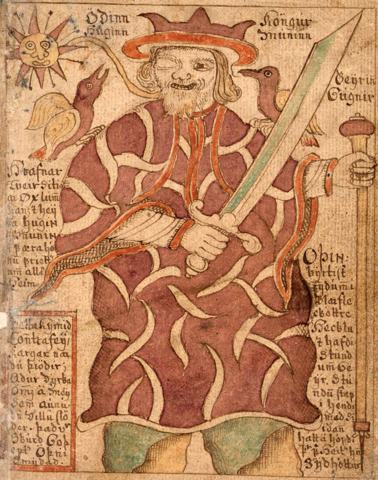
The Allfather. God of war, poetry and the dead who traded an eye for wisdom and hanged himself on the world tree to win the runes.
The weave of fate. The Germanic idea that what happens has already turned — laid down at a well by the norns, binding gods and men alike.
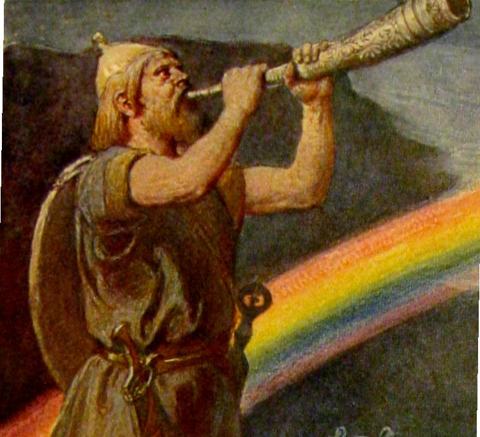
The burning rainbow bridge from earth to Asgard. Strongest thing ever built, guarded by Heimdall - and fated to shatter under the riders of Ragnarok.
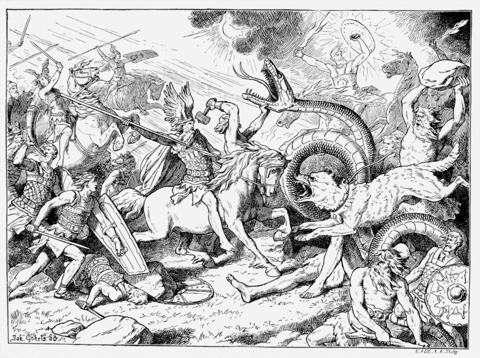
The Twilight of the Gods. The prophesied end: a killing winter, the breaking of every bond, a battle no one survives — and an earth that rises again.
Also mentioned inThe Nine Realms
Sources & Further Reading
- 1.Poetic Edda — Voluspa and Fafnismal (Codex Regius, 13th century).
- 2.Snorri Sturluson, Prose Edda — Gylfaginning (c. 1220).
- 3.Njals saga — Darradarljod, chapter 157 (Iceland, late 13th century).
- 4.Norna-Gests thattr, in Flateyjarbok (Iceland, 14th century).
- 5.Bek-Pedersen, Karen. The Norns in Old Norse Mythology. Dunedin Academic Press, 2011.
- 6.Lindow, John. Norse Mythology — A Guide to the Gods, Heroes, Rituals, and Beliefs. Oxford University Press, 2001.
- 7.Simek, Rudolf. Dictionary of Northern Mythology. Trans. Angela Hall. D.S. Brewer, 1993.
Spot an error or have a source to suggest? Write to info@viseterna.com. We cite primary sources and modern scholarship, and we correct fast.