
The Temple at Uppsala
A golden temple with statues of Thor, Odin and Freyr, described by Adam of Bremen c. 1075 — a real cult site, but archaeology and legend disagree on its form.
On the Glorious Temple Devoted to the Nordic Gods, woodcut, Olaus Magnus, 1555 (Historia de Gentibus Septentrionalibus) · Public domain · source
Adam of Bremen's Account
Nearly everything popularly "known" about a pagan temple at Uppsala comes from one source: Adam of Bremen, a German canon who never visited Sweden himself and wrote up secondhand reports around 1075 in his history of the archbishops of Hamburg-Bremen 1. He describes a temple entirely covered in gold, holding three idols on a triple throne — Thor in the centre, holding a sceptre; Odin armed for war; and Freyr, whom he calls Fricco, shown with an oversized phallus 1. A golden chain is said to hang around the gables of the roof, visible from far off 1.
Beside the temple, Adam reports a sacred grove where the bodies of sacrificed men and animals hung from the trees, and a spring where living victims were drowned. Every nine years, he writes, representatives from every part of Sweden gathered for a nine-day festival at which nine males of every living species — including men — were offered, their bodies left hanging in the grove; he claims a Christian informant counted seventy-two 1. The scale and detail are striking, and so is the source: a churchman writing decades after any such ceremony, reporting what he had heard rather than seen, with every incentive to make paganism look as lurid as possible 3,4. Andy Orchard's survey of the sources treats Adam's chapter as containing real, otherwise unattested information about Norse cult practice alongside clear rhetorical exaggeration, a mixture rather than a straightforward fabrication 5.
What Archaeology Shows
Old Uppsala is a real and important site regardless of the temple question: three enormous royal burial mounds from the 5th and 6th centuries dominate it, evidence of a genuine power centre long before Adam's account 3. The temple itself is a harder claim to pin down. In 1926 the archaeologist Sune Lindqvist excavated postholes beneath the medieval church that still stands on the site and reconstructed a large pillared hall from them, widely publicised as physical confirmation of Adam's temple 3. Later re-examination complicated that picture: the postholes belong to several different building phases rather than one coherent structure, and dating them precisely enough to match Adam's century has proved difficult 3.
A 2013 excavation added a genuinely unexpected find — long rows of wooden posts, one stretching roughly a kilometre with some 144 uprights, dated to around the 5th century CE, several hundred years before Adam wrote 3. What that structure was for is still debated, but its date alone shows that Uppsala's ceremonial landscape was rebuilt and reused across centuries, which cautions against reading any single excavated layer as "the" temple Adam described 3,7.
Ynglinga Saga and the Ynglings
Snorri's Ynglinga saga gives Uppsala a dynastic rather than architectural role. It names Freyr — as Yngvi-Freyr — a king who ruled from Uppsala and founded the Yngling line from which the historical kings of Sweden and Norway claimed descent, and it places his burial mound there, tended with tribute for years after his death to keep the good seasons coming 2. That legend and Adam's temple describe the same place from opposite directions: one a cult centre defined by sacrifice, the other a royal seat defined by ancestry, and the medieval sources are comfortable holding both accounts of Uppsala's importance at once 2,3. H.R. Ellis Davidson reads the two strands as reinforcing rather than competing: a dynasty that claimed descent from a fertility god had every reason to keep his cult, and its sacrifices, at the centre of its own capital 6.
Scholarly Debate
How much of Adam's account to trust remains genuinely contested rather than settled. Simek treats the temple's existence in some form as reasonably secure but is candid that its precise appearance, and even whether Adam's informants were describing pagan or already-converted use of the site, cannot be fully recovered from his text alone 4. Sundqvist's detailed study situates Adam within the wider, largely accurate pattern of ceremonial hall-buildings known from Scandinavian archaeology, while stressing that Adam's specific numbers — the nine-year cycle, the seventy-two bodies — read like rhetorical intensification layered onto a real underlying practice 3. The responsible position is neither to dismiss Adam as invention nor to treat him as a transcript: something significant stood at Uppsala, and its description reached Bremen already shaped by the purposes of the people telling it 3,4.
Present Status
The site survives as Gamla Uppsala, a few kilometres from the modern city, protected as a national heritage landscape with an on-site museum built around the mounds, the church, and the ongoing excavations 3. It remains one of Sweden's most visited archaeological sites and a focal point for both academic research and, on the summer solstice and at other points in the year, gatherings connected to modern Heathen practice inspired by — but explicitly distinct from — the blot and Yule ceremonies the medieval sources describe as having taken place there 3,7.
Continue Exploring
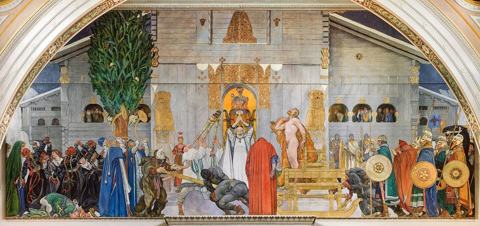
The Old Norse sacrifice: an animal killed, its blood sprinkled on altar and idols, its meat boiled and shared in a hall feast to buy the gods' favour.
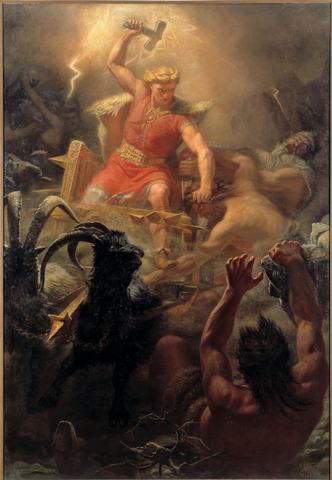
God of Thunder. Son of Odin and the earth, wielder of Mjolnir, and the gods' front line against the giants — fated to fall with the World Serpent.
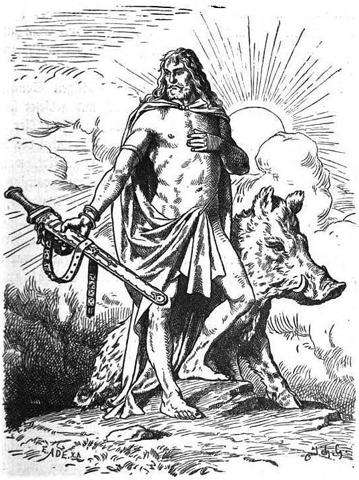
Vanir god of harvest, peace and kingship. Owner of the golden boar Gullinbursti, he traded away his sword for love and pays for it at Ragnarok.
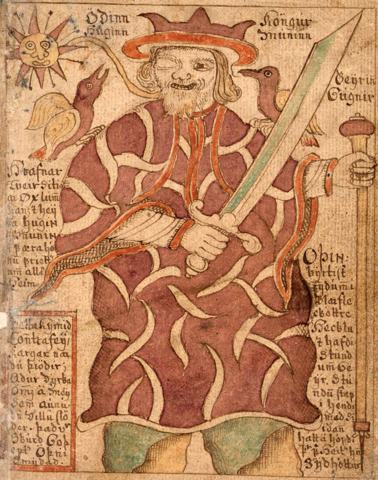
The Allfather. God of war, poetry and the dead who traded an eye for wisdom and hanged himself on the world tree to win the runes.
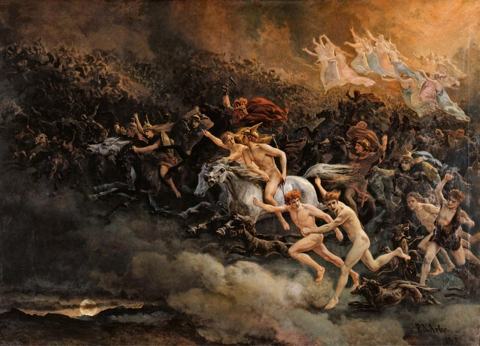
The Norse and wider Germanic midwinter festival of feasting, sacrifice and oath-swearing — later fixed to Christmas by royal decree, not by simple continuity.
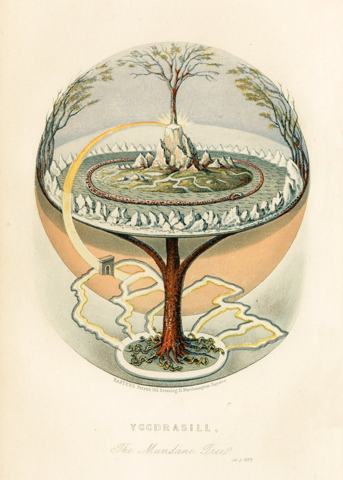
The World Tree. The great ash whose roots reach three wells and nine worlds, tended by the norns, eaten from every side, and still standing when the sky burns.
Sources & Further Reading
- 1.Adam of Bremen. Gesta Hammaburgensis Ecclesiae Pontificum, Book IV (c. 1075). Trans. Francis J. Tschan as History of the Archbishops of Hamburg-Bremen. Columbia University Press, 1959 (repr. 2002).
- 2.Snorri Sturluson, Ynglinga saga, in Heimskringla (c. 1230).
- 3.Sundqvist, Olof. An Arena for Higher Powers: Ceremonial Buildings and Religious Strategies for Rulership in Late Iron Age Scandinavia. Brill, 2015.
- 4.Simek, Rudolf. Dictionary of Northern Mythology. Trans. Angela Hall. D.S. Brewer, 1993.
- 5.Orchard, Andy. Dictionary of Norse Myth and Legend. Cassell, 1997.
- 6.Davidson, H.R. Ellis. Gods and Myths of Northern Europe. Penguin, 1964.
- 7.Price, Neil. The Viking Way: Magic and Mind in Late Iron Age Scandinavia. 2nd ed., Oxbow Books, 2019.
Spot an error or have a source to suggest? Write to info@viseterna.com. We cite primary sources and modern scholarship, and we correct fast.