
King Arthur
The once and future king: a shadowy British war-leader who medieval writers rebuilt into the emperor of Camelot and the Round Table.
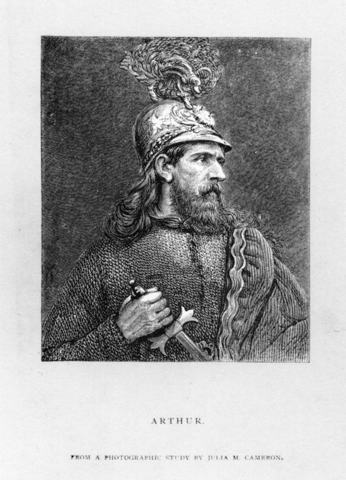
King Arthur, Charles Ernest Butler, 1903 · Public domain · source
Legend, Not Religion
Arthur is not a god and was never worshipped. He belongs to what medieval writers called the Matter of Britain: a body of secular, largely literary legend that grew across roughly seven centuries, in Welsh, Latin, French, German and English, and that was shaped at every stage by the politics of the people telling it 8. That makes him a different kind of subject from Odin or Zeus. There is no cult, no ritual calendar, no priesthood — only a story that kept being rewritten because it was useful, and because it was good.
The Historical Question
The earliest surviving notices are thin. The Historia Brittonum, compiled in Wales around 829-830 and traditionally credited to Nennius, calls Arthur dux bellorum, leader of battles, fighting alongside the kings of the Britons in twelve engagements that end at Mount Badon, where he is said to have killed 960 men single-handed 1. The tenth-century Annales Cambriae place Badon at 516 and add, at 537, "the strife of Camlann, in which Arthur and Medraut fell" 2. Neither text is contemporary with the events it describes, and Gildas, writing in the sixth century and closest to the period, names the battle of Badon but not Arthur at all 7.
Modern scholarship divides sharply. Leslie Alcock and others once read the sources as pointing to a real post-Roman commander of the late fifth or early sixth century. N. J. Higham argues that the earliest texts are best understood as ninth- and tenth-century political constructions rather than survivals of genuine memory, and that historians have consistently read their own present into the gap 7. Thomas Green goes further and treats Arthur as a mythological or folkloric figure who was later historicised. No archaeological find has ever been tied to him. The honest position is that the evidence permits a historical kernel but does not require one.
The Welsh Arthur who appears in the folkloric material is, in any case, not the king of later romance. In Culhwch and Olwen he presides over a warband of superhuman companions and hunts a monstrous boar across Britain and Ireland; the Triads and early poems attach him to giant- killing, otherworld raids and marvels 3. He is closer to a legendary champion than to a sovereign.
Geoffrey of Monmouth Builds the King
The Arthur the world knows was assembled by one writer. Geoffrey of Monmouth's Historia Regum Britanniae, finished around 1136, gave him a full biography: conceived at Tintagel when Merlin disguises Uther Pendragon as the husband of Igerna; crowned at fifteen; victorious over the Saxons; conqueror of Ireland, Iceland, Norway and Gaul; holder of a plenary court at Caerleon; challenger of Rome itself 4. Geoffrey claimed to be translating "a certain very ancient book in the British tongue" that no one has ever found.
Wace turned Geoffrey's Latin into Norman French verse in 1155 and added the Round Table, explaining it as a device to stop the barons quarrelling over precedence; he also records that the Britons still expected Arthur to return 5. Within two generations the story had a court, a fellowship and a promise.
The Court of Romance
Chretien de Troyes, writing in Champagne from roughly 1170, made the decisive change: Arthur stops being the protagonist and becomes the fixed point from which the story departs. The king holds court at Pentecost, a marvel intrudes, and a knight — Gawain, Lancelot, Yvain, Perceval — rides out to answer it 5,8. Arthur's own character thins as his court's prestige grows.
The vast prose Vulgate Cycle of the early thirteenth century then supplied what romance had lacked: a single tragic architecture. The adultery of Lancelot and Guinevere, the Grail quest that drains the fellowship of its best men, and the treachery of Mordred are welded into one chain of consequence, so that the kingdom's brilliance and its destruction have the same cause 5,8.
Camlann, Avalon, and the Return
The ending is remarkably stable across the tradition. Arthur crosses to the continent, Mordred seizes the crown and the queen, and the two meet in a final battle at Camlann in which the fellowship destroys itself. Geoffrey says only that the mortally wounded king was carried to the isle of Avalon so that his wounds might be tended, and pointedly declines to say that he died 4. That silence became the legend's most durable feature: the Breton hope, the belief that Arthur sleeps and will return in Britain's need. Caxton's edition of Malory prints the epitaph hic iacet Arthurus, rex quondam rexque futurus — here lies Arthur, the once and future king 6.
Malory and the English Arthur
Sir Thomas Malory compiled Le Morte Darthur in English from French and English sources, finishing around 1469-1470, apparently while a prisoner. William Caxton printed it in 1485, dividing it into twenty-one books; a manuscript found at Winchester College in 1934 shows that Caxton edited his copy substantially 6. Malory's plain, fast prose is the channel through which nearly every later English-language retelling reaches the story: Tennyson, T. H. White, and the film and television versions after them all descend from him rather than directly from the French.
In Popular Culture
Tennyson's Idylls of the King (1859-1885) made Arthur a Victorian moral exemplar; T. H. White's The Once and Future King (1958) made him a reluctant pacifist and produced the musical Camelot (1960) and Disney's The Sword in the Stone (1963). Monty Python and the Holy Grail (1975) and John Boorman's Excalibur (1981) fixed two opposite modern tones, comic and mythic. Games have been at least as busy: Arthurian material anchors titles such as King Arthur: Knight's Tale and Tainted Grail: The Fall of Avalon (2025), and Arthur, Merlin and Morgan appear as playable or summonable characters across the Smite and Fate franchises. The pattern is the one that has always held. Every age gets the Arthur it needs.
Continue Exploring
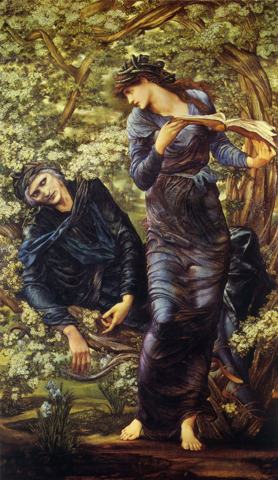
Britain's prophet and enchanter: a mad Welsh seer whom Geoffrey of Monmouth rebuilt as the wizard who made Arthur possible.
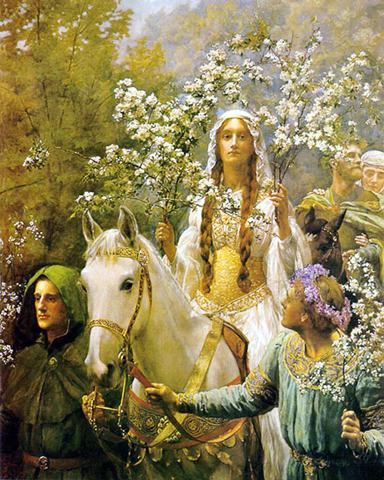
Queen of Britain and Arthur's wife: a figure repeatedly stolen, blamed and reinvented, whose love for Lancelot brings the Round Table down.
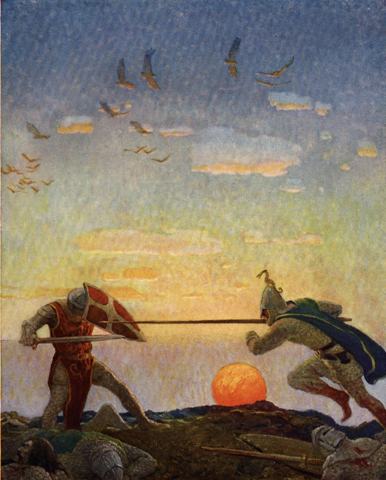
The traitor of Camlann: Arthur's nephew and, in later tradition, his incestuous son, who seizes the crown and destroys the Round Table.
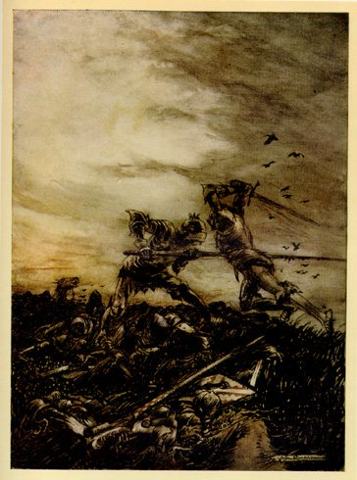
The battle that ended Arthur's reign: a single line in a medieval annal grew, over nine centuries, into the mutual destruction of Arthur and Mordred.
Tennyson's Victorian retelling of the Arthur story in blank verse, published across 26 years — the most influential English version of the legend after Malory.
The medieval term for the whole Arthurian tradition, coined around 1200 to separate British legend from the Matter of France and the Matter of Rome.
Also mentioned inAvalonCamelotCulhwch and OlwenElaine of Astolat (the Lady of Shalott)ExcaliburGalahadGlastonbury (Isle of Avalon)Historia Regum BritanniaeLe Morte d'ArthurMorgan le FayPercival (Perceval)Sir BorsSir KayThe Battle of BadonThe Green KnightThe Holy GrailThe Lady of the LakeThe Questing BeastThe Round TableThe Siege PerilousThe Sword in the StoneThe Winchester Round TableTintagelTristan and IseultUther PendragonVortigern
Sources & Further Reading
- 1.Nennius (attrib.), Historia Brittonum (c. 829-830), chs. 56 and 73.
- 2.Annales Cambriae (10th century), entries for the years 516 (Badon) and 537 (Camlann).
- 3.Culhwch and Olwen (c. 1100) and Trioedd Ynys Prydein (the Welsh Triads).
- 4.Geoffrey of Monmouth, Historia Regum Britanniae (c. 1136), Books VIII-XI.
- 5.Wace, Roman de Brut (1155); Chretien de Troyes, Arthurian romances (c. 1170-1190); the Vulgate (Lancelot-Grail) Cycle (c. 1215-1235).
- 6.Thomas Malory, Le Morte Darthur (completed c. 1469-1470; printed by William Caxton, 1485).
- 7.Higham, N. J. King Arthur: Myth-Making and History. London: Routledge, 2002.
- 8.Archibald, Elizabeth and Ad Putter (eds.). The Cambridge Companion to the Arthurian Legend. Cambridge University Press, 2009.
Spot an error or have a source to suggest? Write to info@viseterna.com. We cite primary sources and modern scholarship, and we correct fast.