
Mimir
The being who keeps the well of wisdom beneath Yggdrasil — beheaded in a botched peace treaty, and consulted by Odin as a severed head ever after.
Odin am Brunnen der Weisheit, Robert Engels, 1903 · Public domain · source
The Well Beneath the Root
Mimir is not one of the Aesir or the Vanir; the sources never quite settle what he is, only where he is — beneath one of the three roots of Yggdrasil, guarding a well of wisdom that carries his name, Mimisbrunnr. Snorri says Mimir is full of wisdom because he drinks from the well every day with the Gjallarhorn as his cup, and that the well's water is the source of his knowledge and foresight 2. The name itself is usually connected by philologists to an old root meaning "to remember," though Simek notes the etymology is not fully secure and warns against treating it as settled 6,8.
Odin's Eye
The best-known story about the well is not really Mimir's; it belongs to Odin, and Mimir appears in it as a toll-keeper rather than an actor. Voluspa has the seeress recall that Odin's eye lies hidden in the famous well of Mimir, who drinks mead there every morning from Valfather's pledge — a riddling stanza that scholars read as confirming a trade: Odin gives up an eye for a single drink of the well's water, and Mimir keeps the eye as security 1. Snorri repeats the exchange more plainly: Odin came asking for a drink and did not get one until he left an eye in pledge 2. It is one of two acts of self-mutilation that define Odin's pursuit of knowledge, the other being his nine nights hanging on the tree, and in neither case does the source explain what Mimir personally gains from the arrangement 1,2,5.
Hostage and Head
Mimir's fullest story is also his worst. Ynglinga saga tells how the Aesir and the Vanir, after their first war, exchanged hostages to seal the peace: the Aesir sent Hoenir, tall and well made, together with the wise Mimir, and the Vanir sent Njord and Freyr the other way 3. The Vanir made Hoenir a chief on the strength of his looks, but discovered that whenever Mimir was not standing beside him to answer for him, Hoenir could only say "let others decide." Concluding they had been cheated in the trade, the Vanir cut off Mimir's head and sent it back to the Aesir 3. Odin's response turns the corpse into an oracle: he embalms the head with herbs so it will not rot, sings spells over it, and afterward consults it for knowledge hidden from every other source 3,6. A treaty meant to end a war produces, as its most lasting result, the strangest of Odin's advisors.
The Head at the End of the World
The consultation does not stop once. Voluspa places it at the very edge of Ragnarok: as the Gjallarhorn sounds and the world tree groans, the seeress says Odin speaks with Mimir's head one last time, seeking counsel as the end arrives 1. Whatever passes between them is never reported — the poem states only that the conversation happens, which is consistent with the rest of Odin's information-gathering apparatus: ravens who report and are never quoted, a well whose water is never described, a head that answers but whose answers go unrecorded. Wisdom in this mythology is something Odin possesses, not something the audience is given to share 1,5.
Mimir's Grove
A separate, harder puzzle is Hoddmimir's holt — "Mimir's hoard-grove" or "Mimir's wood" — the one place Vafthrudnismal says will shelter two human survivors, Lif and Lifthrasir, through the fire that consumes the world at Ragnarok, feeding on the morning dews until a new earth is ready for them 1. The poem never explains whose grove it is or how it relates to the well beneath the tree, and scholars disagree over whether "Mimir" here names the same being at all, a memory of him folded into a different, half-forgotten cosmology, or simply a poetic name reused for a second, unrelated purpose 1,6,7.
A Second Mimir in Saxo
Saxo Grammaticus adds a further complication. In Gesta Danorum, a wood-dwelling being named Miming owns an invincible sword and a ring of plenty, and it is from Miming that the warrior Hotherus obtains the weapon he uses to kill Balderus — Saxo's version of the story told in Norse sources as the death of Baldr at the hand of Hodr 4. Whether Miming is a Latinized echo of Mimir, a distinct figure who has absorbed some of his attributes, or simply a similar name attached to a similar role — a keeper of something precious in the woods — is argued rather than settled, and no scholarly consensus treats the identification as certain 4,6,7.
Legacy
Mimir never receives a myth of his own; every story about him is really a story about what someone else took from him — an eye, a head, a location in someone else's prophecy. That absence is itself the character: a source of wisdom valuable enough to be fought over, mutilated, and preserved past death, but never once given the chance to speak for himself in his own name 1,2,3,5.
Continue Exploring
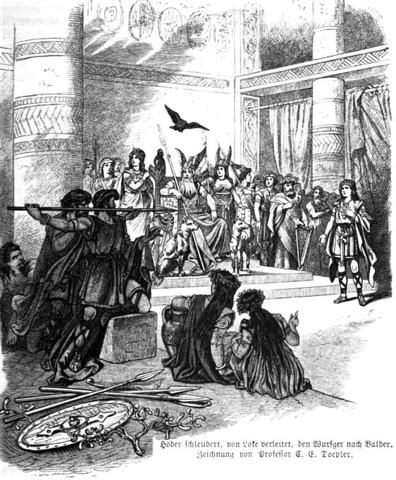
The blind god who threw the dart that killed Baldr, guided by Loki's hand — Norse myth's clearest case of a killer who may not be the guilty party.
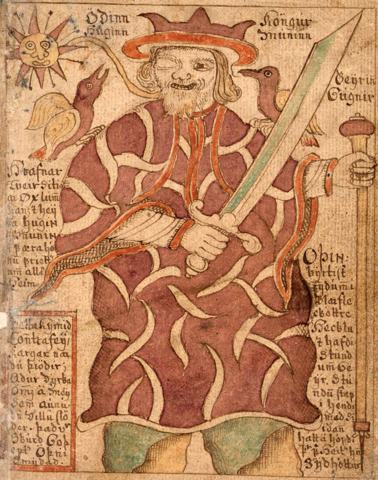
The Allfather. God of war, poetry and the dead who traded an eye for wisdom and hanged himself on the world tree to win the runes.
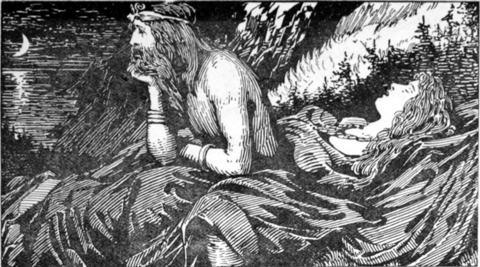
Vanir god of harbours, wind and wealth. Sent to the Aesir as a hostage; father of Freyr and Freyja; husband of a mountain giantess, briefly.
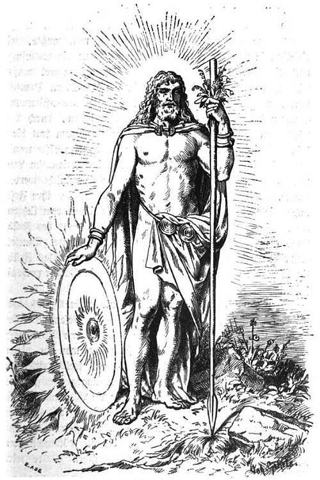
God of Light. The most beloved of the Aesir, made immune to all harm but one plant — and killed by it, which set the world's ending in motion.
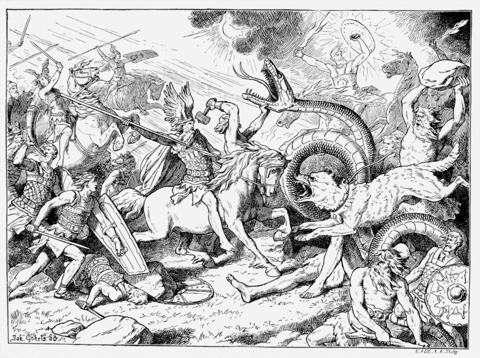
The Twilight of the Gods. The prophesied end: a killing winter, the breaking of every bond, a battle no one survives — and an earth that rises again.
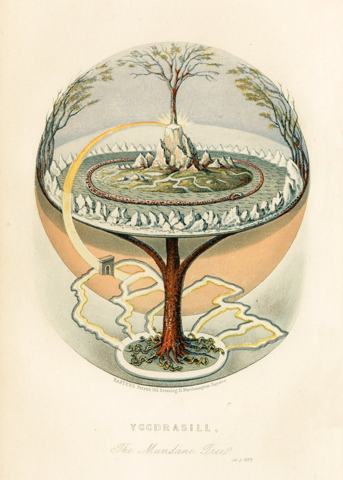
The World Tree. The great ash whose roots reach three wells and nine worlds, tended by the norns, eaten from every side, and still standing when the sky burns.
Also mentioned inHuginn and MuninnThe Aesir-Vanir War
Sources & Further Reading
- 1.Poetic Edda — Voluspa and Vafthrudnismal (Codex Regius, 13th century).
- 2.Snorri Sturluson, Prose Edda — Gylfaginning (c. 1220).
- 3.Snorri Sturluson, Ynglinga saga, in Heimskringla (c. 1230).
- 4.Saxo Grammaticus, Gesta Danorum, Book 3 (c. 1200).
- 5.Lindow, John. Norse Mythology — A Guide to the Gods, Heroes, Rituals, and Beliefs. Oxford University Press, 2001.
- 6.Simek, Rudolf. Dictionary of Northern Mythology. Trans. Angela Hall. D.S. Brewer, 1993.
- 7.Turville-Petre, E.O.G. Myth and Religion of the North — The Religion of Ancient Scandinavia. Weidenfeld & Nicolson, 1964.
- 8.Orchard, Andy. Dictionary of Norse Myth and Legend. Cassell, 1997.
Spot an error or have a source to suggest? Write to info@viseterna.com. We cite primary sources and modern scholarship, and we correct fast.