
Gleipnir
The binding ribbon. A silk-soft cord spun from six impossible things — the only fetter that ever held Fenrir, and it cost Tyr his sword-hand to fasten.
Fenrir bound with Gleipnir, 17th-century Icelandic manuscript (AM 738 4to, Arni Magnusson Institute) · Public domain · source
Two Failures First
Gleipnir is the third attempt, and the story only works because the first two fail.
Snorri Sturluson tells it in Gylfaginning. Loki fathers three children on the giantess Angrboda: the serpent Jormungandr, the death-goddess Hel, and the wolf Fenrir. Warned by prophecy, the gods take the wolf into Asgard and raise him there, and only Tyr has the courage to feed him. He grows daily, and the gods decide he must be bound 1.
They make the fetter Laeding, very strong, and persuade the wolf to test his strength against it; he snaps it at the first kick. They make Dromi, half again as strong, and offer him the fame of breaking it; he strains, and it flies apart in pieces 1. Snorri notes that both attempts left proverbs behind in Icelandic — "to loose oneself out of Laeding", "to strike out of Dromi", for escaping any hard situation 1,4.
Two honest engineering solutions have now been tried and have made the problem worse, because each one has taught the wolf what he can do.
Six Things That Do Not Exist
Odin sends Freyr's messenger Skirnir down to the world of the dark elves, and there the dwarfs make a fetter of six ingredients: the sound of a cat's footfall, the beard of a woman, the roots of a mountain, the sinews of a bear, the breath of a fish, and the spittle of a bird 1.
Snorri adds a wry aetiology. You will not have heard a cat's footstep, seen a woman's beard, found a mountain's roots or a bird's spit — but you may be sure the account is true, because these things were used up in the making 1,4. It is a joke and a theology at once: the world is missing six small pieces, permanently, so that the wolf can be held.
The result is Gleipnir, a name usually taken to mean "the open one" or "the entangler", from a root suggesting slipping or gripping 5,7. It is smooth and soft as a silk ribbon, and it is the only thing that works. Force has already been shown to be useless; what holds Fenrir is a paradox, a rope made of absences 4,6.
Tyr's Hand
The binding scene is the moral centre of the myth. The gods take Fenrir out to the island Lyngvi in the lake Amsvartnir and invite him to test the ribbon, praising his strength. The wolf looks at it and says what any sensible creature would: if it is made with cunning, there will be no fame in breaking it, and if it cannot be broken he will get no help from the gods. He agrees only on a pledge — someone must lay a hand in his mouth as a guarantee of good faith 1.
The gods look at each other. Tyr puts in his right hand.
The ribbon holds; the harder the wolf strains, the tighter it grips; the gods laugh — all except Tyr, who loses the hand at the wrist, which Norse poets afterwards called the wolf-joint 1,4. Fenrir is bound to a cord called Gelgja, threaded through a slab named Gjoll, pinned by a boulder named Thviti, and a sword is set upright in his jaws to hold them apart, his slaver running out to form a river 1.
The gods win by cheating, and only one of them pays for it. Lokasenna has Loki taunt Tyr about the hand in open hall, and Tyr's reply is that he lost a hand but Loki lost a wolf, and neither of them came off well 3,8. Scholars have made much of the fact that the god who forfeits his sword-hand is the god most associated with law, assembly and sworn agreement: the guarantor of oaths personally underwrites a lie, and pays the standing penalty for a broken pledge 4,6.
What the Binding Cost
The Norse gods do not come out of this story clean, and the sources seem aware of it. Gleipnir is commissioned in secret, presented as a game, and fastened by a promise the gods intend to break. Voluspa tracks the consequences without comment: Fenrir bound at Gnipahellir, the hound howling, the fetter eventually breaking 3,8.
This is one of a set of Norse myths about binding — Loki tied on the rocks with his son's entrails after the death of Baldr, Jormungandr thrown into the encircling sea, Hel confined below. Every existential threat in the mythology is contained rather than destroyed, and every containment has a deadline 4,6. Nothing in Norse myth is ever killed successfully in advance.
The Snap
Gleipnir does not fray or wear out. It simply stops holding when the appointed time comes. In Voluspa, the fetter breaks, the wolf runs free, and Fenrir goes forward at Ragnarok with his lower jaw against the ground and his upper against the sky, and swallows Odin 3,8.
Tyr, in Snorri's account, meets the hound Garmr at the same battle, and the two kill each other 1. The god who bought the delay is not spared by it. Odin's son Vidar avenges his father by tearing the wolf apart, and the ribbon spun from a cat's footfall has, in the end, bought the gods exactly the length of the world's life and not one day more 1,3,4.
Continue Exploring
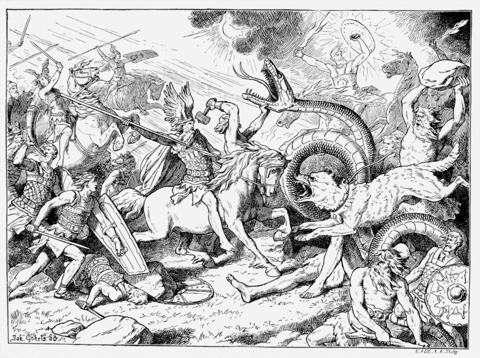
The Twilight of the Gods. The prophesied end: a killing winter, the breaking of every bond, a battle no one survives — and an earth that rises again.
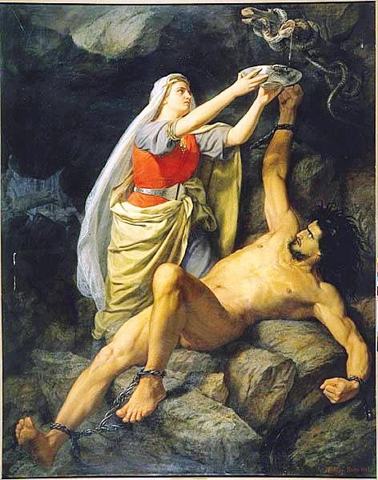
The Trickster. Shape-shifter of giant blood counted among the gods — their cleverest ally, the father of monsters, and the spark of Ragnarok.
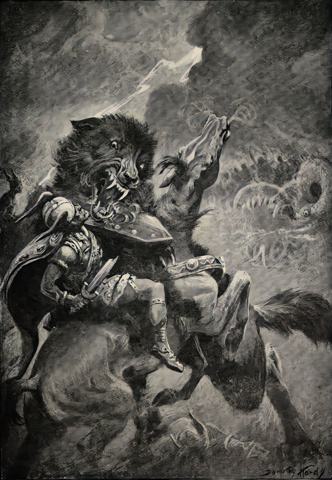
The Bound Wolf. Loki's son, raised among the gods and chained by a trick that cost Tyr his hand — until Ragnarok, when he devours Odin.
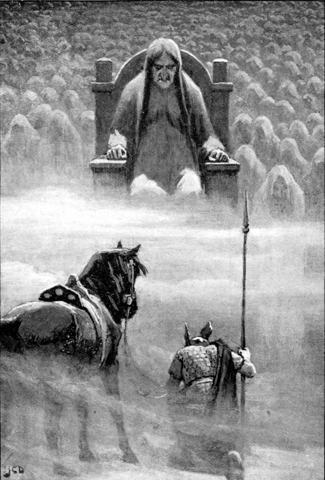
Queen of the Dead. Half living woman and half corpse, Loki's daughter rules the cold realm where those who die of sickness and age must go.
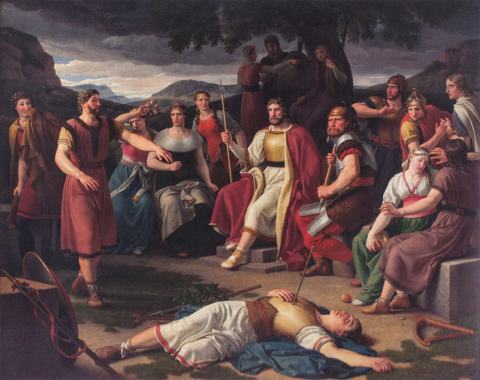
The first tragedy. A god made invulnerable by oath, killed by the one plant nobody asked — the murder that starts the clock on Ragnarok and cannot be undone.
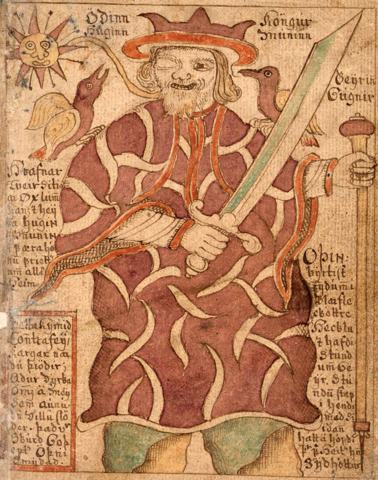
The Allfather. God of war, poetry and the dead who traded an eye for wisdom and hanged himself on the world tree to win the runes.
Also mentioned inDwarves (Dvergar)
Sources & Further Reading
- 1.Snorri Sturluson, Prose Edda — Gylfaginning (c. 1220).
- 2.Snorri Sturluson, Prose Edda — Skaldskaparmal (c. 1220).
- 3.Poetic Edda — Voluspa and Lokasenna (Codex Regius, 13th century).
- 4.Lindow, John. Norse Mythology — A Guide to the Gods, Heroes, Rituals, and Beliefs. Oxford University Press, 2001.
- 5.Simek, Rudolf. Dictionary of Northern Mythology. Trans. Angela Hall. D.S. Brewer, 1993.
- 6.Turville-Petre, E.O.G. Myth and Religion of the North — The Religion of Ancient Scandinavia. Weidenfeld & Nicolson, 1964.
- 7.Orchard, Andy. Cassell Dictionary of Norse Myth and Legend. Cassell, 1997.
- 8.Larrington, Carolyne (trans.). The Poetic Edda. Rev. ed., Oxford World's Classics, 2014.
Spot an error or have a source to suggest? Write to info@viseterna.com. We cite primary sources and modern scholarship, and we correct fast.