
Njord (Njörðr)
Vanir god of harbours, wind and wealth. Sent to the Aesir as a hostage; father of Freyr and Freyja; husband of a mountain giantess, briefly.
Njord's Desire of the Sea, W. G. Collingwood, 1908 (illustration to The Elder or Poetic Edda) · Public domain · source
Who Njord Is
Njord — Old Norse Njörðr — is the god of the coast rather than the deep: of harbours, of sailing weather, of fishing and of the wealth that arrives by ship. Snorri says he rules the course of the wind, stills sea and fire, and is to be invoked for voyages and for catches, adding that he is so rich that he can grant land and movable goods to anyone who calls on him for them 2. His hall is Noatun, "ship-enclosure" or "ship-yard", a name that puts him squarely at the waterline where boats are drawn up, not out among the waves where the sea-giant Aegir keeps his own hall 2,7.
He belongs to the Vanir, the second family of gods, whose concerns run to fertility, prosperity and prophecy rather than to war and sovereignty. That difference matters: where Odin presides and Thor fights, Njord provides 6,8.
The Hostage of the Vanir
The Aesir and the Vanir fought a first war that ended in a negotiated exchange of hostages. Njord went to the Aesir along with his son Freyr — and, in Snorri's telling, with Kvasir — while Hoenir and Mimir went the other way 2,4. Vafthrudnismal makes the arrangement explicit and adds a striking coda: Njord was "reared among the Vanir" and at the ending of the world he will return to the wise Vanir, which quietly exempts him from the general destruction that consumes most of the Aesir 1.
Snorri's euhemerised Ynglinga saga retells the same events as political history, with Njord as a Swedish king at Noatun who succeeded Odin, kept the sacrifices going, and presided over a peace and plenty so complete that later generations remembered it as a golden age 4. He notes there that among the Vanir it was lawful to marry one's own sister, and that Freyr and Freyja were born of such a union 4. Lokasenna has Loki fling the same accusation at Njord in front of the whole assembly, so the tradition is at least older than Snorri's rationalising of it 1.
Njord and Skadi
The most-told story about Njord is a marriage that does not work. When the gods killed the giant Thjazi, his daughter Skadi came armed to Asgard demanding compensation. The settlement let her choose a husband from among the gods by looking only at their feet; she picked the finest pair, expecting Baldr, and got Njord 3.
The couple then tried to live in two places at once. By the terms they agreed, they would spend nine nights in Thjazi's mountain hall Thrymheim and three at Noatun 2. Snorri gives each of them a small verse of complaint, and they are among the most human lines in the whole Edda: Njord cannot sleep for the howling of wolves after the song of swans, and Skadi cannot sleep for the screaming of seabirds over the noise of the surf 2. The marriage ends. Scholars often read the pairing as a deliberate image of incompatible domains — the productive shoreline against the barren winter uplands — rather than as a story that ever expected a happy ending 6,7.
Nerthus and the Older Layer
Njord's name is the exact linguistic descendant of Nerthus, the deity Tacitus describes among the Germanic tribes around the Baltic in the first century CE: a Terra Mater carried in a covered wagon on a sacred island, greeted with festival and peace, her cart and vestments afterwards washed in a secret lake by slaves who were then drowned 5. The correspondence of the names is not in doubt, but what it means is debated. Some scholars posit an original divine pair, a brother-sister or twin couple of whom only the male name survived in Scandinavia; others argue for a change of gender over a thousand years of transmission, or for a female Vanir figure who was later absorbed into Freyja 6,7,8. Njord's own unnamed sister-wife is frequently pressed into service as the missing half.
Cult and Traces
Njord was worshipped, not merely narrated. Place names built on his — Njardarlög, Njarðvík, Nærøy and their kin across Norway, Sweden and Iceland — cluster in coastal and agricultural districts and are numerous enough to indicate a real and widespread cult 7,8. Icelandic legal formulae preserved in Landnamabok have oaths sworn by Freyr, Njord and "the almighty god", pairing him with his son at the head of the oath list 8. Skaldic poets used him as a routine base for man-kennings — a warrior is a "Njord of battle" — which shows the name stayed alive as a byword for a lordly male figure well into the Christian period 3,6.
Legacy
What survives is a god defined by exchange: hostage between two divine families, husband across the Aesir-giant divide, patron of the trade and fishing that turned wind and water into wealth. He does not fight at Ragnarok and he does not die there. Of the gods named in the eddic poems, he is one of the very few given an explicit route home 1,6.
Continue Exploring
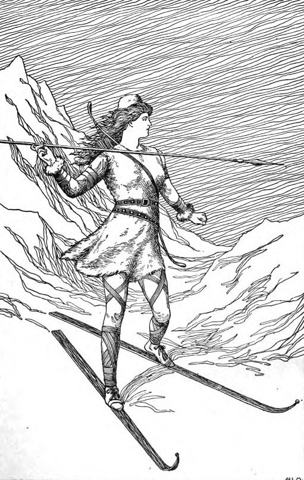
Giantess turned goddess of winter and the hunt. She came armed to Asgard for her father's blood-price and chose a husband by his feet alone.
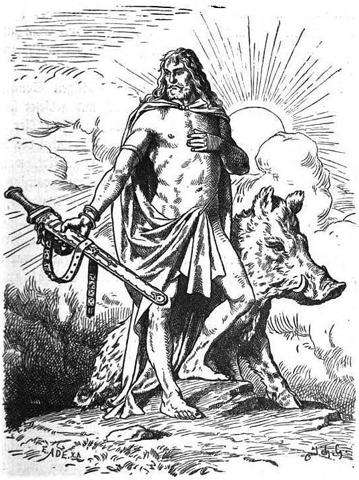
Vanir god of harvest, peace and kingship. Owner of the golden boar Gullinbursti, he traded away his sword for love and pays for it at Ragnarok.
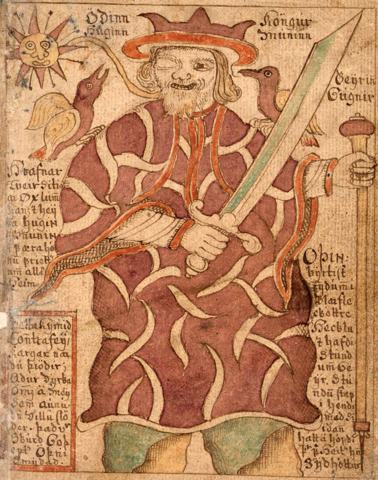
The Allfather. God of war, poetry and the dead who traded an eye for wisdom and hanged himself on the world tree to win the runes.
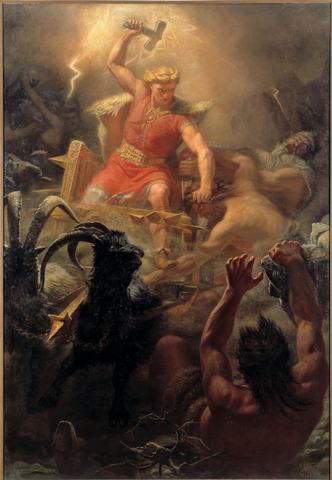
God of Thunder. Son of Odin and the earth, wielder of Mjolnir, and the gods' front line against the giants — fated to fall with the World Serpent.
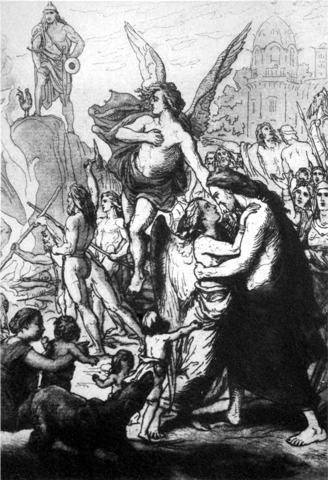
The stronghold of the AEsir. A walled citadel of halls at the top of the world tree, reached by the rainbow bridge and built on a bargain the gods broke.
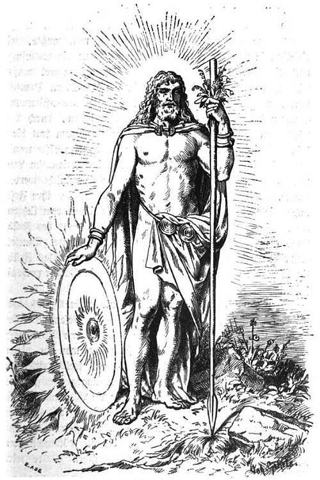
God of Light. The most beloved of the Aesir, made immune to all harm but one plant — and killed by it, which set the world's ending in motion.
Also mentioned inBlot (Norse Sacrifice)MimirVanaheim
Sources & Further Reading
- 1.Poetic Edda — Vafthrudnismal, Grimnismal and Lokasenna (Codex Regius, 13th century).
- 2.Snorri Sturluson, Prose Edda — Gylfaginning (c. 1220).
- 3.Snorri Sturluson, Prose Edda — Skaldskaparmal (c. 1220).
- 4.Snorri Sturluson, Ynglinga saga, in Heimskringla (c. 1230).
- 5.Tacitus, Germania, ch. 40 — the rites of Nerthus (c. 98 CE).
- 6.Lindow, John. Norse Mythology — A Guide to the Gods, Heroes, Rituals, and Beliefs. Oxford University Press, 2001.
- 7.Simek, Rudolf. Dictionary of Northern Mythology. Trans. Angela Hall. D.S. Brewer, 1993.
- 8.Turville-Petre, E.O.G. Myth and Religion of the North. Weidenfeld & Nicolson, 1964.
Spot an error or have a source to suggest? Write to info@viseterna.com. We cite primary sources and modern scholarship, and we correct fast.