
Aegir and Ran
Aegir brews ale for the gods in a hall lit by gold; Ran drags the drowned down in her net. Together they are the Norse sea, hospitable and lethal.
Aegir and Ran, Friedrich Wilhelm Heine, 1882 (from Wilhelm Waegner, Nordisch-germanische Goetter und Helden) · Public domain · source
Two Faces of the Same Water
The Norse sea has a household. Aegir (Old Norse Ægir, also called Hler and, confusingly, Gymir) is its lord, a brewer and a host; Ran (Rán) is his wife, and she fishes for men 2,5. The pairing is not sentimental. Aegir is the sea you sail on and feast beside; Ran is the sea that takes you. Scholars generally read them as two aspects of a single conception rather than as a married couple in the ordinary mythological sense, and the sources treat their names almost interchangeably in kennings for the ocean 5,6.
Neither is straightforwardly one of the Aesir. Aegir is usually classed as a jotunn, and Snorri's frame narrative in Skaldskaparmal introduces him as a man of Hlesey skilled in magic who travels to Asgard to learn where the gods' poetry comes from 2,6. Yet he sits at their tables and they at his, which puts him in the same ambiguous category as Loki — inside the hall, outside the family 5,6.
The Cauldron and the Feast
Hymiskvida explains how the gods got their drink. Aegir agrees to brew ale for the whole company only if they can bring him a kettle big enough, and no such kettle exists in Asgard. Tyr knows of one: his kinsman the giant Hymir owns a cauldron a mile deep. Thor and Tyr go and get it, by way of the famous fishing trip in which Thor hooks Jormungandr, and Thor eventually carries the cauldron off on his head 1,8. Ever after, the poem says, the gods drink well at Aegir's each winter 1,8.
Snorri fills in the hall. The ale brews itself; there is no fire, because gold laid on the floor lights the room the way flame would in any other hall — which is why "Aegir's fire" became a standard skaldic kenning for gold 2. Aegir's two servants are named Fimafeng, "handy-fetcher", and Eldir, "fire-tender" 1,2.
That same feast is the setting for one of the most savage poems in the corpus. In Lokasenna, Loki arrives uninvited, kills Fimafeng out of pique at the servant's popularity, is thrown out, argues his way back in on the strength of an old oath of blood-brotherhood with Odin, and then insults every god and goddess present in turn until Thor arrives and threatens him out of the hall 1,8. The gods' most public humiliation happens under a sea-giant's roof, and the poem never lets you forget whose hospitality is being abused.
Ran, Her Net, and the Drowned
Ran's name means something close to "robbery" or "plunder", and her single defining possession is a net in which she catches men who go into the sea 2,5,6. To drown was, in this idiom, to "go to Ran" or to "be Ran's guest", and skaldic verse uses her freely: the sea is Ránar vegr, "Ran's road" 2,5.
The most personal surviving witness is Egill Skallagrimsson's Sonatorrek, "the irreparable loss of sons", composed after Egill's son Bodvar drowned. The poem accuses the sea directly — Egill says he would fight the sea-god and Ran's company if he could, and speaks of Ran having dealt harshly with him. It is the closest thing Old Norse literature has to a man in grief taking a deity to court 3,5,7. Fridthjofs saga preserves a related belief in a lighter key: caught in a storm, Fridthjof divides gold among his crew so that none of them will arrive at Ran's hall empty-handed and be received badly 4,6.
Whether Ran's hall was imagined as a genuine afterlife destination, parallel to Valhalla or Helheim, is debated. Some scholars take the sources at face value as evidence of a drowned-men's realm; others read the phrasing as poetic convention for dying at sea rather than a worked-out cosmology 5,6,7.
The Nine Daughters
Aegir and Ran have nine daughters, and Skaldskaparmal names them: Himinglaeva, Dufa, Blodughadda, Hefring, Unn (Udr), Hronn, Bylgja, Drofn and Kolga 2. The names are a small poem about surf. Himinglaeva is roughly "the one through which the sky shines", the glassy face of a calm swell; Blodughadda is "bloody-haired", the reddened foam of a breaking wave; Bylgja is "billow", Hronn "welling wave", Kolga "the cold one" 2,5,6. Snorri's list is not perfectly stable — elsewhere in his own kenning material Bara, "tidal wave", stands in place of Drofn 2,5.
Because Heimdall is said to have been born of nine mothers, some traditions and many modern retellings identify those nine with the daughters of Aegir and Ran. The medieval sources never actually make the equation, and scholars remain divided on whether the parallel is meaningful or coincidental 5,6.
What the Sea Meant
Read together, Aegir and Ran give the Norse ocean the shape it has in the rest of the literature: a road, a larder and a grave, held by powers older than the gods and never quite governed by them. Aegir's ale-hall is where the Aesir go to be at their most convivial and, in Lokasenna, at their worst; Ran's net is the reason a Norwegian or Icelandic crew putting to sea had something specific to fear and something specific to pay 5,7.
They are also useful evidence that Norse cosmology is not tidy. The sea's rulers are giants who dine with gods, their children are waves with names, and their household sits somewhere off the map of the Nine Realms that later systematisers tried to draw 5,6.
Continue Exploring
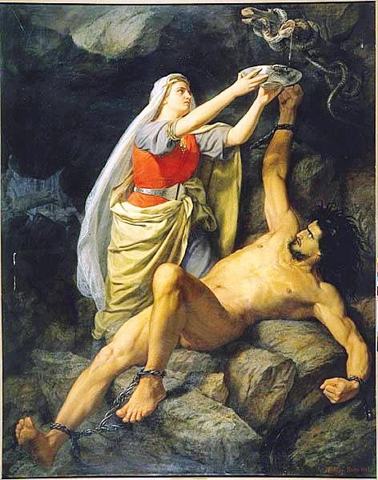
The Trickster. Shape-shifter of giant blood counted among the gods — their cleverest ally, the father of monsters, and the spark of Ragnarok.
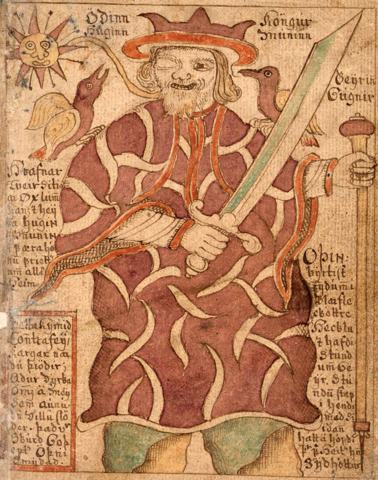
The Allfather. God of war, poetry and the dead who traded an eye for wisdom and hanged himself on the world tree to win the runes.
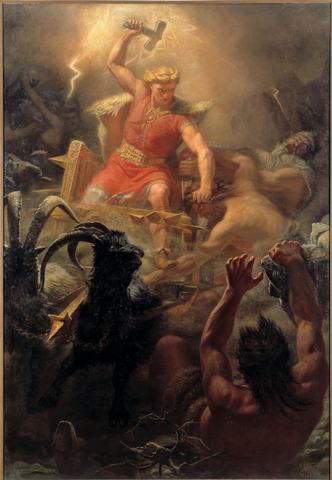
God of Thunder. Son of Odin and the earth, wielder of Mjolnir, and the gods' front line against the giants — fated to fall with the World Serpent.
The stronghold of the AEsir. A walled citadel of halls at the top of the world tree, reached by the rainbow bridge and built on a bargain the gods broke.
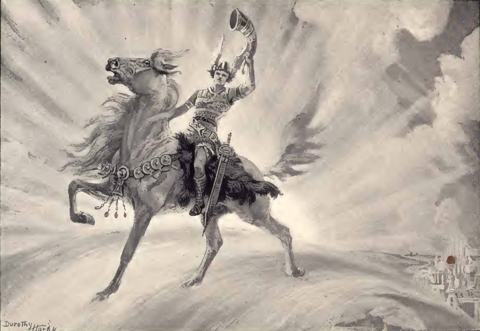
Watchman of the Gods. Born of nine mothers, he guards the rainbow bridge, hears wool grow on sheep, and will sound the horn that begins the end.
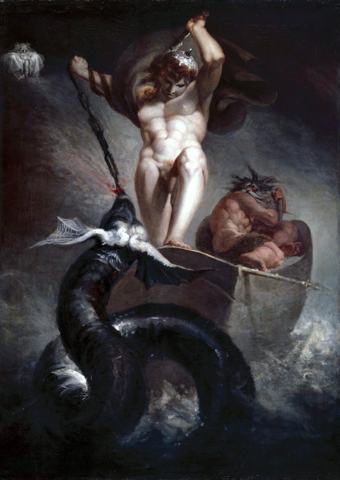
The World Serpent. Loki's monstrous child, cast into the ocean until it grew to ring all Midgard and bite its own tail. Thor's appointed enemy.
Sources & Further Reading
- 1.Poetic Edda — Hymiskvida, Lokasenna and Grimnismal (Codex Regius, 13th century).
- 2.Snorri Sturluson, Prose Edda — Skaldskaparmal (c. 1220).
- 3.Egils saga Skallagrimssonar, including the poem Sonatorrek (13th century).
- 4.Fridthjofs saga hins froekna (14th century).
- 5.Lindow, John. Norse Mythology — A Guide to the Gods, Heroes, Rituals, and Beliefs. Oxford University Press, 2001.
- 6.Simek, Rudolf. Dictionary of Northern Mythology. Trans. Angela Hall. D.S. Brewer, 1993.
- 7.Turville-Petre, E.O.G. Myth and Religion of the North — The Religion of Ancient Scandinavia. Weidenfeld & Nicolson, 1964.
- 8.Larrington, Carolyne (trans.). The Poetic Edda. Rev. ed., Oxford World's Classics, 2014.
Spot an error or have a source to suggest? Write to info@viseterna.com. We cite primary sources and modern scholarship, and we correct fast.