
Bifrost (The Rainbow Bridge)
The burning rainbow bridge from earth to Asgard. Strongest thing ever built, guarded by Heimdall - and fated to shatter under the riders of Ragnarok.
Heimdall an der Himmelsbruecke, Emil Doepler, c. 1905 (Walhall, die Goetterwelt der Germanen) · Public domain · source
The Bridge Between Earth and Heaven
Bifrost is the bridge the gods built from earth up to the sky, and the surviving Norse sources are unusually definite about both what it is and what will happen to it. Snorri says plainly that the Aesir made a bridge from earth to heaven, that it is called Bifrost, that it has three colours, and that people on the ground call it the rainbow 2,3. Only two other things about it matter as much: it is the strongest structure ever built, and it will break 1,2.
The name is unstable across the sources, which is itself a scholarly clue. The Poetic Edda prefers Bilrost, Snorri writes Bifrost, and Grimnismal also uses Asbru, "the Aesir's bridge" 1,5,7. The second element, -rost, is a road or a distance; the first is disputed. Bif- is usually taken from a verb meaning to shake or shimmer, giving "the shimmering way"; Bil- would suggest something momentary or glimpsed, giving roughly "the fleeting way" 4,5. Either reading fits a rainbow, and scholars debate which form is the older 4,5.
Fire in the Red Band
Snorri's most memorable detail explains what the colours are for. Of the bridge's three bands, the red one is burning fire, and it is there to stop frost-giants and mountain-giants from climbing into heaven if they should get onto the bridge at all 2,3. It is a rainbow that is also a defensive work.
Grimnismal confirms the fire from the poetic side and adds a consequence. Every day the gods ride over the bridge to hold their court beneath Yggdrasil at the well of fate — but Thor does not. He wades instead, crossing the rivers Kormt and Ormt and the two Kerlaugar, because the Aesir's bridge burns with flame and the holy waters seethe 1,7. Snorri and the poem agree that Thor is the one god excluded, though they differ slightly on the reason; a common medieval and modern reading is that the sheer heat of the thunder god, or his weight, would destroy the crossing 2,4,5.
Heimdall at the Far End
Guarding the bridge is the whole job of one god. Heimdall lives at Himinbjorg, "sky-cliffs", at the point where Bifrost meets heaven; he needs less sleep than a bird, can see a hundred leagues by night or day, and can hear grass grow on the earth and wool on sheep 1,2,3. He is placed there to watch for giants coming up the bridge, and he holds the Gjallarhorn, whose blast will be heard through all the worlds when the attack finally comes 1,2.
The picture the sources build is of a border, not a road. Bifrost is the only ordinary route between Midgard and Asgard, which makes it simultaneously the gods' greatest convenience and their single point of failure — an arrangement the mythology treats as a known, accepted risk rather than an oversight 4,6.
The Break
Fafnismal is blunt about the ending: Bilrost will break when the hosts ride over it, and their horses will swim in the river 1,7. Snorri gives the scene at length. The sons of Muspell will ride to the attack led by Surtr with fire before and behind him; they will cross Bifrost, and the bridge will shatter under them as they pass 2,3.
He then anticipates the obvious objection and answers it in a line worth the whole passage: someone asks how the bridge can break if it was built by the gods and is the strongest of all things, and the answer is that there is nothing in this world that can be relied on when the sons of Muspell come harrying 2,3. This is a mythology that builds its best work knowing exactly how it fails.
That collapse is the hinge of Ragnarok. Once the bridge is gone, the field of Vigrid is the only meeting place left, and there Odin faces Fenrir, Thor faces Jormungandr, and Heimdall and Loki kill each other 1,2.
Rainbow, Milky Way, or Neither
Not everyone accepts Snorri's identification. Because Bifrost is described as a road across the sky trodden nightly by the gods, some scholars have argued the underlying image was originally the Milky Way rather than the rainbow, and that Snorri, writing two centuries after conversion and systematising as he went, made the rainbow equation himself 5,6. Others point out that the burning red band only makes sense for a rainbow and that the identification is likely traditional 4,6. The question is genuinely open.
It is worth separating Bifrost from the other famous bridge in the corpus. The crossing to Helheim is Gjallarbru, the bridge over the river Gjoll, thatched with shining gold and watched by the maiden Modgud; Hermod rides it on Sleipnir on his way to ransom Baldr 2,3. Modern retellings sometimes merge the two, but the sources keep them separate — one bridge goes up, the other down 4,5.
Bifrost's afterlife has been busy: the rainbow bridge is one of the few pieces of Norse cosmology to survive intact into opera, comics and film, usually as a shimmering road and rarely with its fire or its expiry date attached 4,5.
Continue Exploring
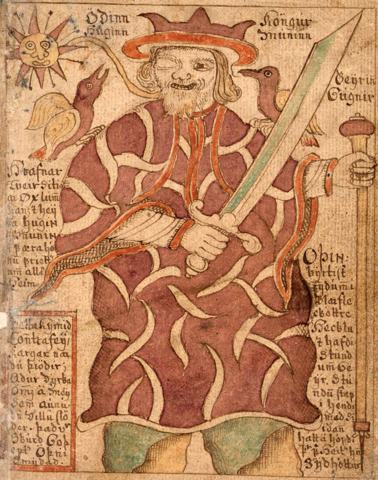
The Allfather. God of war, poetry and the dead who traded an eye for wisdom and hanged himself on the world tree to win the runes.
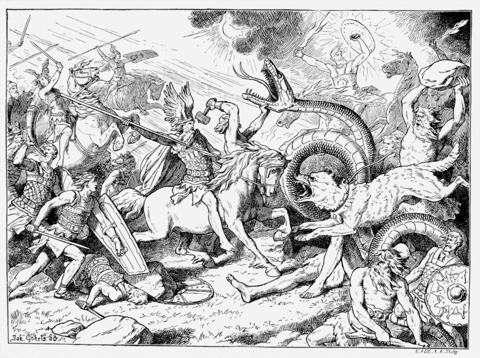
The Twilight of the Gods. The prophesied end: a killing winter, the breaking of every bond, a battle no one survives — and an earth that rises again.
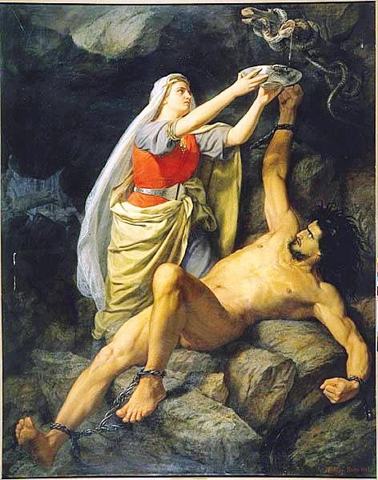
The Trickster. Shape-shifter of giant blood counted among the gods — their cleverest ally, the father of monsters, and the spark of Ragnarok.
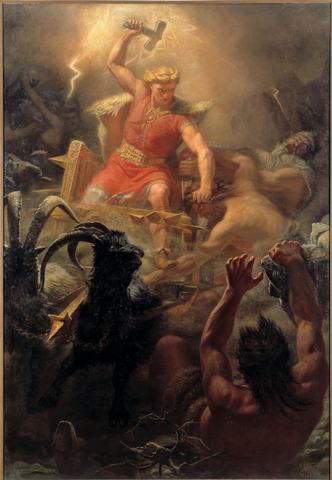
God of Thunder. Son of Odin and the earth, wielder of Mjolnir, and the gods' front line against the giants — fated to fall with the World Serpent.
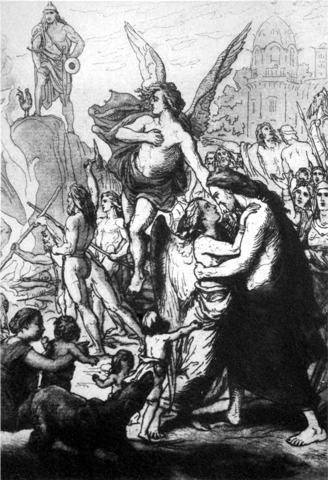
The stronghold of the AEsir. A walled citadel of halls at the top of the world tree, reached by the rainbow bridge and built on a bargain the gods broke.
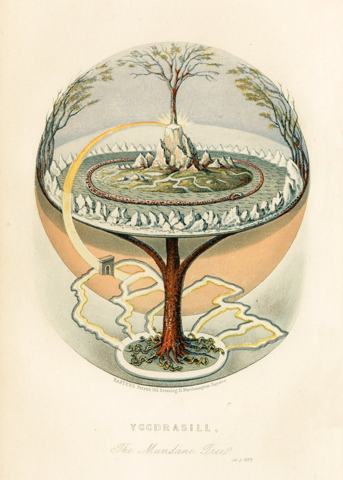
The World Tree. The great ash whose roots reach three wells and nine worlds, tended by the norns, eaten from every side, and still standing when the sky burns.
Also mentioned inMuspelheimThe Norns
Sources & Further Reading
- 1.Poetic Edda — Grimnismal, Fafnismal and Voluspa (Codex Regius, 13th century).
- 2.Snorri Sturluson, Prose Edda — Gylfaginning (c. 1220).
- 3.Faulkes, Anthony (trans.). Snorri Sturluson — Edda. Everyman, 1987.
- 4.Lindow, John. Norse Mythology — A Guide to the Gods, Heroes, Rituals, and Beliefs. Oxford University Press, 2001.
- 5.Simek, Rudolf. Dictionary of Northern Mythology. Trans. Angela Hall. D.S. Brewer, 1993.
- 6.Turville-Petre, E.O.G. Myth and Religion of the North — The Religion of Ancient Scandinavia. Weidenfeld & Nicolson, 1964.
- 7.Larrington, Carolyne (trans.). The Poetic Edda. Rev. ed., Oxford World's Classics, 2014.
Spot an error or have a source to suggest? Write to info@viseterna.com. We cite primary sources and modern scholarship, and we correct fast.