
Gungnir
Odin's spear. Dwarf-made, rune-carved, and thrown over an army to hand it to the god of the hanged — the weapon that starts the first war in the world.
Odin holding Gungnir atop Sleipnir, Lorenz Frolich, 1895 · Public domain · source
The Swaying One
Gungnir is usually derived from a root meaning to sway or to tremble — "the swaying one", "the shaker" — which reads as a description of a spear-shaft in flight or held level before a throw 6. It is a plainer name than Mjolnir's and it fits its owner: where Thor's hammer is a tool of hallowing and demolition, Odin's spear is an instrument of decision. It selects.
Forged in a Wager
The making is told in Skaldskaparmal, in one of the funniest and most consequential episodes in the Prose Edda. Loki, for no stated reason beyond mischief, cuts off all the hair of Thor's wife Sif. Thor catches him and Loki buys his life by promising replacement hair of real gold from the dwarfs 2.
He goes to the sons of Ivaldi, who make three things: the golden hair, the ship Skidbladnir, and the spear Gungnir. Loki then bets his own head against the dwarf Brokkr that Brokkr's brother cannot match them. Brokkr works the bellows while the smith makes the boar Gullinbursti, the ring Draupnir, and finally Mjolnir — with Loki in the form of a biting fly trying to ruin each pour, and succeeding only in shortening the hammer's handle 2.
The AEsir judge. Gungnir goes to Odin, the ship and the hair to Freyr and Thor, and the hammer is declared the best of all because it is the gods' defence against the giants. Loki loses, keeps his head on a technicality about his neck, and has his lips sewn shut 2,5.
Snorri gives Gungnir the property that its thrust never falters — that once launched it does not stop or miss 2. The dwarf-gift structure matters as much as the object: divine power in Norse myth is not innate, it is commissioned, from craftsmen who live outside Asgard and get nothing much in return 5,7.
Runes on the Point
Sigrdrifumal contains a remarkable catalogue in which a valkyrie tells a hero where the runes of victory and wisdom were carved: on a bear's paw, on Bragi's tongue, on a wolf's claw, on an eagle's beak, on bloody wings, on a bridge's end — and on the point of Gungnir 1,8.
The spear, in other words, is not merely a weapon with a good edge. It is inscribed, and the inscription is the reason it works. This lines up with everything else about Odin, whose power in the poems is verbal and cognitive far more than physical: he wins by knowing the formula, the name, the answer to the last question 5,7. Runic inscriptions on real Iron Age and Viking Age weapons — including spearheads carrying names and short formulas — show the practice was not a literary invention 6,7.
The Cast That Starts a War
Gungnir's most important appearance is a throw at nothing in particular. Voluspa describes the first war in the world, between the AEsir and the Vanir, and says Odin cast his spear and shot it over the host 1,8.
That gesture is documented well outside mythology. Throwing a spear over an enemy army was a recognised act of dedication: everything on the far side of it belonged to the god, and the battle became a sacrifice rather than a fight. Classical writers noted that northern peoples devoted the defeated to a war-god, and archaeology backs it — the great Danish bog deposits at Illerup, Nydam and Ejsbol contain hundreds of destroyed weapons, including spears, sunk as war booty 6,7.
Odin is the god who receives the hanged and the speared, and Havamal has him say that he hung nine nights on a windy tree, wounded by a spear, given to Odin, himself to himself 1,8. Snorri reports in Ynglinga saga that Odin, dying, had himself marked with a spear-point and claimed all men killed by weapons 4. The spear is the mark of ownership, and Odin used it on himself first.
At the End
At Ragnarok, Gungnir gets one last cast. Snorri describes Odin riding out ahead of the host in a gold helmet and a fine mail-coat, carrying the spear, and advancing against Fenrir 3. The wolf swallows him.
Nothing is said about the spear afterwards. Mjolnir survives — Thor's sons Modi and Magni carry it across the reborn earth — but Gungnir simply stops being mentioned, which is a fitting end for an object whose whole purpose was to hand things over to a god who no longer exists 1,3,5.
Why the Spear and Not the Sword
Norse heroic literature is full of named swords, and the god at the top of the pantheon does not carry one. That is a deliberate distribution. Thor has the hammer of the smallholder and the storm; Freyr had a sword and gave it away for a marriage; Odin holds the weapon of the levelled line and the mass grave, the one that decides the shape of a battle before contact 5,7.
Roman-era observers identified the northern war-god with Mercury rather than Mars, and scholars have long connected that to Odin's character: the spear-cast is not bravery, it is a transaction 6,7. Gungnir is Odin's argument in physical form. It never misses, and it never fights fair.
Continue Exploring
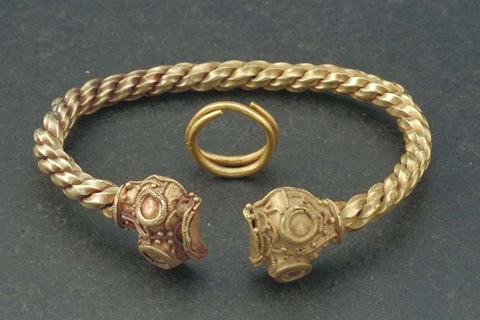
The dripping ring. Odin's gold arm-ring, which sheds eight more of its own weight every ninth night — burned on Baldr's pyre, and sent back from Hel.
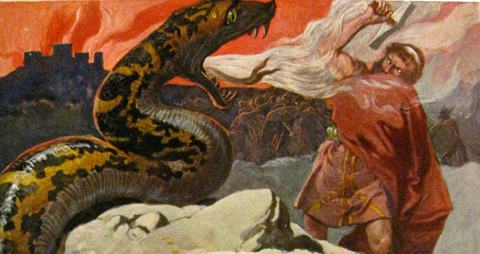
Hammer of Thor. Dwarf-forged, short in the handle, it strikes like lightning, hallows oaths and the dead, and always returns to the hand that throws it.
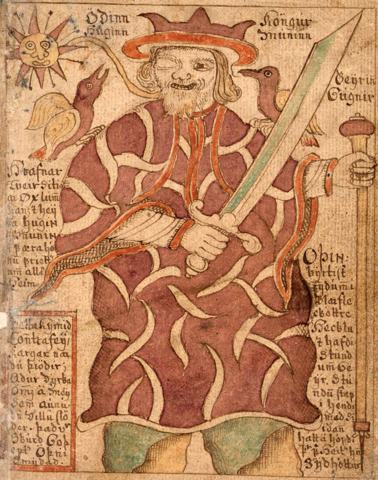
The Allfather. God of war, poetry and the dead who traded an eye for wisdom and hanged himself on the world tree to win the runes.
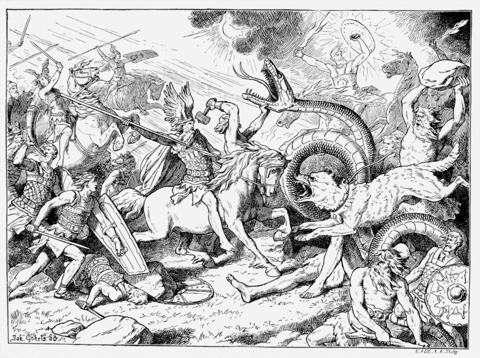
The Twilight of the Gods. The prophesied end: a killing winter, the breaking of every bond, a battle no one survives — and an earth that rises again.
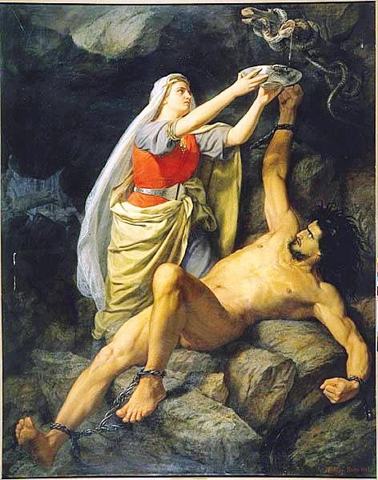
The Trickster. Shape-shifter of giant blood counted among the gods — their cleverest ally, the father of monsters, and the spark of Ragnarok.
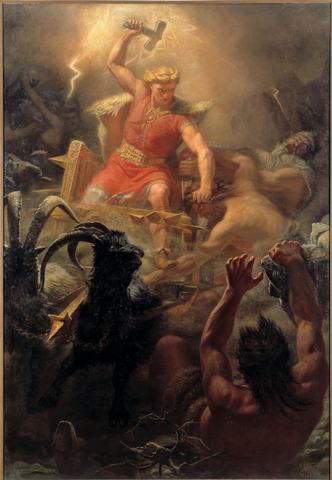
God of Thunder. Son of Odin and the earth, wielder of Mjolnir, and the gods' front line against the giants — fated to fall with the World Serpent.
Also mentioned inDwarves (Dvergar)SifSleipnirSvartalfheimThe Runes
Sources & Further Reading
- 1.Poetic Edda — Voluspa, Havamal and Sigrdrifumal (Codex Regius, 13th century).
- 2.Snorri Sturluson, Prose Edda — Skaldskaparmal (c. 1220).
- 3.Snorri Sturluson, Prose Edda — Gylfaginning (c. 1220).
- 4.Snorri Sturluson, Ynglinga saga, in Heimskringla (c. 1230).
- 5.Lindow, John. Norse Mythology — A Guide to the Gods, Heroes, Rituals, and Beliefs. Oxford University Press, 2001.
- 6.Simek, Rudolf. Dictionary of Northern Mythology. Trans. Angela Hall. D.S. Brewer, 1993.
- 7.Turville-Petre, E.O.G. Myth and Religion of the North — The Religion of Ancient Scandinavia. Weidenfeld & Nicolson, 1964.
- 8.Larrington, Carolyne (trans.). The Poetic Edda. Rev. ed., Oxford World's Classics, 2014.
Spot an error or have a source to suggest? Write to info@viseterna.com. We cite primary sources and modern scholarship, and we correct fast.