
Surtr
The Black One. The fire-giant who comes from the south at Ragnarok with a sword brighter than the sun, and burns the whole world to the ground behind him.
The Giant with the Flaming Sword, John Charles Dollman, 1909 · Public domain · source
The Black One
Surtr means "the black one" or "the swarthy one", from the Old Norse adjective svartr. It is an ordinary word — the same one used of dark-haired men and dark animals — which makes it a strange name for a being of fire until you picture what fire actually leaves behind. Soot, char, scorched rock. The name describes the aftermath, not the flame 5,6.
He is one of the oldest figures in the corpus and one of the least developed. Surtr has no family, no hall, no story of his own, and appears in the surviving poems only in connection with the end of the world. Everything about him is arrival 4,5.
From the South, with Fire
Voluspa introduces him in one of the most quoted stanzas in Norse literature: Surtr comes from the south carrying the bane of branches, and the sun shines from the sword of the slaughter-gods. The rocks crack open, troll-women stumble, men tread the road to Hel, and the sky splits 1,8. "Bane of branches" is a kenning for fire, and the image of a blade so bright it outshines the sun does not recur anywhere else in the Eddic poems — it is Surtr's alone.
The direction matters. Norse cosmology runs cold to the north, where Helheim and the ice lie, and the giants' country of Jotunheim sits east across the river. South is the odd quarter, and it belongs to Muspell — heat, brightness, and a host that rides in only once 3,5. Voluspa has the sons of Muspell coming over the sea while Loki steers the ship Naglfar, and the rainbow bridge Bifrost breaking under the weight of their crossing 1,4.
Muspellheim and the Flaming Sword
Snorri Sturluson supplies the details every later retelling depends on. In Gylfaginning, Muspellheim is the bright, hot, burning region in the south, impassable to anyone not born there, and Surtr sits at its frontier holding a flaming sword. At the end of the world he will ride out, harry, defeat every one of the gods, and burn the whole world with fire 3.
Snorri also makes Muspellheim one of the two primordial regions: its sparks and glowing embers meet the rime of Niflheim in the void of Ginnungagap, and life begins in the melt. If that is accurate to older tradition, Surtr is present at the world's beginning as well as its end, stationed at the edge of the thing he will eventually use 3,5,7.
Two cautions from scholarship. First, Snorri is doing systematic work: he had Voluspa and Vafthrudnismal in front of him and arranged their scattered lines into a coherent geography, so the neat "Surtr, ruler of Muspellheim" is at least partly his construction 5,7. Second, the poems never call Surtr a jotunn outright. He is grouped with the enemies of the gods, but the label "fire giant" is a convenience of later summary rather than a term the sources use 4,5.
Vigrid and the Fall of Freyr
Vafthrudnismal names the battlefield. Odin, in disguise, asks the wise giant Vafthrudnir what the plain is called where Surtr and the sweet gods will meet in battle, and the answer is Vigrid — a hundred leagues on every side 2,8. Fafnismal gives an alternative name, Oskopnir, for the island where the gods and Surtr's company gather; the two traditions were evidently never harmonised 2,5.
Snorri sets out the individual duels. Odin goes against Fenrir, Thor against Jormungandr, Heimdallr against Loki — and Freyr, brother of Freyja, falls to Surtr. The reason is one of the neatest pieces of long-range plotting in the mythology: Freyr gave away his self-swinging sword as the price of winning the giantess Gerd, and at Vigrid he has nothing to fight with 3,4. A god's marriage bargain, made in a courtship poem, is paid off at the end of the world.
Then Surtr flings fire over the earth and burns the whole world 1,3. He does not appear again. The renewal Voluspa describes — the land rising green from the sea, the surviving gods returning to the field at Asgard and finding the golden gaming pieces in the grass — happens after his fire has passed, and nothing in the poem says he is defeated. He simply finishes and is not mentioned 1,4,7.
Fire in the Icelandic Landscape
Surtr is one of the few mythological figures with a durable footprint in the real geography of Iceland. Surtshellir, a long lava tube in the west of the island, carries his name in medieval sources including Landnamabok, and Icelandic tradition placed a giant in it 5,6. Iceland sits on the mid-Atlantic ridge; the settlers who recorded these poems lived on fissure eruptions and lava fields, and scholars have long argued that the volcanic imagery in Voluspa — the crash of rocks, the sky splitting, steam and flame — reflects that landscape rather than an inherited abstraction 4,6,7.
The habit persisted. When a submarine eruption threw up a new island off the Icelandic coast in 1963, it was named Surtsey 5.
Reading Surtr
Comparative scholarship has offered Surtr as a Norse reflex of an older cosmic conflagration motif, and has also pointed at the Christian apocalypse — the world consumed by fire is a very familiar thirteenth-century idea, and the poems were written down by Christians 4,6,7. The argument is unresolved and probably unresolvable.
What is distinctive is the tone. Surtr is not evil, not vengeful, and not given a motive. He is positioned at a border at the start of time and crosses it at the end, and the poems present this the way they present the seasons: as something that will happen. In a mythology otherwise crowded with quarrels, oaths and grudges, Ragnarok's final agent has no personality at all — and that is the point of him 4,7.
Continue Exploring
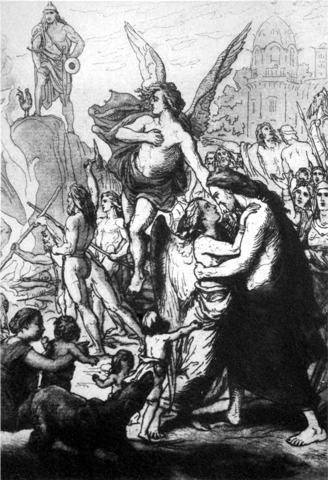
The stronghold of the AEsir. A walled citadel of halls at the top of the world tree, reached by the rainbow bridge and built on a bargain the gods broke.
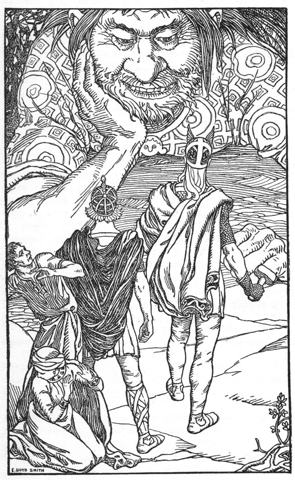
Land of the giants. The wild country east of the fence, older than the gods, holding the wisdom and the brides the AEsir keep going out to take.
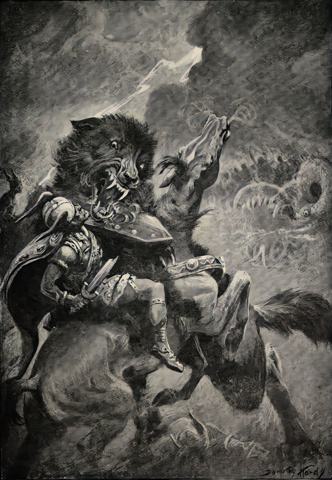
The Bound Wolf. Loki's son, raised among the gods and chained by a trick that cost Tyr his hand — until Ragnarok, when he devours Odin.
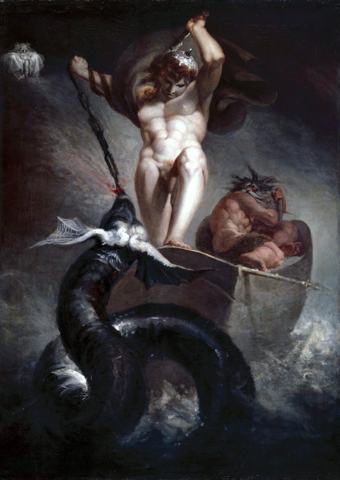
The World Serpent. Loki's monstrous child, cast into the ocean until it grew to ring all Midgard and bite its own tail. Thor's appointed enemy.
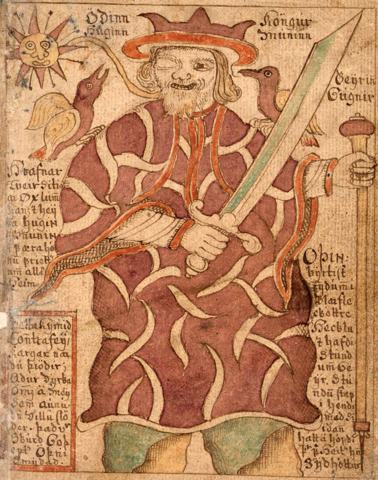
The Allfather. God of war, poetry and the dead who traded an eye for wisdom and hanged himself on the world tree to win the runes.
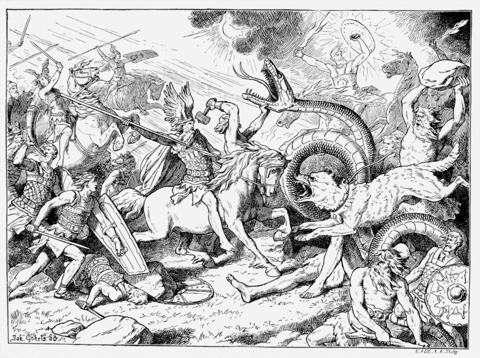
The Twilight of the Gods. The prophesied end: a killing winter, the breaking of every bond, a battle no one survives — and an earth that rises again.
Also mentioned inBifrost (The Rainbow Bridge)Freyr (Frey)MidgardMuspelheim
Sources & Further Reading
- 1.Poetic Edda — Voluspa (Codex Regius, 13th century).
- 2.Poetic Edda — Vafthrudnismal and Fafnismal (Codex Regius, 13th century).
- 3.Snorri Sturluson, Prose Edda — Gylfaginning (c. 1220).
- 4.Lindow, John. Norse Mythology — A Guide to the Gods, Heroes, Rituals, and Beliefs. Oxford University Press, 2001.
- 5.Simek, Rudolf. Dictionary of Northern Mythology. Trans. Angela Hall. D.S. Brewer, 1993.
- 6.Turville-Petre, E.O.G. Myth and Religion of the North — The Religion of Ancient Scandinavia. Weidenfeld & Nicolson, 1964.
- 7.Abram, Christopher. Myths of the Pagan North — The Gods of the Norsemen. Continuum, 2011.
- 8.Larrington, Carolyne (trans.). The Poetic Edda. Rev. ed., Oxford World's Classics, 2014.
Spot an error or have a source to suggest? Write to info@viseterna.com. We cite primary sources and modern scholarship, and we correct fast.