
Freyja (Freya)
Lady of the Vanir. Goddess of love, war, gold and seidr magic — often spelled Freya — who claims half of the battle-slain for her own hall.
Freja Seeking her Husband, Nils Blommer, 1852 (Nationalmuseum, Stockholm) · Public domain · source
Name and Origins
Freyja — very commonly spelled Freya in English, and appearing in the sources under a run of by-names including Mardoll, Horn, Gefn, Syr and Vanadis — is the foremost goddess of the Vanir, the second family of Norse gods 2,6. Her name is not really a name at all: it means "lady", the feminine counterpart of her brother Freyr's "lord", and both look like titles that hardened into personal names 6.
She is the daughter of the sea-god Njord and, in Snorri's telling, twin to Freyr. The three of them came to live among the Aesir as part of the settlement that ended the war between the two divine families — hostages in form, permanent residents in practice 2,4. Her husband Odr is a shadowy figure who is always away; Freyja travels the worlds searching for him and weeps tears of red gold, which is why skalds could call gold "Freyja's tears" 2,3. Their daughters are Hnoss and Gersemi, both of whose names mean "treasure".
Mistress of Seidr
Freyja's defining skill is seidr — the Norse magic of prophecy, fate-shaping, cursing and blessing. Snorri states in Ynglinga saga that she brought it to the Aesir and taught it to them, which makes her the source of Odin's most controversial power 4. That inheritance carries a social charge: seidr was primarily women's practice, and in Lokasenna the accusation that Odin performs it is a sexual insult 1.
Modern archaeology has given this material unexpected weight. Graves across Scandinavia containing iron staffs, unusual amulets and non-standard burial arrangements have been read as the burials of practitioners, giving a real-world profession behind the mythological picture of the goddess who taught it 7,8.
Her equipment is a magician's. She owns a cloak of falcon feathers that grants flight — repeatedly borrowed by Loki when he needs to get somewhere fast — a chariot drawn by two cats, and the boar Hildisvini, on whose back she rides in Hyndluljod 1,2.
Brisingamen
Freyja's most famous possession is the necklace or collar Brisingamen, forged by dwarves and named simply "the Brisings' ornament" 3,6. The Eddas assume the reader knows it; the fullest surviving account of how she got it comes from the much later Sorla thattr, which turns the acquisition into a scandal and is generally treated as a late, moralising elaboration rather than early tradition 5,6.
The necklace shows up as a fixed attribute nonetheless. Skaldic verse records a contest between Heimdall and Loki, fought in seal form over Brisingamen, and in Thrymskvida Freyja's rage at being offered as a giant's bride is violent enough to snap the necklace clean off her neck 1,3.
Claimer of the Slain
The detail most often lost in popular retellings is that Freyja is a war goddess with first claim on the dead. Grimnismal states it flatly: she holds the field of Folkvangr, and of those who fall in battle she chooses half, while Odin takes the other half to Valhalla 1,2. Her hall there is Sessrumnir, "the seat-roomy one".
That division puts her on structural parity with the Allfather rather than beneath him, and the sources never explain the split or say which half she picks. Some scholars connect her to the Valkyries and to the disir, collective female powers attached to families and battlefields; the boundaries between all these categories are porous in the surviving texts 5,6,8.
Freyja and Frigg
One of the longest-running debates in the field is whether Freyja and Frigg — Odin's wife, and a distinct goddess in every Norse source — descend from a single earlier Germanic figure who split in two. The arguments for it are real: both are associated with a wandering or absent husband, both are linked to fertility and to knowledge of fate, and the continental West Germanic material preserves only one such goddess 6,5. The arguments against are equally real, and the question remains genuinely open rather than settled either way. English Friday derives from Frigg's name, not Freyja's, though the two are often conflated in popular writing 6.
Worship and Legacy
Freyja was widely honoured. Place-names built on her title cluster in Sweden and Norway, and the Vanir generally are associated with prosperity, good seasons and peace — the everyday goods that a warrior aristocracy's poetry tends to under-report 5,7,8. What the literature preserves is the sharper edge: a goddess of desire and gold who is also a taker of corpses, and who is never once shown asking anyone's permission.
Continue Exploring
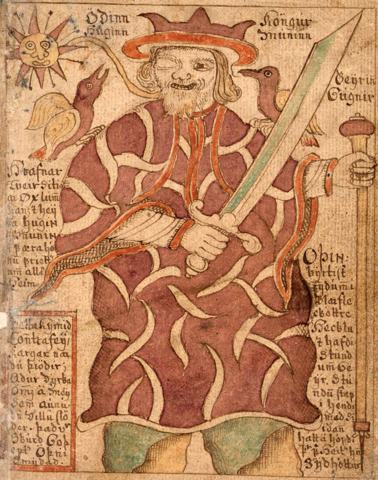
The Allfather. God of war, poetry and the dead who traded an eye for wisdom and hanged himself on the world tree to win the runes.
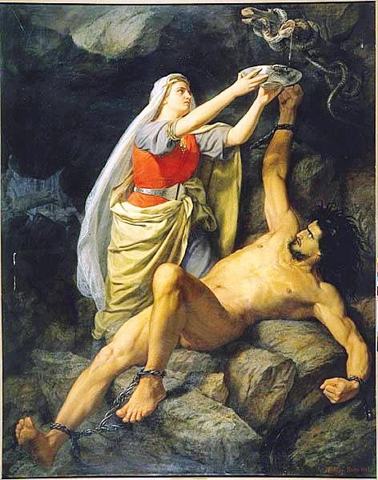
The Trickster. Shape-shifter of giant blood counted among the gods — their cleverest ally, the father of monsters, and the spark of Ragnarok.
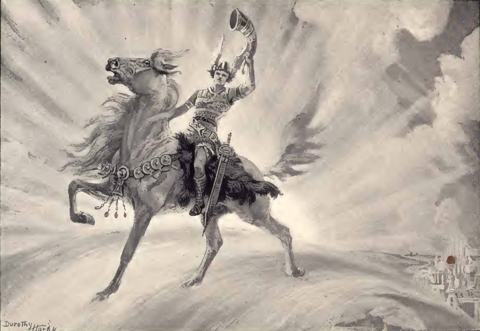
Watchman of the Gods. Born of nine mothers, he guards the rainbow bridge, hears wool grow on sheep, and will sound the horn that begins the end.
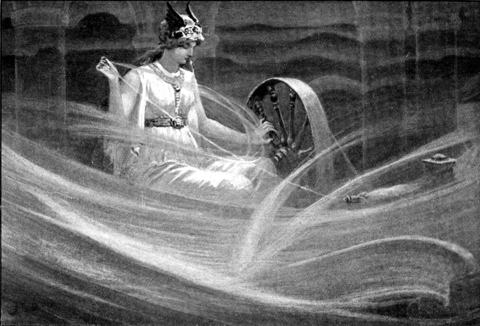
Odin's wife and the highest-ranking goddess of the Aesir — keeper of foreknowledge she will not speak, and the mother whose oaths could not save Baldr.
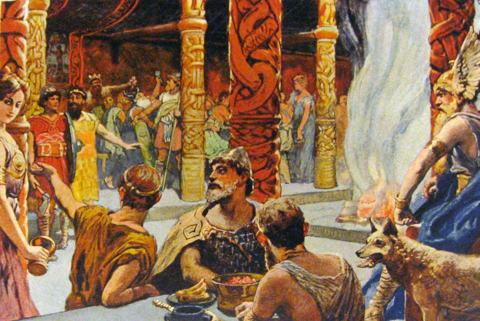
Hall of the Slain. Odin's roof of shields where the chosen dead feast, fight, and are healed each night — an army kept in reserve for Ragnarok.
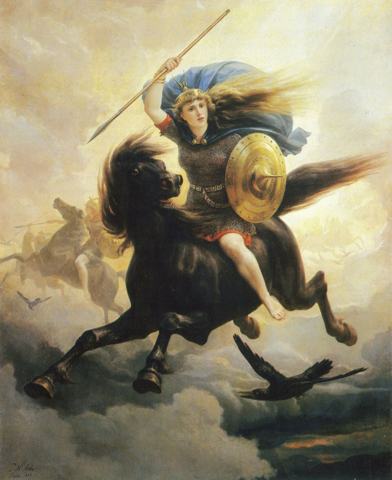
Choosers of the Slain. Odin's riders who decide who dies in battle and carry the chosen to Valhalla — battlefield spirits before they were shieldmaidens.
Also mentioned inAsgardBrisingamenFreyr (Frey)HelHelheimIdunn (Idun)JotunheimMidgardMjolnirNjord (Njörðr)Seidr (Norse Magic)Skadi (Skaði)SleipnirSurtrThe Aesir-Vanir WarThorVanaheim
Sources & Further Reading
- 1.Poetic Edda — Grimnismal, Thrymskvida, Lokasenna and Hyndluljod (Codex Regius, 13th century).
- 2.Snorri Sturluson, Prose Edda — Gylfaginning (c. 1220).
- 3.Snorri Sturluson, Prose Edda — Skaldskaparmal (c. 1220).
- 4.Snorri Sturluson, Ynglinga saga, in Heimskringla (c. 1230).
- 5.Lindow, John. Norse Mythology — A Guide to the Gods, Heroes, Rituals, and Beliefs. Oxford University Press, 2001.
- 6.Simek, Rudolf. Dictionary of Northern Mythology. Trans. Angela Hall. D.S. Brewer, 1993.
- 7.Price, Neil. The Viking Way — Magic and Mind in Late Iron Age Scandinavia. 2nd ed., Oxbow Books, 2019.
- 8.Davidson, H.R. Ellis. Gods and Myths of Northern Europe. Penguin, 1964.
Spot an error or have a source to suggest? Write to info@viseterna.com. We cite primary sources and modern scholarship, and we correct fast.