
Loki
The Trickster. Shape-shifter of giant blood counted among the gods — their cleverest ally, the father of monsters, and the spark of Ragnarok.
Loki, Marten Eskil Winge, 1890 · Public domain · source
A God Who Fits Nowhere
Loki is the son of the giant Farbauti and a figure named Laufey, and by descent he has no business living in Asgard at all. He is there because Odin swore blood-brotherhood with him — a fact Loki throws back at the Allfather in Lokasenna when the gods try to have him thrown out of a feast 1. That single relationship holds the whole arrangement together, and when it fails, everything does.
He is not a god of anything. Where Thor has thunder and Freyja has love and war, Loki has no domain, no temple, no known cult, and no place-names — a silence in the archaeological and toponymic record that scholars treat as significant 5,6. What he has instead is a role: he causes the crisis, and then he is the only one who can solve it. Snorri calls him the slanderer of the gods and the source of all deceit, and in the same breath credits him with wits that no one else can match 2.
A persistent modern error makes him a fire god. That comes from confusing Loki with Logi, the giant who is literally wildfire and who out-eats him in an eating contest at Utgard — the two are separate figures in the sources, and the etymology of Loki's name is still unsettled 5.
Shapes and Offspring
No other Norse figure changes form as freely. Loki becomes a fly to sabotage a forging, a falcon to fly into Jotunheim, a salmon to escape capture, a seal to fight over a necklace, and an old woman to withhold a single tear at the worst possible moment. Most famously he becomes a mare, distracts the stallion Svadilfari so that a giant builder cannot finish Asgard's walls on schedule, and later gives birth to the eight-legged horse Sleipnir, which he hands to Odin 2.
By the giantess Angrboda he fathered three children the gods could not live with: the wolf Fenrir, the World Serpent Jormungandr, and Hel, who rules the dishonoured dead. Odin's response — bind one, drown one, exile one — is prudent and also, in the way of prophecy, the mechanism by which all three become exactly what he feared 2,4. With his wife Sigyn, Loki also had ordinary sons, Narfi and Vali, whose fate is the cruellest detail in the whole corpus.
The Treasures of the Gods
Loki's single most productive disaster begins with vandalism: he cuts off Sif's golden hair for no stated reason beyond mischief. Threatened by Thor, he goes to the dwarves and comes back with replacement hair that grows, plus Odin's spear Gungnir and the ship Skidbladnir. Then, unable to stop, he bets his own head that the brothers Brokkr and Eitri cannot make anything better — and stings the working smith as a fly to spoil the bellows 3.
He loses. The dwarves produce the ring Draupnir, the golden boar Gullinbursti, and Mjolnir, whose handle is short only because of Loki's interference. He wriggles out of the forfeit on a technicality — the bet was for his head, not his neck — and the dwarf sews his lips shut instead 3. The episode is the whole character in miniature: every treasure the gods rely on exists because Loki caused a problem first.
The Death of Baldr
The turn comes with Baldr. When the beloved son of Odin and Frigg is made immune to all harm by an oath sworn from every thing in the world, the gods make a game of throwing weapons at him. Loki learns that one plant was overlooked as too young to swear — mistletoe — and puts a shaft of it into the hands of the blind god Hodr, guiding the throw 1,2.
Then he closes the door behind it. When Hel agrees to release Baldr on the condition that every living thing weep for him, one giantess named Thokk refuses. Snorri says plainly that most believe this was Loki 2. Modern scholarship reads the sequence as a feud narrative rather than a nature myth: a killing that cannot be avenged in the normal way, inside a family that cannot expel the killer 4.
Binding and Release
At the feast in Lokasenna he insults every god and goddess present in turn, accurately, and leaves. The Aesir hunt him down at the falls of Franangr, where he has taken salmon form, and bind him across three stones with the entrails of his own son. A serpent is fixed above him to drip venom on his face; Sigyn catches it in a bowl, and when she turns to empty it the drops land and Loki convulses — which is what earthquakes are 2.
He does not stay bound. At Ragnarok the fetters break, and Loki steers the ship Naglfar with the forces of Hel aboard, arriving at last on the opposite side from the gods he lived among. On the field he and Heimdall kill each other, ending an enmity the sources only half explain 1,2.
Whether Loki was ever worshipped, and whether the darker figure of the Eddas owes something to Christian conceptions of the devil, is genuinely unresolved. What survives is a character the mythology cannot function without and cannot survive keeping 4,5,7.
Continue Exploring
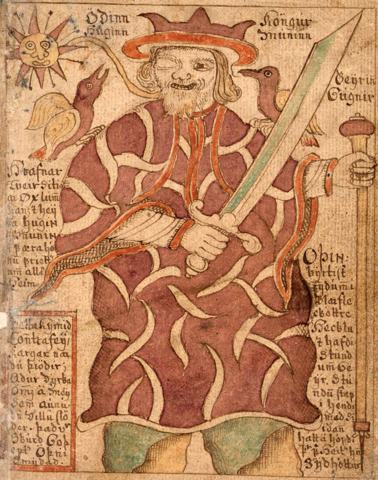
The Allfather. God of war, poetry and the dead who traded an eye for wisdom and hanged himself on the world tree to win the runes.
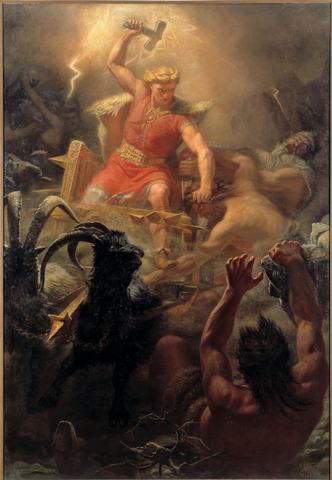
God of Thunder. Son of Odin and the earth, wielder of Mjolnir, and the gods' front line against the giants — fated to fall with the World Serpent.
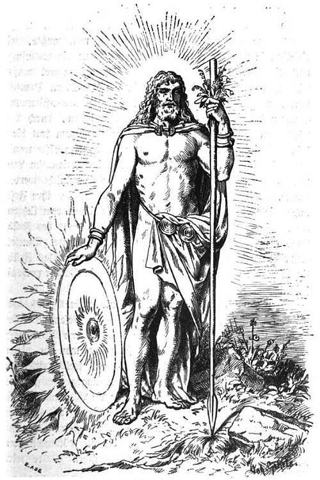
God of Light. The most beloved of the Aesir, made immune to all harm but one plant — and killed by it, which set the world's ending in motion.
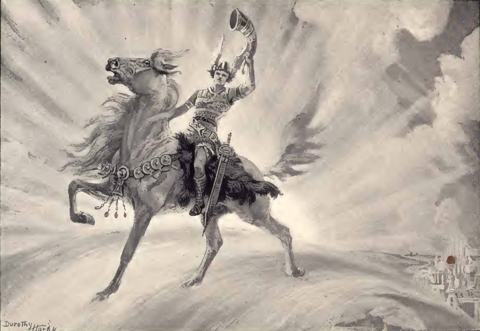
Watchman of the Gods. Born of nine mothers, he guards the rainbow bridge, hears wool grow on sheep, and will sound the horn that begins the end.
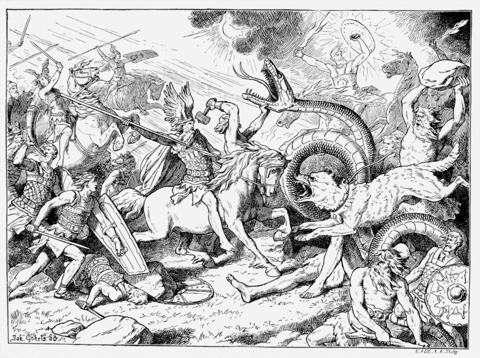
The Twilight of the Gods. The prophesied end: a killing winter, the breaking of every bond, a battle no one survives — and an earth that rises again.
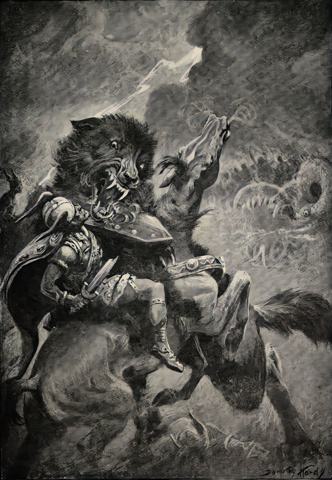
The Bound Wolf. Loki's son, raised among the gods and chained by a trick that cost Tyr his hand — until Ragnarok, when he devours Odin.
Also mentioned inAegir and RanAsgardBifrost (The Rainbow Bridge)BragiBrisingamenDraupnirDwarves (Dvergar)FafnirFreyja (Freya)FriggGleipnirGungnirHelHelheimHodr (Hod)Idunn (Idun)JormungandrMidgardMjolnirMuspelheimSeidr (Norse Magic)SifSigurd (Siegfried)Skadi (Skaði)SleipnirSurtrThe Death of BaldrThe Prose Edda
Sources & Further Reading
- 1.Poetic Edda — Voluspa, Lokasenna, Thrymskvida and Baldrs draumar (Codex Regius, 13th century).
- 2.Snorri Sturluson, Prose Edda — Gylfaginning (c. 1220).
- 3.Snorri Sturluson, Prose Edda — Skaldskaparmal (c. 1220).
- 4.Lindow, John. Norse Mythology — A Guide to the Gods, Heroes, Rituals, and Beliefs. Oxford University Press, 2001.
- 5.Simek, Rudolf. Dictionary of Northern Mythology. Trans. Angela Hall. D.S. Brewer, 1993.
- 6.Turville-Petre, E.O.G. Myth and Religion of the North — The Religion of Ancient Scandinavia. Weidenfeld & Nicolson, 1964.
- 7.Abram, Christopher. Myths of the Pagan North — The Gods of the Norsemen. Continuum, 2011.
Spot an error or have a source to suggest? Write to info@viseterna.com. We cite primary sources and modern scholarship, and we correct fast.