
Jormungandr
The World Serpent. Loki's monstrous child, cast into the ocean until it grew to ring all Midgard and bite its own tail. Thor's appointed enemy.
Thor battering the Midgard Serpent, Henry Fuseli, 1790 (Royal Academy of Arts, London) · Public domain · source
The Serpent That Rings the World
Jormungandr — the name means something like "huge monster" — is the middle child of Loki and the giantess Angrboda, and it is also called Midgardsormr, the Midgard Serpent 1,5. When Odin learned what Loki's three children were fated to do, he threw the serpent into the deep sea that surrounds the lands of men. It kept growing there until it circled the entire world and could close its jaws on its own tail 1.
That posture is the whole idea. Jormungandr is not a monster that lurks somewhere on the map; it is the boundary of the map, the line where the known world stops. Everything inside is Midgard. The serpent is what the inside is inside of 4,6.
Thor Goes Fishing
The most told story about the serpent is a fishing trip, and it survives in more independent versions than almost any other Norse myth — the poem Hymiskvida, Snorri's prose in Gylfaginning, and fragments of three separate skaldic poems that assume their audience already knows it 2,1,3.
Thor, lodging with the giant Hymir, tears the head off the giant's best ox for bait and rows out well past the grounds where Hymir dares to fish. He drops the line, and Jormungandr takes it. Thor braces so hard that his feet go through the bottom of the boat and plant on the sea floor; he hauls, the serpent hauls back, and the two of them lock eyes over the gunwale with venom running down the serpent's chin. Then Hymir — either terrified or reasonably concerned about the boat — cuts the line, and the serpent sinks back 1,2.
Whether Thor would have killed it there is left open, and the versions disagree about what he does to Hymir afterwards. What the scene establishes is that the confrontation is personal and has been postponed rather than avoided 4,6.
The episode was carved as often as it was recited. The Altuna runestone in Sweden shows a figure in a boat with his foot punching through the hull; the Gosforth fishing stone in Cumbria and the Hordum stone in Denmark show the same moment, and together they prove the myth was current across the Norse world well before anyone wrote it down 4,6,7.
The Cat in Utgard
Thor meets the serpent a second time without knowing it. At the hall of the giant king Utgarda-Loki he is challenged to lift a large grey cat off the floor, and manages only to raise one of its paws — after which the giant admits, once his guests are safely outside, that the cat was Jormungandr, and that everyone present was appalled to see Thor pull an edge of the world loose from the ground 1.
The trick is characteristic of the Utgard episode, where each humiliating failure turns out to be an impossible feat nearly accomplished. It also quietly restates the serpent's function: it is the same size as the world, and Thor is the only being who can shift it at all 1,4.
The Final Duel
At Ragnarok the serpent lets go of its tail — the boundary opens — and comes ashore, thrashing the sea into the land and blowing venom across the air and water 2,1. Thor meets it there, and the two of them settle an appointment that both have kept since the sea first closed over it.
Thor wins, and Voluspa spends exactly one line on the victory before taking it back: he kills the serpent, walks nine paces, and falls dead of the venom 2. Snorri repeats the detail without adding to it 1. Of all the paired deaths at the world's end, this is the one the poetry treats as inevitable rather than tragic — the strongest god and the largest monster were always going to cancel each other out.
Interpretations
Scholars have compared Jormungandr to the world-encircling serpents of other traditions, from the Greek Ouroboros to the cosmic sea-monsters of Near Eastern myth, and to the widespread storm-god-versus-serpent pattern reconstructed for Indo-European religion — the same shape that puts Indra against Vritra and Zeus against Typhon 5,6,7. The Norse version is distinctive in two ways: the serpent is not chaos before creation but a permanent feature of the finished world, and the storm god does not win. He draws 4,6.
Continue Exploring
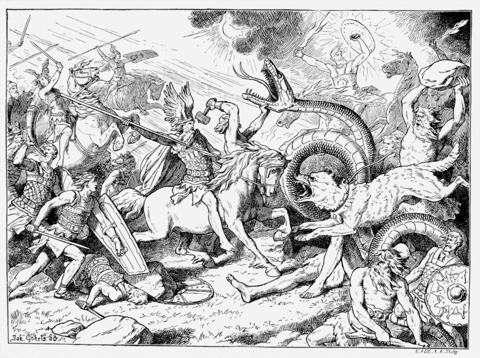
The Twilight of the Gods. The prophesied end: a killing winter, the breaking of every bond, a battle no one survives — and an earth that rises again.
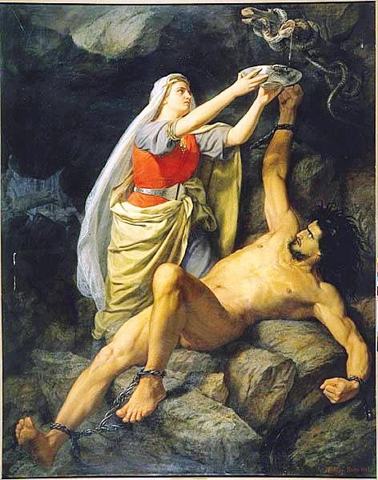
The Trickster. Shape-shifter of giant blood counted among the gods — their cleverest ally, the father of monsters, and the spark of Ragnarok.
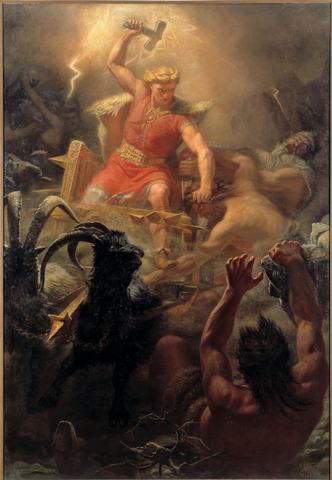
God of Thunder. Son of Odin and the earth, wielder of Mjolnir, and the gods' front line against the giants — fated to fall with the World Serpent.
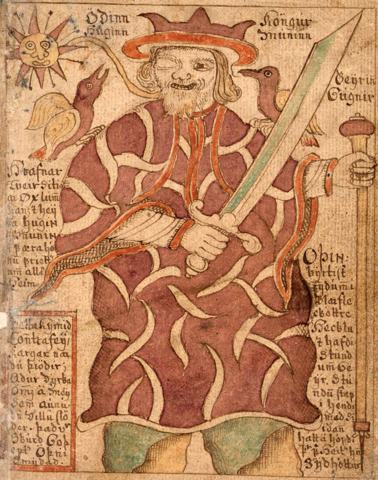
The Allfather. God of war, poetry and the dead who traded an eye for wisdom and hanged himself on the world tree to win the runes.
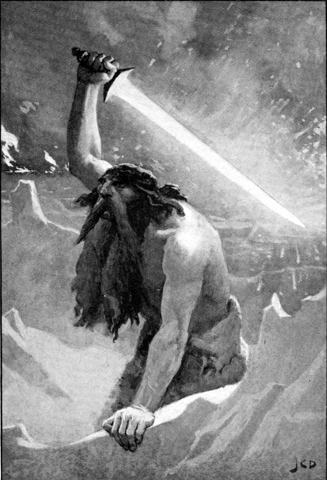
The Black One. The fire-giant who comes from the south at Ragnarok with a sword brighter than the sun, and burns the whole world to the ground behind him.
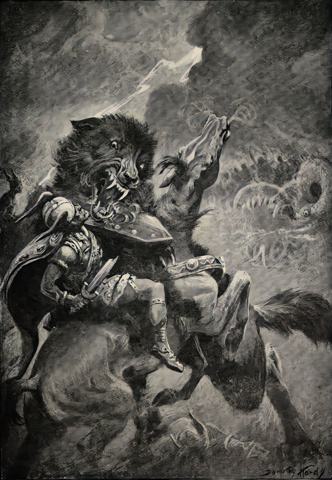
The Bound Wolf. Loki's son, raised among the gods and chained by a trick that cost Tyr his hand — until Ragnarok, when he devours Odin.
Also mentioned inAegir and RanAsgardBifrost (The Rainbow Bridge)GleipnirHelJotunheimMidgardMjolnirNidhoggrThe Nine Realms
Sources & Further Reading
- 1.Snorri Sturluson, Prose Edda — Gylfaginning (c. 1220).
- 2.Poetic Edda — Voluspa and Hymiskvida (Codex Regius, 13th century).
- 3.Snorri Sturluson, Prose Edda — Skaldskaparmal (c. 1220).
- 4.Lindow, John. Norse Mythology — A Guide to the Gods, Heroes, Rituals, and Beliefs. Oxford University Press, 2001.
- 5.Simek, Rudolf. Dictionary of Northern Mythology. Trans. Angela Hall. D.S. Brewer, 1993.
- 6.Turville-Petre, E.O.G. Myth and Religion of the North — The Religion of Ancient Scandinavia. Weidenfeld & Nicolson, 1964.
- 7.Davidson, H.R. Ellis. Gods and Myths of Northern Europe. Penguin, 1964.
Spot an error or have a source to suggest? Write to info@viseterna.com. We cite primary sources and modern scholarship, and we correct fast.