
Valhalla
Hall of the Slain. Odin's roof of shields where the chosen dead feast, fight, and are healed each night — an army kept in reserve for Ragnarok.
Walhall, Emil Doepler, c. 1905 · Public domain · source
The Hall Itself
Valhalla — Old Norse Valholl, "hall of the slain" — stands in Asgard as Odin's own dwelling, and the description in Grimnismal is one of the great set-pieces of Norse poetry. The rafters are spear-shafts, the roof is thatched with shields, and mail-coats are strewn over the benches. A wolf hangs before the western door with an eagle above it. The gate is called Valgrind, and beyond it are five hundred and forty doors, each wide enough for eight hundred warriors to march out abreast when the wolf comes 1.
The arithmetic is not decoration. Multiply it out and Odin's household comes to well over four hundred thousand fighting men, assembled for one specific morning 1,4.
Who Gets In
Entry is by selection, not merit in any moral sense. The Valkyries ride out over battlefields and choose; Odin takes half the slain, and Freyja takes the other half to her field Folkvangr, a division stated flatly in Grimnismal and repeated by Snorri without explanation 1,2. Nobody in the sources ever says how the two halves are decided, or what makes one dead warrior Odin's and the next Freyja's.
Snorri's tidier scheme sends those who die of sickness or old age down to Hel instead, which is where the popular contrast between a warrior's heaven and a coward's underworld comes from 2. The older material is far less systematic — plenty of people who died violently end up in Hel, and burial mounds, sea-halls and family afterlives appear alongside all of it 4,6,7. Valhalla is better read as one strand of belief that skaldic poets, working for kings, had every reason to amplify.
The Daily Routine
Life in Valhalla is a loop. The Einherjar — the "single fighters", or possibly "those who fight alone" — arm themselves every morning, go out into the yard, and kill one another. At evening they are healed, restored and ride back in to drink together 2.
Dinner is provided by a boar named Saehrimnir, cooked each day by the cook Andhrimnir in the cauldron Eldhrimnir and whole again by nightfall. The drink is mead from the udder of the goat Heidrun, who browses on the branches of a tree above the roof and fills a vat daily. A stag named Eikthyrnir stands beside her, and the water dripping from its antlers feeds the rivers of the worlds 1,2. Odin himself eats nothing, giving his portion to the wolves Geri and Freki and living on wine alone 1.
The Valkyries serve the ale, which is the same job they do on the battlefield seen from a different angle: they bring the warriors in, and then they pour 1,4.
Real Kings, Real Poems
Two tenth-century memorial poems show the idea in working use rather than as literary mythology. Eiriksmal, composed for the Norwegian king Eirik Bloodaxe, opens with Odin waking and ordering the benches strewn and the ale brought out because a great king is arriving; Sigmund and Sinfjotli are sent to the door to meet him 3. Hakonarmal does the same for Hakon the Good — with the pointed complication that Hakon was a Christian, and the poem manoeuvres him into Valhalla anyway 3,4,7.
These are commissioned pieces for a warrior aristocracy, and that is exactly what makes them evidence. Valhalla was a live idea that people used to say something about a specific dead man, not only a cosmological fixture 4,7.
Etymology and Doubts
Valholl transparently combines valr, the slain on a battlefield, with holl, hall. A minority proposal reads an older form as valhallr, "rock of the slain", connecting the hall to the widespread notion of the dead dwelling inside a mountain or mound — which would make the shining hall a later poetic development of a much homelier belief 5,6.
However it began, its afterlife has been enormous. From Wagner through Victorian painting to modern games and film, Valhalla is now the default English shorthand for a heroic afterlife, generally shorn of the detail that makes it strange: the point of the hall is not reward. It is a mustering ground, and every man in it has been recruited for a battle Odin already knows he will lose 4,7.
At Ragnarok
When the horn sounds, the doors open and the Einherjar march to Vigrid behind Odin 1,2. The poetry does not record what becomes of them individually — they exist as a number, and the number turns out not to be enough. Odin falls to Fenrir with his whole army on the field 1,2,8.
Continue Exploring
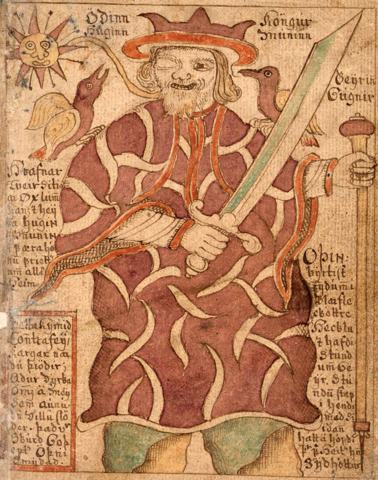
The Allfather. God of war, poetry and the dead who traded an eye for wisdom and hanged himself on the world tree to win the runes.
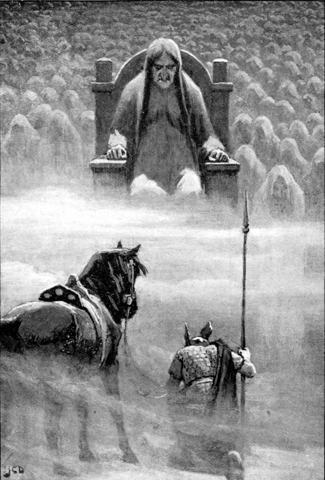
Queen of the Dead. Half living woman and half corpse, Loki's daughter rules the cold realm where those who die of sickness and age must go.
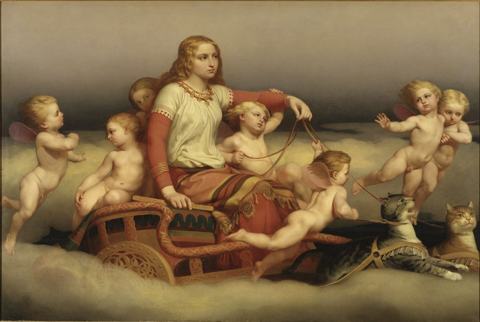
Lady of the Vanir. Goddess of love, war, gold and seidr magic — often spelled Freya — who claims half of the battle-slain for her own hall.
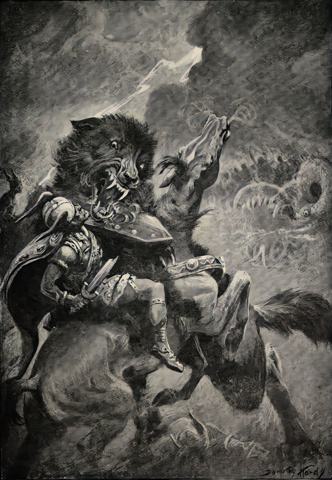
The Bound Wolf. Loki's son, raised among the gods and chained by a trick that cost Tyr his hand — until Ragnarok, when he devours Odin.
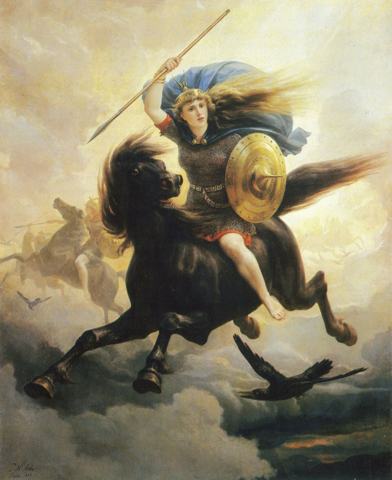
Choosers of the Slain. Odin's riders who decide who dies in battle and carry the chosen to Valhalla — battlefield spirits before they were shieldmaidens.
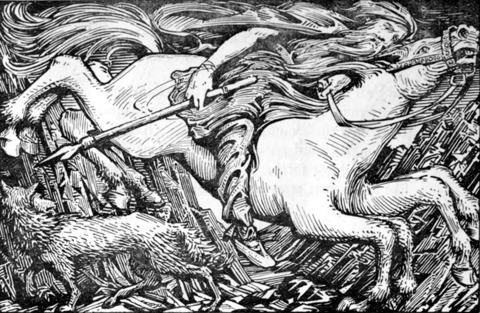
The cold underworld. Down and to the north, past a gold-roofed bridge and a gate that does not open twice, the hall where most of the Norse dead actually go.
Also mentioned inAegir and RanAsgardBragiRagnarokSleipnirWyrd
Sources & Further Reading
- 1.Poetic Edda — Grimnismal, Voluspa and Vafthrudnismal (Codex Regius, 13th century).
- 2.Snorri Sturluson, Prose Edda — Gylfaginning (c. 1220).
- 3.Eiriksmal and Hakonarmal (anonymous skaldic memorial poems, 10th century).
- 4.Lindow, John. Norse Mythology — A Guide to the Gods, Heroes, Rituals, and Beliefs. Oxford University Press, 2001.
- 5.Simek, Rudolf. Dictionary of Northern Mythology. Trans. Angela Hall. D.S. Brewer, 1993.
- 6.Turville-Petre, E.O.G. Myth and Religion of the North — The Religion of Ancient Scandinavia. Weidenfeld & Nicolson, 1964.
- 7.Abram, Christopher. Myths of the Pagan North — The Gods of the Norsemen. Continuum, 2011.
- 8.Larrington, Carolyne (trans.). The Poetic Edda. Rev. ed., Oxford World's Classics, 2014.
Spot an error or have a source to suggest? Write to info@viseterna.com. We cite primary sources and modern scholarship, and we correct fast.