
Yggdrasil
The World Tree. The great ash whose roots reach three wells and nine worlds, tended by the norns, eaten from every side, and still standing when the sky burns.
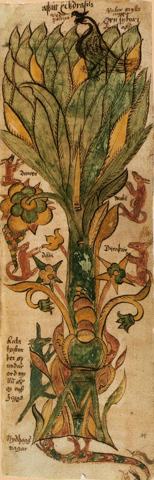
Yggdrasil, The Mundane Tree, Oluf Olufsen Bagge, 1847 · Public domain · source
The Gallows of the Terrible One
The name is a compound of Yggr, "the terrible one" — one of Odin's many by-names — and drasill, a poetic word for horse. "Ygg's horse" sounds like an odd label for a tree until you know the standard Norse kenning for a gallows: the condemned man rides the timber. Yggdrasil is therefore Odin's gallows, and the name points directly at Havamal, where the god says he hung nine nights on a windy tree, wounded by a spear, given to himself, on a tree whose roots no one knows — until he took up the runes, screaming, and fell back 3,5,6.
That is the founding transaction of Norse wisdom: knowledge bought by hanging on the world's own axis. Some scholars prefer a different etymology, reading the first element as "yew" or treating drasill as "support", and the sources themselves usually call the tree simply askr Yggdrasils, "the ash of Yggdrasil" 5,6. Voluspa muddies even the species, describing an evergreen tree sprinkled with white mud, which fits a yew better than an ash 1,8.
Three Roots, Three Wells
Grimnismal gives the tree three roots: one reaching to Helheim, one to the frost-giants, one over the world of men 2,8. Snorri Sturluson keeps the number and changes two of the destinations, and it is his arrangement that everyone now recites 4.
In Gylfaginning the first root reaches to the gods in Asgard, and beneath it lies Urdarbrunnr, the Well of Urd, where the gods hold their court every day, riding over the bridge Bifrost to reach it. The second reaches to the frost-giants, and under it is Mimir's Well, full of wisdom and understanding, where Odin left an eye in pledge for a single drink. The third runs over Niflheim, and beneath it seethes Hvergelmir, where Nidhoggr gnaws 4.
The discrepancy between the poem and Snorri's account is one of the standard examples of how Norse cosmology actually works. There is no single authoritative map. Snorri was a thirteenth-century Christian writing a handbook for poets, working from verse that was already old, allusive and mutually inconsistent, and he smoothed it into a system 5,7. The system is useful and it is not scripture.
Who Lives in the Tree
The inhabitants are specific and strange, and Grimnismal lists most of them. An eagle sits in the branches, knowing many things, with the hawk Vedrfolnir perched between its eyes. The squirrel Ratatoskr runs the trunk carrying insults between that eagle and the dragon Nidhoggr below. Four harts — Dainn, Dvalinn, Duneyrr and Durathror — crane their necks and bite the highest shoots. Serpents beyond counting lie under the roots 2,8.
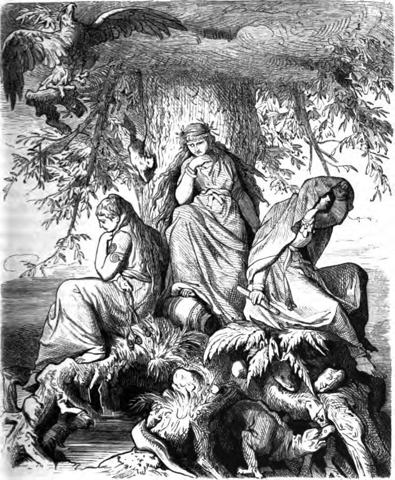
The poem then states the tree's condition plainly: the ash suffers more hardship than anyone knows, with the hart biting above, the trunk rotting at the sides, and Nidhoggr tearing below 2. Against this stands the daily maintenance. Voluspa and Gylfaginning both describe three maidens under the tree — Urd, Verdandi and Skuld, the norns — who draw water from Urd's well and pour it with the white clay of the bank over the branches, so that its limbs will not rot or wither. The water is so holy that everything touching it turns white as an eggshell, and dew falls from it into the valleys as honeydew 1,4.
The tree is therefore not simply a piece of scenery. It is a structure under continuous attack and continuous repair, and the weave of fate is what keeps it upright 5,7.
The Axis of the Nine Worlds
Yggdrasil is what makes the Nine Realms one cosmos rather than nine unrelated places. Voluspa opens with the seeress recalling nine worlds and nine wood-dwellings, "the glorious measuring-tree, below the earth", and Snorri arranges the realms around the trunk and along the roots: Asgard above, Midgard in the middle ring, Jotunheim outside it, the misty and fiery regions at the extremes 1,4,8. The tree's branches spread over the whole world and reach above heaven 4.
Scholars describe this as an axis mundi, the vertical pole around which a mythological world organises itself — a pattern found across Eurasia, from Siberian shamanic tradition to Indian cosmology 5,6. The Norse version has an unusual emphasis. The vertical axis is also a legal one: the gods' daily assembly sits at the root, at a well, and the well is named for a norn whose name means "that which has come to pass". Judgement, memory and fate are all located at the tree's base 5,7.
There is a real-world echo. Adam of Bremen, describing the temple at Uppsala in the 1070s, wrote of a great evergreen tree of unknown species standing beside it, and a spring where sacrifices were drowned. Whether he was reporting a cult practice or working from the same literary tradition is debated, but Scandinavian farms kept guardian trees into modern times 5,6.
Ragnarok and What Survives
At the end, the tree shakes. Voluspa has the old ash groaning as the fires rise and the giant comes loose, and the sound of the world tree in distress is one of the signals that Ragnarok has begun 1,8.
But it is not consumed. Snorri records that two human beings, Lif and Lifthrasir, shelter through the fire in a place called Hoddmimis holt — Mimir's grove, which most readers take to be the tree itself — living on the morning dew and repopulating the world afterwards 4,5. When the earth rises green from the sea and the surviving gods gather again, the tree that everything was hung on has quietly outlasted everyone who hung there.
That is the argument of Yggdrasil in a sentence. Gods die, wolves get loose, the sky burns — and the structure holding it all together is a tree that has been dying the entire time and never quite does 5,7.
Continue Exploring
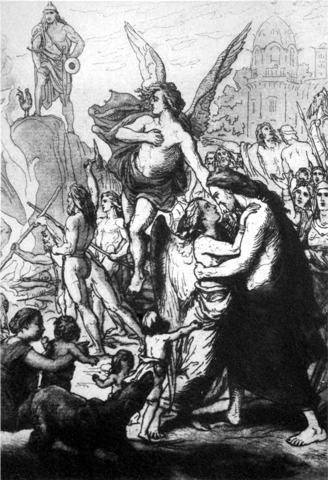
The stronghold of the AEsir. A walled citadel of halls at the top of the world tree, reached by the rainbow bridge and built on a bargain the gods broke.
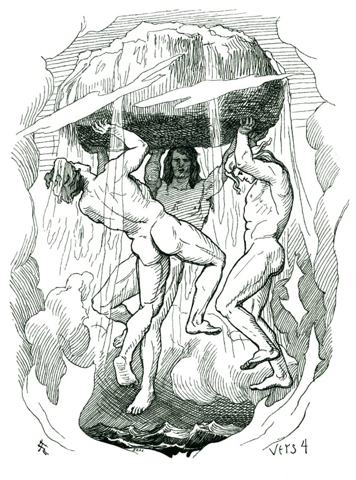
The middle enclosure. The human world, built from a murdered giant's body, fenced by his eyebrows, and ringed by a serpent that will one day let go of its tail.
Gnawer of roots. The dragon chewing the world tree from below, feeding on oath-breakers, and flying up out of the dark in the last stanza of Voluspa.
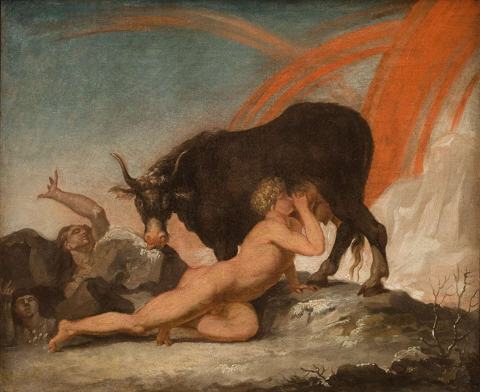
The primordial realm of frost and mist in the north — and, in Snorri's telling, confused ever after with the realm of Hel.
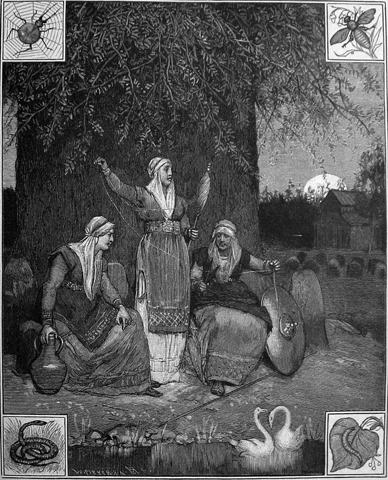
Urd, Verdandi and Skuld, the three women who tend Yggdrasil's well and lay down the fates of gods and men — plus the lesser norns who visit every birth.
The Worlds of Yggdrasil. Norse sources count nine worlds on the world tree — but no medieval text ever lists them, and the familiar roster is modern.
Also mentioned inBifrost (The Rainbow Bridge)BragiHeimdall (Heimdallr)HelHuginn and MuninnMimirOdinSleipnirThe RunesUllrWyrd
Sources & Further Reading
- 1.Poetic Edda — Voluspa (Codex Regius, 13th century).
- 2.Poetic Edda — Grimnismal (Codex Regius, 13th century).
- 3.Poetic Edda — Havamal (Codex Regius, 13th century).
- 4.Snorri Sturluson, Prose Edda — Gylfaginning (c. 1220).
- 5.Lindow, John. Norse Mythology — A Guide to the Gods, Heroes, Rituals, and Beliefs. Oxford University Press, 2001.
- 6.Simek, Rudolf. Dictionary of Northern Mythology. Trans. Angela Hall. D.S. Brewer, 1993.
- 7.Clunies Ross, Margaret. Prolonged Echoes — Old Norse Myths in Medieval Northern Society, vol. 1: The Myths. The Viking Collection 7. Odense University Press, 1994.
- 8.Larrington, Carolyne (trans.). The Poetic Edda. Rev. ed., Oxford World's Classics, 2014.
Spot an error or have a source to suggest? Write to info@viseterna.com. We cite primary sources and modern scholarship, and we correct fast.