
The Poetic Edda
Anonymous Old Norse poems on gods and heroes, preserved in one 13th-century manuscript — the primary source for most of what survives of Norse myth.
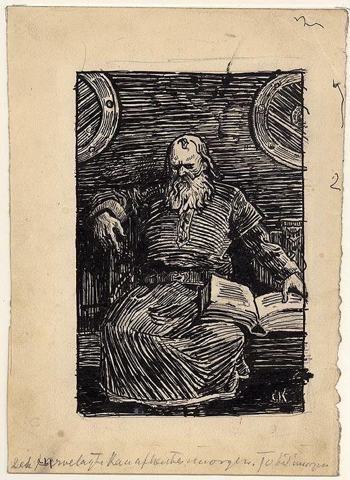
Portrait of Brynjolfur Sveinsson, unknown artist · Public domain · source
What the Poetic Edda Is
The Poetic Edda — also called the Elder Edda to separate it from Snorri Sturluson's Prose Edda — is a collection of roughly thirty anonymous Old Norse poems, composed in alliterative verse rather than end-rhyme, that together form the single most important surviving source for Norse mythology 1,6. Most of what a modern reader knows about Odin's ordeal on the world tree, the binding of Fenrir, or the shape of Ragnarok descends from these poems, either directly or through Snorri's later paraphrase of them 1,3.
No one poet wrote it, and no medieval Icelander called it "the Poetic Edda" — the name is an 18th-century scholarly convention. What survives is a manuscript anthology: an unknown compiler, working in Iceland around 1270, gathered poems of very different ages and outlooks — some plainly pagan, some composed by Christian Icelanders remembering a pagan past — into a single book, now called the Codex Regius 1,7. How old the individual poems are, versus the book that finally wrote them down, is one of the field's longest-running arguments, and it is worth separating from the question of what they contain.
The Manuscript's Journey
That book, catalogued today as GKS 2365 4to and written by a single scribal hand on 45 leaves of vellum, disappears from the historical record for roughly four centuries after its composition 1. It resurfaces in 1643, in the possession of Brynjolfur Sveinsson, the bishop of Skalholt, who recognised it as a companion to the Edda of Snorri Sturluson he already owned and concluded — wrongly, as later scholarship established, but influentially — that it was the work of the 12th-century priest Saemundr the Wise 1,6. That misattribution is why some 19th-century editions still call it the Saemundar Edda.
Brynjolfur sent the manuscript to King Frederik III of Denmark as a gift, and it spent the next three centuries in the Royal Library in Copenhagen, acquiring its Latin name, Codex Regius, "the King's Book", along the way 1. It came home in 1971, part of a negotiated transfer of medieval Icelandic manuscripts from Denmark to Iceland that Icelanders had campaigned for since independence; the ship carrying it received a naval escort, and it is now held at the Arni Magnusson Institute in Reykjavik 1.
What It Contains
The Codex Regius divides cleanly into two halves. The first collects mythological poems: Voluspa, a seeress's vision of the world's creation and its end at Ragnarok; Havamal, a compendium of proverbial wisdom attributed to Odin that includes his self-sacrifice on the tree; Grimnismal, Vafthrudnismal, Skirnismal, Lokasenna and several shorter pieces that between them supply most of what is known about Thor, Freyr, the Valkyries and the structure of the Nine Realms 1,3,6.
The second half turns to heroic legend: the Helgi poems, and then the long, interlocking tragedy of the Volsung and Niflung families — Sigurd, the dragon Fafnir, Brynhild, and Gudrun's revenges — material that also underlies the Nibelungenlied and, much later, Wagner's Ring 1,7. A handful of leaves are missing from the middle of the manuscript, tearing a gap through the Sigurd material that other, later texts partly fill 1.
Beyond the Codex Regius
Not every eddic poem survives in the Codex Regius. Snorri quotes stanzas in his own Edda from poems the Regius does not contain at all, and other eddic-style poems — Baldrs draumar, Rigsthula, Hyndluljod, Svipdagsmal — are preserved only in later paper manuscripts or scattered among sagas 3,6. Scholars group all of this material, Regius and non-Regius alike, under the modern label "eddic poetry", as distinct from the more ornate, individually attributed court poetry called skaldic verse 6,7.
This is also the most reliable way to keep the Poetic and Prose Edda straight, since visitors often conflate them: the Poetic Edda is the older, anonymous raw material, while Snorri's Prose Edda is a 13th-century handbook that explains and quotes from poems very like these ones, sometimes citing the Regius poems directly and sometimes preserving stanzas found nowhere else 3,7.
Translations and Rediscovery
European scholars rediscovered the Poetic Edda in the wake of Romantic nationalism, and its 19th-century reception did as much to shape modern ideas about the Vikings as the medieval text itself. English translation began in earnest with Henry Adams Bellows's 1923 edition for the American-Scandinavian Foundation, still in print and widely read for its extensive notes 2. Later scholarly translations by Ursula Dronke and Andy Orchard aimed for closer philological accuracy, while Carolyne Larrington's Oxford World's Classics version, first published in 1996 and revised in 2014, is now the standard English text for general readers and students alike 3,4,5.
Dating and the Christian Question
The central scholarly debate is not whether the poems are old — clearly some material is — but how old, and how much each poem has been reshaped by the Christian culture that finally wrote it down. Voluspa has been dated anywhere from the late 10th century to the Christian 13th, and arguments turn on details as small as a single borrowed image from the Book of Revelation 4,6. Other poems, such as Rigsthula, show signs of being considerably later compositions dressed in an archaic style, deliberately imitating older verse 6,7. None of this makes the collection less valuable; it means every poem has to be read as a specific, datable act of memory and reinterpretation, not as a single frozen transcript of pre-Christian belief 6,7.
Continue Exploring
Snorri Sturluson's 13th-century handbook of Norse myth and poetics, in four parts — the fullest surviving guide to the gods, written to keep old poetry legible.
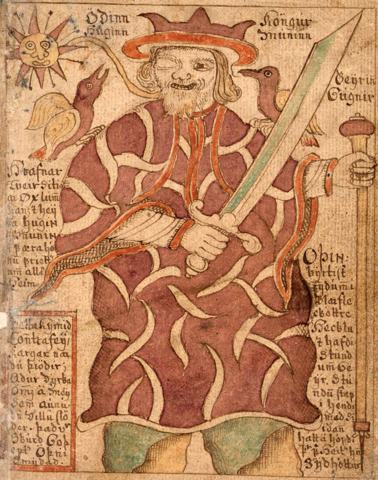
The Allfather. God of war, poetry and the dead who traded an eye for wisdom and hanged himself on the world tree to win the runes.
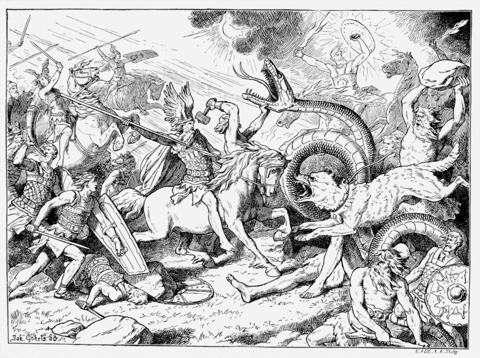
The Twilight of the Gods. The prophesied end: a killing winter, the breaking of every bond, a battle no one survives — and an earth that rises again.
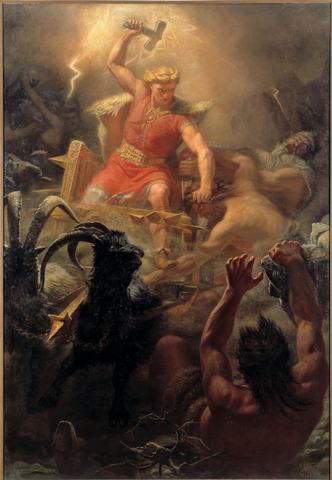
God of Thunder. Son of Odin and the earth, wielder of Mjolnir, and the gods' front line against the giants — fated to fall with the World Serpent.
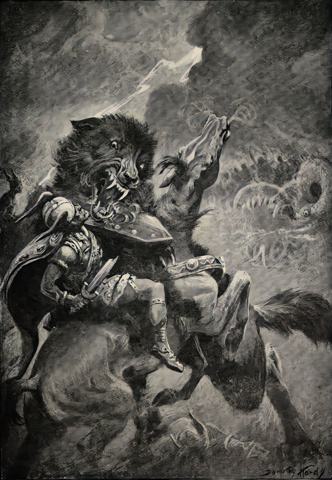
The Bound Wolf. Loki's son, raised among the gods and chained by a trick that cost Tyr his hand — until Ragnarok, when he devours Odin.
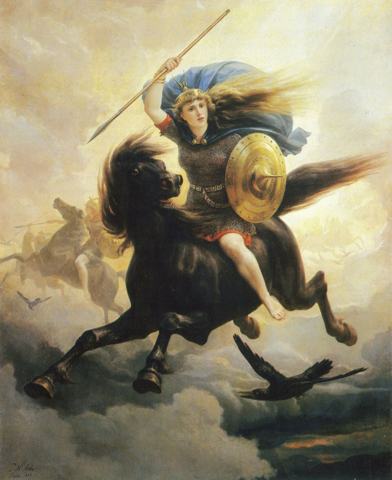
Choosers of the Slain. Odin's riders who decide who dies in battle and carry the chosen to Valhalla — battlefield spirits before they were shieldmaidens.
Sources & Further Reading
- 1.Poetic Edda — Codex Regius, GKS 2365 4to (Iceland, c. 1270).
- 2.Bellows, Henry Adams, trans. The Poetic Edda. American-Scandinavian Foundation, 1923.
- 3.Larrington, Carolyne, trans. The Poetic Edda. Rev. ed., Oxford World's Classics, 2014.
- 4.Dronke, Ursula, ed. and trans. The Poetic Edda, Volume II: Mythological Poems. Oxford University Press, 1997.
- 5.Orchard, Andy, trans. The Elder Edda: A Book of Viking Lore. Penguin Classics, 2011.
- 6.Quinn, Judy. "Eddic Poetry." In A Companion to Old Norse-Icelandic Literature and Culture, edited by Rory McTurk. Blackwell, 2005.
- 7.Clunies Ross, Margaret. A History of Old Norse Poetry and Poetics. D.S. Brewer, 2005.
Spot an error or have a source to suggest? Write to info@viseterna.com. We cite primary sources and modern scholarship, and we correct fast.