
The Runes
The runic alphabets of the Germanic world, won by Odin on the tree in Havamal — a real writing system long before it became a modern divination kit.
Gold bracteate from the Vadstena area, Sweden, Migration Period (5th-6th century); photograph by Ulf Bruxe, 1993 (Swedish History Museum) · CC BY-SA 2.5 · source
Odin's Price
The Norse myth of the runes' origin is also one of the strangest self-sacrifice stories in the corpus. In Havamal, Odin says he hung nine full nights on a windswept tree, wounded by his own spear, given to himself — "a sacrifice to Odin, myself to myself" — with no food, no drink, and no one to help him. No one, he says, knew what roots that tree ran to. Only at the end, screaming, did he see the runes below him, take them up, and fall back down 1,7.
The poem does not name the tree, though tradition has long identified it with Yggdrasil, and it presents the runes as knowledge that has to be paid for rather than knowledge that is simply given — consistent with the rest of Odin's career, in which an eye buys a drink from Mimir's well and wisdom always costs something physical 1.
Sigrdrifumal's Catalogue
A second Eddic poem treats runes as a practical, teachable craft rather than a single mystical event. In Sigrdrifumal, the valkyrie Sigrdrifa, woken by the hero Sigurd, instructs him in categories of runes for specific purposes — victory-runes cut on a sword, ale-runes to guard against a treacherous drink, birth-runes to ease labour, speech-runes for the assembly, and more — and lists the surfaces on which the great runes were once carved: a bear's paw, a wolf's claw, an eagle's beak, a bridge's end, Bragi's tongue, and the point of Gungnir itself 2. The poem imagines runic knowledge as something transmitted and applied, closer to a craft manual than to Odin's solitary ordeal.
This applied, purpose-built quality recurs across the corpus: Tyr has victory-runes named for him and carved on sword hilts, and Sigrdrifumal has runes carved even into Sleipnir's teeth — runic lore attaches itself to nearly every powerful object in the mythology 2.
What the Elder Futhark Actually Is
Set beside the myth, the historical picture is more modest and, in its own way, more remarkable. The Elder Futhark — named for its first six letters, f, u, þ, a, r, k — is a twenty-four-character alphabet used across the Germanic-speaking world from roughly the second century CE, with the earliest securely dated inscriptions appearing on combs, brooches and weapons rather than monuments 4,6. It was a working script for ordinary purposes — naming an owner, marking a maker, commemorating a death — centuries before any surviving text describes Odin discovering it 4,6.
Around the seventh and eighth centuries the script diverged. Scandinavia simplified it down to the sixteen-character Younger Futhark, even as spoken Old Norse grew more complex — a puzzling reduction runologists still debate the reasons for — while Anglo-Saxon England expanded its version into a larger Futhorc to cover new sounds in Old English 4,6. Barnes stresses that runes were never a secret priestly script confined to ritual specialists; the surviving corpus is overwhelmingly ordinary, public, and legible to anyone who could read 4.
Memorial, Magic, and the Objects That Carry Both
The single largest category of surviving runic writing is not spellcraft but memorial: thousands of raised stones across Scandinavia, especially from the Viking Age, commemorate the dead in short formulaic inscriptions naming who raised the stone and for whom 6. Alongside that overwhelmingly practical record sits a genuine tradition of charm and amulet inscriptions — protective or curative formulas cut into small portable objects, including gold bracteates like the one pictured here, pendants stamped with a figure and ringed with runes that late Migration Period Scandinavians wore rather than read as literature 5. MacLeod and Mees catalogue this material carefully, and caution that "magical" is a modern label applied to a real but a minority use of a script whose everyday job was closer to a signature than a spell 5.
Modern Divination Is Modern
It is worth being direct about the gap between this record and rune divination as it is popularly practised today. The one classical hint of Germanic lot-casting comes from Tacitus, writing around 98 CE, who describes marked strips cut from a fruit-bearing tree, scattered on a cloth and drawn at random — a passage often cited as evidence for rune divination, though Tacitus never uses the word "rune," his account predates the Elder Futhark's likely development, and nothing ties his marked strips to the alphabet that later emerged 3,4.
No medieval Norse source describes anything resembling the modern practice of drawing individual rune-staves from a bag for personal guidance. That system, now widespread, descends largely from nineteenth- and twentieth-century esoteric revival movements and twentieth-century popularisations rather than from an unbroken Viking Age practice, and treating it as ancient in origin is exactly the kind of honest gap this Codex tries not to paper over 4,5. The historical runes were a writing system first — used for names, ownership, memory and the occasional charm — and the fortune-telling kit is a modern invention wearing a very old alphabet.
Continue Exploring
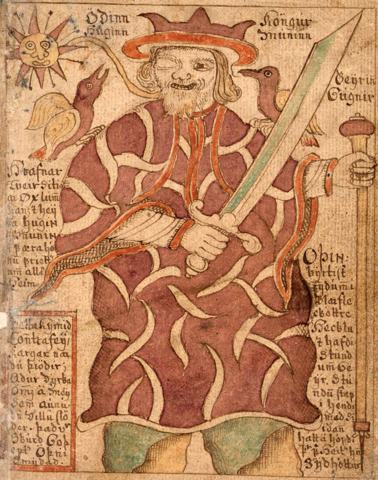
The Allfather. God of war, poetry and the dead who traded an eye for wisdom and hanged himself on the world tree to win the runes.
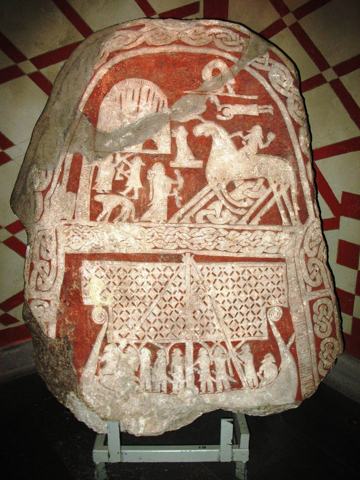
The grey eight-legged horse Loki bore as a mare. Best of all steeds, Odin's mount between the worlds, and the only horse to jump the gate of Hel.
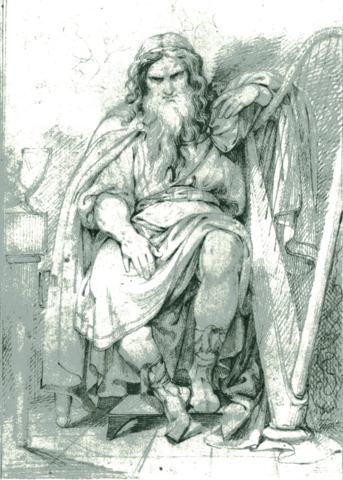
Norse god of poetry and eloquence, husband of Idunn, who greets fallen kings at Valhalla's door and may have begun as a real ninth-century skald.
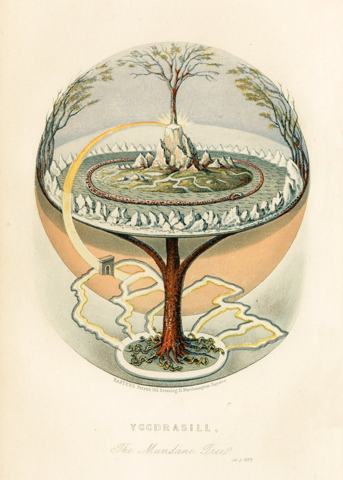
The World Tree. The great ash whose roots reach three wells and nine worlds, tended by the norns, eaten from every side, and still standing when the sky burns.
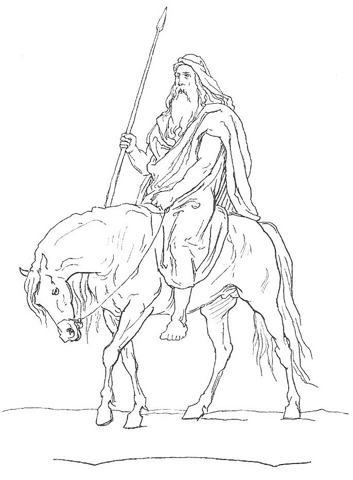
Odin's spear. Dwarf-made, rune-carved, and thrown over an army to hand it to the god of the hanged — the weapon that starts the first war in the world.
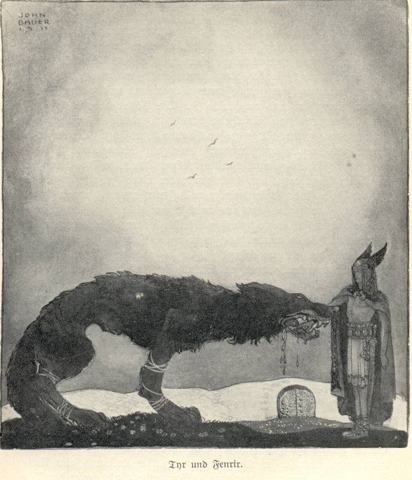
God of Sacred Law. Once perhaps the sky-father of the north, remembered chiefly for putting his sword hand into a wolf's mouth and losing it.
Sources & Further Reading
- 1.Poetic Edda — Havamal (Codex Regius, 13th century).
- 2.Poetic Edda — Sigrdrifumal (Codex Regius, 13th century).
- 3.Tacitus. Germania, ch. 10 (c. 98 CE).
- 4.Barnes, Michael P. Runes. Boydell Press, 2012.
- 5.MacLeod, Mindy & Bernard Mees. Runic Amulets and Magic Objects. Boydell Press, 2006.
- 6.Spurkland, Terje. Norwegian Runes and Runic Inscriptions. Trans. Betsy van der Hoek. Boydell Press, 2005.
- 7.Larrington, Carolyne (trans.). The Poetic Edda. Rev. ed., Oxford World's Classics, 2014.
Spot an error or have a source to suggest? Write to info@viseterna.com. We cite primary sources and modern scholarship, and we correct fast.