
Tyr
God of Sacred Law. Once perhaps the sky-father of the north, remembered chiefly for putting his sword hand into a wolf's mouth and losing it.
Tyr and Fenrir, John Bauer, 1911 · Public domain · source
A God Older Than His Stories
Tyr's name is the oldest thing about him. It descends from Proto-Germanic Tiwaz, and behind that from the Indo-European dyeus, the same root that produced Greek Zeus, Latin Iuppiter and deus, and Sanskrit Dyaus 5,6. In the other branches of the family that word names the chief sky-god. In Norse it names a one-handed god who has been comprehensively overtaken by Odin, and whose name has additionally decayed into a common noun — tyr can simply mean "god" in poetic compounds 4,5.
The usual reconstruction is that Tyr was once far more important than the surviving Icelandic literature makes him: a sky-father and guarantor of order, displaced in the mythology of the Viking Age by Odin's rise 5,6,7. The external evidence supports it. Tacitus reports that the Germanic peoples honoured a god the Romans identified with Mars, and a group of third-century altars from Housesteads on Hadrian's Wall, dedicated by Frisian soldiers, name Mars Thingsus — Mars of the assembly, a war god attached to the legal gathering 3,5,6. Tuesday, Old English Tiwesdaeg, still carries his name where Latin had the day of Mars 5.
That epithet is the key to him. Tyr's domain is not battle in the abstract but the lawful, sworn, publicly agreed side of it — the assembly, the oath, the settlement, and the war that a community has properly declared 4,6,7.
The Binding of Fenrir
Everything above is inference. The one full story Norse literature tells about Tyr is the binding of Fenrir, and it is exactly the story you would want about a god of oaths.
The Aesir raised Loki's wolf in Asgard, and as he grew only Tyr had the nerve to feed him 1. When the gods decided he had to be chained, they made it a contest of strength and let him break two fetters for his own glory. Then they produced Gleipnir, the dwarf-made ribbon, and Fenrir — who could see perfectly well that a ribbon that thin was not there for the reason they claimed — refused unless one of them laid a hand in his jaws as a pledge.
Tyr did it, knowing what a pledge given in bad faith is worth. The wolf could not break Gleipnir, the gods laughed, and Fenrir bit the hand off at the wrist 1. Snorri notes that Tyr is therefore not called a reconciler of men — the god of sworn agreements is the one who broke one, and lost his sword hand for it 1,4.
The episode is a genuine ethical knot rather than a heroic set-piece. The world is preserved by an act that damages the very thing that makes it worth preserving, and the cost falls on the god least willing to shift it onto anyone else 4,6.
Inconsistencies in the Sources
Tyr is treated inconsistently by the two Eddas. Snorri makes him a son of Odin and calls him the boldest of the gods, saying men speak of a brave man as "tyr-brave" 1. The poem Hymiskvida, by contrast, has Thor travel with Tyr to the hall of the giant Hymir, who is Tyr's father — placing him among the giants rather than the Aesir 2. In Lokasenna, Loki taunts him with both his missing hand and a claim about his wife, and Tyr answers without much to work with 2.
Such contradictions are normal in the corpus, and here they probably record a figure whose place in the family tree had stopped being important long before anyone wrote it down 4,5.
Runes and Victory
The rune t is named after him — Tiwaz in the elder futhark, Tyr in the younger — and drawn as an upward-pointing arrow. Sigrdrifumal gives the practical instruction: carve victory runes on your sword's hilt and blade, name Tyr twice, and you will have what you asked for 2,5.
Runic inscriptions with repeated t-runes have been recovered from weapons and other objects, which is about as close as this material comes to corroborating a poem with an artefact 5,6.
At the World's End
At Ragnarok Tyr does not face Fenrir. Snorri sends him against Garmr, the hound bound at the cave-mouth Gnipahellir, and the two kill each other 1. It is a small, symmetrical ending for a god whose defining act was already spent: he goes to a different dog, one no one has any illusions about, and finishes the job properly.
Continue Exploring
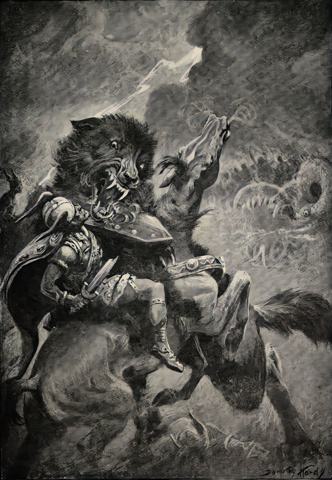
The Bound Wolf. Loki's son, raised among the gods and chained by a trick that cost Tyr his hand — until Ragnarok, when he devours Odin.
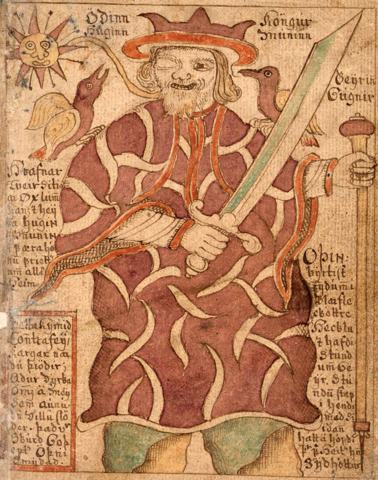
The Allfather. God of war, poetry and the dead who traded an eye for wisdom and hanged himself on the world tree to win the runes.
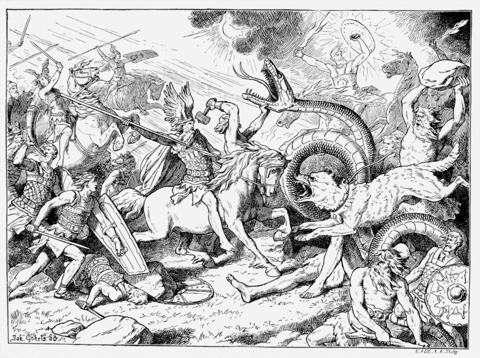
The Twilight of the Gods. The prophesied end: a killing winter, the breaking of every bond, a battle no one survives — and an earth that rises again.
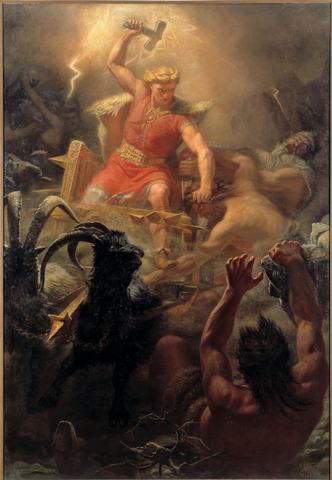
God of Thunder. Son of Odin and the earth, wielder of Mjolnir, and the gods' front line against the giants — fated to fall with the World Serpent.
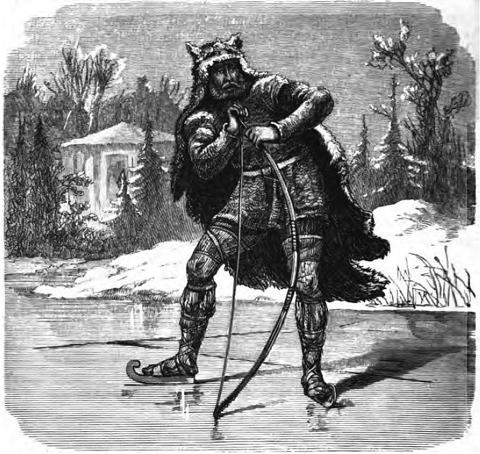
The Norse god of the bow, the ski and the shield. Almost no myth about him survives, yet place-names suggest he was once worshipped everywhere.
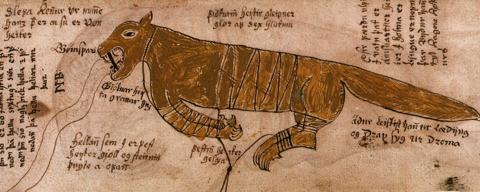
The binding ribbon. A silk-soft cord spun from six impossible things — the only fetter that ever held Fenrir, and it cost Tyr his sword-hand to fasten.
Also mentioned inAegir and RanThe Aesir-Vanir WarThe Runes
Sources & Further Reading
- 1.Snorri Sturluson, Prose Edda — Gylfaginning (c. 1220).
- 2.Poetic Edda — Lokasenna, Hymiskvida and Sigrdrifumal (Codex Regius, 13th century).
- 3.Tacitus, Germania (c. 98 CE).
- 4.Lindow, John. Norse Mythology — A Guide to the Gods, Heroes, Rituals, and Beliefs. Oxford University Press, 2001.
- 5.Simek, Rudolf. Dictionary of Northern Mythology. Trans. Angela Hall. D.S. Brewer, 1993.
- 6.Turville-Petre, E.O.G. Myth and Religion of the North — The Religion of Ancient Scandinavia. Weidenfeld & Nicolson, 1964.
- 7.Davidson, H.R. Ellis. Gods and Myths of Northern Europe. Penguin, 1964.
Spot an error or have a source to suggest? Write to info@viseterna.com. We cite primary sources and modern scholarship, and we correct fast.