
Hel
Queen of the Dead. Half living woman and half corpse, Loki's daughter rules the cold realm where those who die of sickness and age must go.
Hermod before Hela, John Charles Dollman, 1909 · Public domain · source
The Place and the Person
The Old Norse word hel means a concealed or covered place, and it is the direct ancestor of the English word hell — though the Norse original carries none of the fire or the punishment 5,7. It names a location first. Only in the later mythological writing does that location acquire a queen with the same name, and most scholars read Hel-the-person as a personification of Hel-the-place rather than the other way round 4,5.
The evidence supports the caution. Old poetry uses hel freely as a place or a state — to "go to Hel" is simply to die — while the vivid portrait of a ruling goddess is concentrated in Snorri, writing in the thirteenth century for an audience that had been Christian for two hundred years 4,6.
Daughter of Loki
In Snorri's account Hel is one of three children Loki fathered on the giantess Angrboda, alongside the wolf Fenrir and the World Serpent Jormungandr 1. When Odin learned what the three were prophesied to do, he dealt with each in turn: the serpent into the ocean, the wolf into chains, and Hel down into Niflheim — where he gave her authority over the ninth world and the power to allot lodging to everyone sent to her.
The relationship was fixed enough to be usable as poetic shorthand: Snorri's guide to skaldic diction instructs poets that Loki may be named "father of the Midgard Serpent, of the wolf and of Hel", and that Hel herself can be called the sister of the wolf 3.
Her appearance is the single most memorable image Snorri produces. She is half a living woman and half a corpse, black or blue-black down one side and ordinary flesh down the other, with a face grim and downcast 1. Her household is described entirely in nouns that are also words for suffering: the hall Eljudnir, "storm-battered"; the dish Hunger; the knife Famine; the bed Sick-bed and its hangings Glimmering Misfortune; servants named Slow-Walker; and a threshold called Stumbling-Block 1. The joke, if it is one, is bleak and completely consistent.
Who Goes There
The division of the dead in Norse tradition is often flattened into a simple opposition — glorious warriors to Valhalla, everyone else to Hel — and that is roughly Snorri's scheme: those who die of sickness or old age go down, while Odin and Freyja split the battle-slain between them 1,2.
The older material is less tidy. Poems and sagas send plenty of people to Hel who died violently, treat it as the general destination of the dead, and elsewhere describe burial mounds, undersea halls and family afterlives that fit no single system at all 4,6. Archaeology agrees: Viking Age burial practice varies enormously by region and period, and the neat two-door afterlife is best understood as a literary tidying-up rather than a creed anyone held 4,6,7.
Hel's realm is reached by a long road downward and northward, across the river Gjoll on a bridge roofed in gold and kept by a watcher named Modgudr, to a gate that will not open for the living 1.
Hel and Baldr
Hel's one real scene is the best story in Norse mythology. When Baldr dies, Odin's son Hermod rides Sleipnir nine nights down the dark valleys, jumps the gate, and finds Baldr already seated in the place of honour in Hel's hall 1,2.
Hel does not refuse. She sets a condition instead: if every single thing in the world, living and dead, weeps for Baldr, she will let him go. Messengers fan out, and everything weeps — people, animals, earth, stones, trees, metal — except one giantess sitting in a cave, who says she will weep dry tears and that Hel may keep what she has. Snorri notes that most believe this was Loki 1.
It is a test she was always going to win, and she gives nothing away in winning it. The gods get to fail at their own terms rather than hers.
At the World's End
At Ragnarok the dead go to war. The ship Naglfar, built from the untrimmed fingernails of corpses, sails with Hel's people aboard and Loki at the tiller, arriving on the plain of Vigrid against the gods 1,2. Hel herself does not fight a named duel — she is a keeper rather than a combatant, and what she contributes is everyone she has been keeping.
Reading Hel
Simek and Lindow both stress how thin the pre-Christian evidence for the goddess is, and how heavily her portrait may be coloured by medieval Christian imagery of the underworld and its ruler 4,5. That does not make her uninteresting; it makes her a genuine record of what a thirteenth-century Icelandic writer thought the old death-realm had been. What survives underneath, in the older poems, is starker and probably older: not a queen, not a judgement, just a covered place under the roots of Yggdrasil that everything eventually goes into 4,6,7.
Continue Exploring
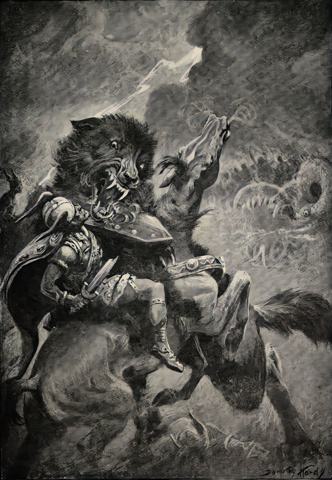
The Bound Wolf. Loki's son, raised among the gods and chained by a trick that cost Tyr his hand — until Ragnarok, when he devours Odin.
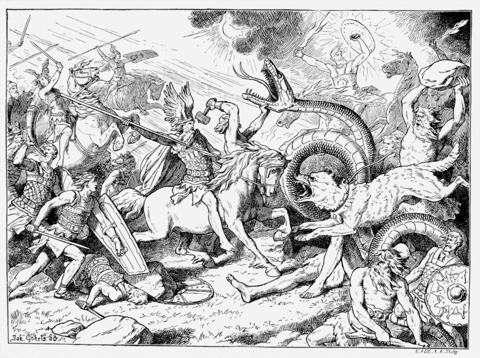
The Twilight of the Gods. The prophesied end: a killing winter, the breaking of every bond, a battle no one survives — and an earth that rises again.
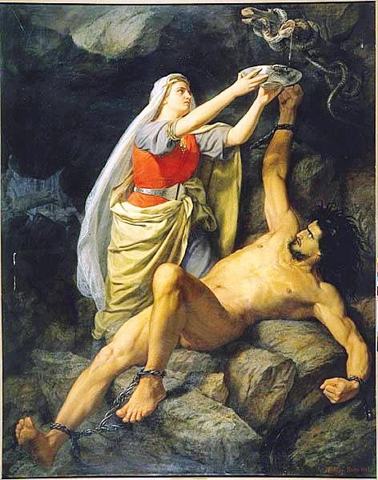
The Trickster. Shape-shifter of giant blood counted among the gods — their cleverest ally, the father of monsters, and the spark of Ragnarok.
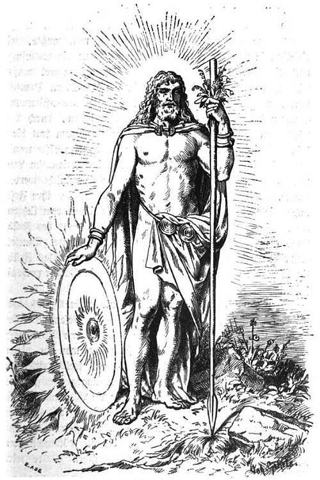
God of Light. The most beloved of the Aesir, made immune to all harm but one plant — and killed by it, which set the world's ending in motion.
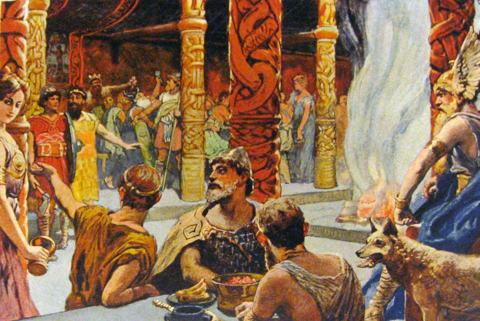
Hall of the Slain. Odin's roof of shields where the chosen dead feast, fight, and are healed each night — an army kept in reserve for Ragnarok.
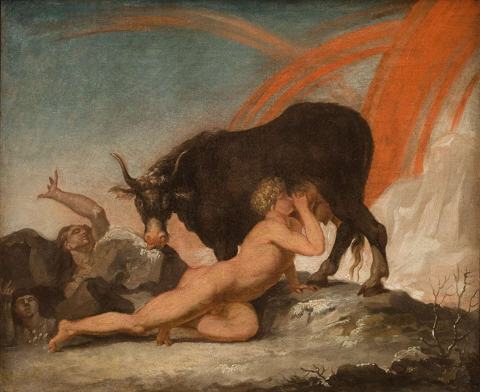
The primordial realm of frost and mist in the north — and, in Snorri's telling, confused ever after with the realm of Hel.
Also mentioned inDraugr (Norse Undead)GleipnirHelheimNidhoggrSleipnirThe Death of BaldrThe Nine Realms
Sources & Further Reading
- 1.Snorri Sturluson, Prose Edda — Gylfaginning (c. 1220).
- 2.Poetic Edda — Voluspa, Grimnismal, Baldrs draumar and Vafthrudnismal (Codex Regius, 13th century).
- 3.Snorri Sturluson, Prose Edda — Skaldskaparmal (c. 1220).
- 4.Lindow, John. Norse Mythology — A Guide to the Gods, Heroes, Rituals, and Beliefs. Oxford University Press, 2001.
- 5.Simek, Rudolf. Dictionary of Northern Mythology. Trans. Angela Hall. D.S. Brewer, 1993.
- 6.Turville-Petre, E.O.G. Myth and Religion of the North — The Religion of Ancient Scandinavia. Weidenfeld & Nicolson, 1964.
- 7.Orchard, Andy. Cassell's Dictionary of Norse Myth and Legend. Cassell, 1997.
Spot an error or have a source to suggest? Write to info@viseterna.com. We cite primary sources and modern scholarship, and we correct fast.