
The Prose Edda
Snorri Sturluson's 13th-century handbook of Norse myth and poetics, in four parts — the fullest surviving guide to the gods, written to keep old poetry legible.
Snorre Sturlason, Christian Krohg, 1899 (National Museum of Art, Architecture and Design, Oslo) · Public domain · source
Snorri's Handbook
The Prose Edda is a 13th-century Icelandic textbook of mythology and poetic craft, written to explain the old gods and the elaborate verse-language that depended on knowing their stories 1,6. It is the fullest connected account of Norse mythology that survives anywhere — more systematic than the Poetic Edda's loose collection of individual poems — because that was exactly its purpose: not scripture, but a reference manual 6,7.
Its author, named in the earliest manuscript that gives one, was Snorri Sturluson (1179-1241), an Icelandic chieftain, twice lawspeaker of the Althing, and one of the wealthiest men in the country, who also wrote the kings' sagas of Heimskringla 2,7. He composed the Edda around 1220, a generation or more after Iceland's conversion to Christianity had already broken the living chain of belief that once made the old references self-explanatory 6,7.
The Four Parts
The book has four sections, read in order. The Prologue is a euhemerised Christian preface, tracing the Aesir back to human refugees from Troy — Odin reimagined as a great king migrating north — a framework that let a Christian audience read what follows as history and poetic memory rather than heresy 1,6.
Gylfaginning, "the Tricking of Gylfi", is the mythology proper: a Swedish king named Gylfi travels to Asgard in disguise and interrogates three enthroned figures, who answer with the creation of the world, the doings of the gods, and the coming of Ragnarok, before the whole hall vanishes and Gylfi finds himself alone on open ground 1. Most popular retellings of Norse myth are, in practice, retellings of Gylfaginning 6.
Skaldskaparmal, "the Language of Poetry", is longer still: a dialogue between the sea-giant Aegir and the god Bragi, working through the kennings — the riddling compound epithets, such as calling gold "Freyja's tears" or the sea "Aegir's fire" — that skaldic poets used, and the myths that explain where each one comes from 1,6. Hattatal, "the Tally of Metres", closes the book with a poem Snorri composed himself in praise of King Hakon Hakonarson and Jarl Skuli, illustrating over a hundred verse-forms with his own running commentary on how each one works 1,7.
Surviving Manuscripts
No copy in Snorri's own hand survives. The work is known from four medieval manuscripts, each slightly different, which is normal for hand-copied texts and part of why editors argue about small points of wording 2,5. The Codex Regius (GKS 2367 4to, early 14th century) is the most complete and forms the base text of most modern editions; the Codex Upsaliensis (DG 11 4to, Uppsala University Library) is somewhat older, dated to around 1300-1325, and carries a short preface, absent from the other copies, that names Snorri Sturluson directly as the compiler 2,5. The Codex Wormianus (mid-14th century) and the Codex Trajectinus, a Dutch copy made around 1600 from a lost 13th-century original, round out the tradition 5,6.
Reliability and Debate
Snorri wrote as a Christian recording a pagan past his own society no longer practised, and scholars read him with that in mind rather than as a neutral transcript. Margaret Clunies Ross has argued that Snorri actively shapes the mythology around a coherent worldview — one where the gods' actions repeatedly defend order against giants and chaos — that may say as much about a 13th-century Icelandic aristocrat's concerns as about actual pre-Christian belief 6. Kevin Wanner reads the whole project as a bid to preserve the cultural capital of skaldic poetry, and Snorri's own status as a master of it, at a Norwegian court increasingly drawn to continental literary fashions 7.
None of that makes Snorri unreliable so much as it makes him an author rather than a scribe. Where his account of a myth can be checked against an independent source — a skaldic stanza, an eddic poem, an image on a picture-stone — it generally holds up in outline, even when he is clearly smoothing over contradictions the older material still preserves 1,6,7. Where no check is available, as with parts of Gylfaginning that quote no known poem, caution is the right default 6.
What Depends on It
A large share of the Codex on this site rests on Snorri, directly or at one remove. The stories of Thor's duels, Loki's schemes, the binding of Fenrir, and the making of treasures such as Mjolnir survive in their fullest narrative form only in Gylfaginning and Skaldskaparmal, even where an eddic poem confirms the outline 1,3,4. Reading the Prose and Poetic Eddas side by side, rather than treating either as sufficient alone, is the closest a modern reader can get to seeing where Snorri is transmitting and where he is interpreting.
Continue Exploring
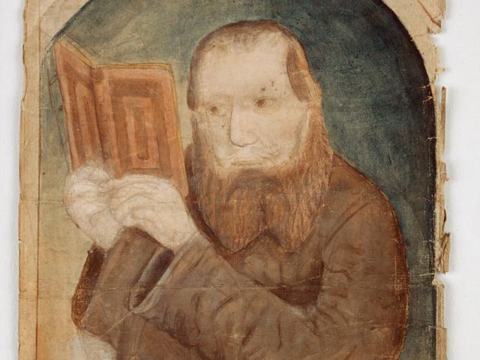
Anonymous Old Norse poems on gods and heroes, preserved in one 13th-century manuscript — the primary source for most of what survives of Norse myth.
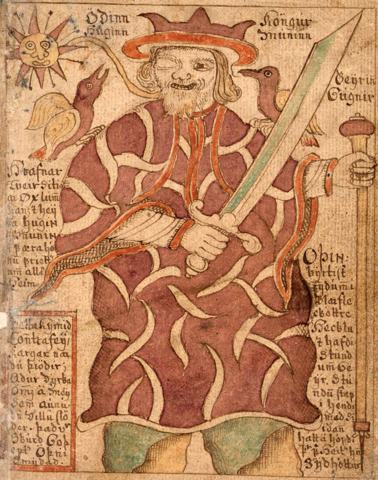
The Allfather. God of war, poetry and the dead who traded an eye for wisdom and hanged himself on the world tree to win the runes.
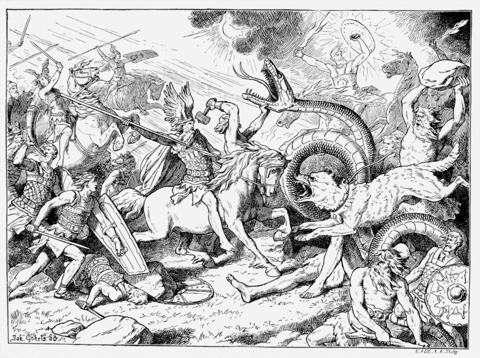
The Twilight of the Gods. The prophesied end: a killing winter, the breaking of every bond, a battle no one survives — and an earth that rises again.
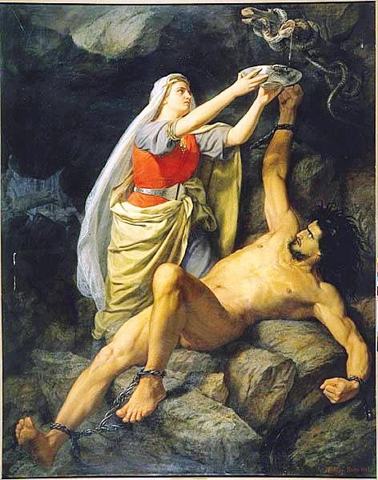
The Trickster. Shape-shifter of giant blood counted among the gods — their cleverest ally, the father of monsters, and the spark of Ragnarok.
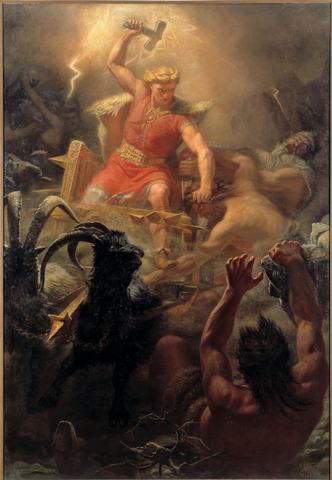
God of Thunder. Son of Odin and the earth, wielder of Mjolnir, and the gods' front line against the giants — fated to fall with the World Serpent.
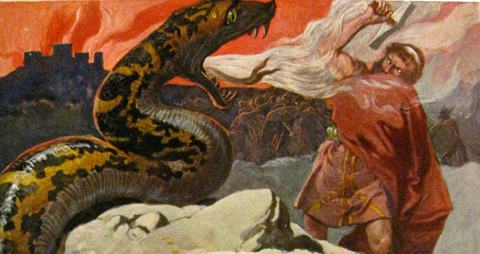
Hammer of Thor. Dwarf-forged, short in the handle, it strikes like lightning, hallows oaths and the dead, and always returns to the hand that throws it.
Also mentioned inBaldr
Sources & Further Reading
- 1.Snorri Sturluson, Prose Edda — Prologue, Gylfaginning, Skaldskaparmal and Hattatal (c. 1220).
- 2.Codex Upsaliensis, DG 11 4to (Uppsala University Library, c. 1300-1325).
- 3.Faulkes, Anthony, trans. Edda. Everyman, 1987 (rev. 1995).
- 4.Byock, Jesse L., trans. The Prose Edda. Penguin Classics, 2006.
- 5.Faulkes, Anthony, ed. Snorri Sturluson: Edda — Prologue and Gylfaginning. 2nd ed., Viking Society for Northern Research, 2005.
- 6.Clunies Ross, Margaret. Prolonged Echoes: Old Norse Myths in Medieval Northern Society, Volume 1: The Myths. Odense University Press, 1994.
- 7.Wanner, Kevin J. Snorri Sturluson and the Edda: The Conversion of Cultural Capital in Medieval Scandinavia. University of Toronto Press, 2008.
Spot an error or have a source to suggest? Write to info@viseterna.com. We cite primary sources and modern scholarship, and we correct fast.