
Idunn (Idun)
Norse goddess who guards the apples that keep the gods young. Her abduction by the giant Thjazi ages the whole pantheon and forces Loki to fetch her back.
Idun and the Apples, James Doyle Penrose, 1890 · Public domain · source
The Goddess and Her Box
Idunn — Old Norse Iðunn — has one function in the surviving mythology, and it is load-bearing. Snorri introduces her in Gylfaginning as the wife of Bragi, and says she keeps in her eski, an ashwood casket, the apples the gods eat when they begin to grow old; they eat and become young again, and this will go on until Ragnarok 3. Nothing else in the Norse sources explains how the gods stay young, and nothing else guards it. She is a single point of failure, and the mythology notices.
Her name is usually parsed as ið- (again, anew) plus a root related to unna, "to love" or "to grant" — roughly "the ever-young" or "the rejuvenating one" — but the reading is not certain and several alternatives have been proposed 6,7.
Apples, or Something Else
The apples are the most famous detail and the least secure. Old Norse epli could denote fruit and nuts broadly rather than the apple specifically, and cultivated apples reached Scandinavia comparatively late, which has led scholars to ask whether the fruit in the original myth was something else — hazelnuts have been suggested — or whether the whole motif was reshaped under classical and Christian influence, with the golden apples of the Hesperides and the fruit of Eden both close to hand for a thirteenth-century Icelandic writer 5,6,7.
The oldest source is decisive on the substance of the story if not on the fruit: Haustlong, a ninth-century skaldic poem by Thjodolf of Hvinir, already knows the abduction and calls Idunn the maiden who understood the age-medicine of the gods 2. Whatever the fruit, the function is old.
Thjazi's Abduction
The narrative Snorri tells in Skaldskaparmal, expanding Thjodolf, is the one myth Idunn is at the centre of 4. Odin, Loki and Hoenir are travelling in barren country and kill an ox, but the meat will not cook. An eagle in an oak above them admits to blocking the fire and offers to release it in exchange for his fill of the meat. When he takes more than his share, Loki strikes at him with a pole — and finds that one end sticks fast to the bird and the other to his own hands. The eagle is the giant Thjazi, and he drags Loki over rocks until Loki, arms nearly torn out, swears to deliver Idunn and her apples out of Asgard 4.
Loki keeps the oath. He lures her out of the walls by telling her he has found apples she will think a great treasure, and asking her to bring her own for comparison. Thjazi takes her in eagle form to Thrymheim 4. The gods, deprived of her fruit, grow grey and old; they hold an assembly, work out who was last seen with her, and threaten Loki with death or torture unless he brings her home 4.
Loki borrows Freyja's falcon skin, flies to Thrymheim while Thjazi is at sea, turns Idunn into a nut and carries her back in his claws. Thjazi returns, takes eagle shape and gives chase. At the walls of Asgard the gods have piled wood-shavings; they fire them as the falcon crosses, the eagle cannot pull up in time, his feathers catch, and the gods kill him inside their own gates 2,4. His daughter Skadi will come armed to Asgard for the blood-price, which is how she enters the story of the gods at all 4.
Lokasenna and the Question of Idunn's Character
In Lokasenna, Idunn is the second to speak. Bragi threatens Loki; Idunn takes her husband by the arms and asks him not to trade insults in Aegir's hall. Loki turns on her at once, calling her the most man-mad of all women and saying she wound her arms about her own brother's killer 1,8.
The charge is obscure. No brother of Idunn is named anywhere in the surviving corpus, and the line has been read variously as a lost myth, as a garbled reference to the Thjazi episode, or simply as the kind of unfalsifiable slander the poem's flyting form runs on 5,6. It is worth noting that Loki's accusations in Lokasenna are aimed to wound rather than to inform, and that scholars generally caution against reconstructing myths from them 5,8.
The late poem Hrafnagaldr Odins, preserved only in post-medieval manuscripts and of disputed date, casts an Idunn figure as one of Ivaldi's children fallen from the world-tree into the valleys below; its authority is weak enough that most handbooks treat it as an antiquarian composition rather than genuine tradition 1,6.
Why She Matters
Idunn is not a fighter and she has no cult that can be traced with confidence in place names or votive finds 6,7. What she has is structural weight. The Norse gods are not immortal by nature — they are kept young by a supply, and the supply has a keeper, and the keeper can be lured outside the wall by a persuasive liar. The Thjazi myth is the demonstration that the entire pantheon's youth is contingent, which is exactly the theology the rest of the corpus assumes when it lets the gods die at Ragnarok 5,7.
Continue Exploring
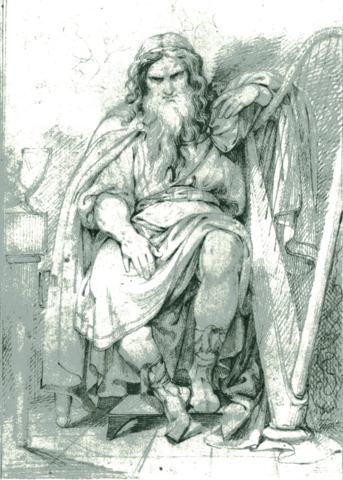
Norse god of poetry and eloquence, husband of Idunn, who greets fallen kings at Valhalla's door and may have begun as a real ninth-century skald.
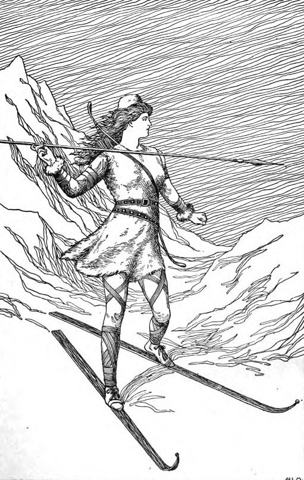
Giantess turned goddess of winter and the hunt. She came armed to Asgard for her father's blood-price and chose a husband by his feet alone.
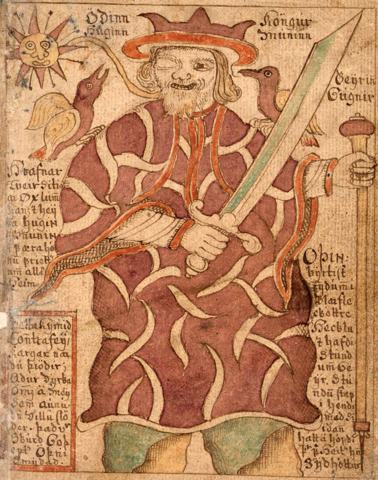
The Allfather. God of war, poetry and the dead who traded an eye for wisdom and hanged himself on the world tree to win the runes.
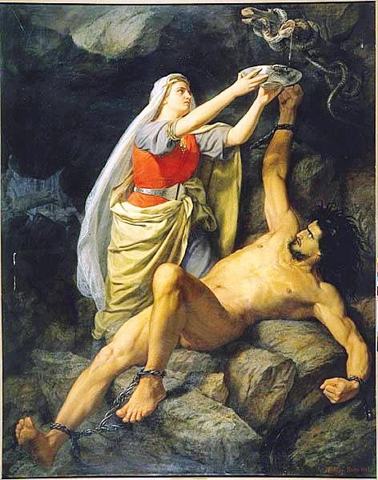
The Trickster. Shape-shifter of giant blood counted among the gods — their cleverest ally, the father of monsters, and the spark of Ragnarok.
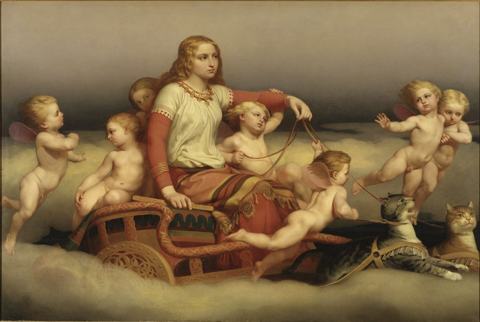
Lady of the Vanir. Goddess of love, war, gold and seidr magic — often spelled Freya — who claims half of the battle-slain for her own hall.
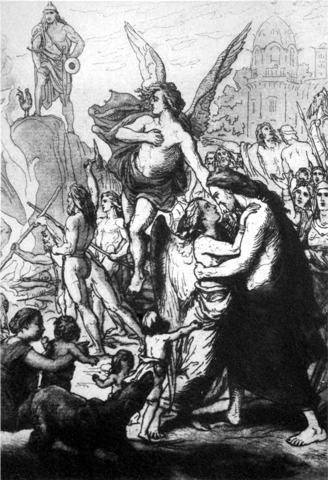
The stronghold of the AEsir. A walled citadel of halls at the top of the world tree, reached by the rainbow bridge and built on a bargain the gods broke.
Sources & Further Reading
- 1.Poetic Edda — Lokasenna and Hrafnagaldr Odins (Codex Regius and later manuscripts, 13th century onward).
- 2.Thjodolf of Hvinir, Haustlong (9th century), quoted in Skaldskaparmal.
- 3.Snorri Sturluson, Prose Edda — Gylfaginning (c. 1220).
- 4.Snorri Sturluson, Prose Edda — Skaldskaparmal (c. 1220).
- 5.Lindow, John. Norse Mythology — A Guide to the Gods, Heroes, Rituals, and Beliefs. Oxford University Press, 2001.
- 6.Simek, Rudolf. Dictionary of Northern Mythology. Trans. Angela Hall. D.S. Brewer, 1993.
- 7.Turville-Petre, E.O.G. Myth and Religion of the North. Weidenfeld & Nicolson, 1964.
- 8.Larrington, Carolyne (trans.). The Poetic Edda. Rev. ed., Oxford World's Classics, 2014.
Spot an error or have a source to suggest? Write to info@viseterna.com. We cite primary sources and modern scholarship, and we correct fast.