
Vidar
Odin's silent, giant-born son, second in strength only to Thor — kept in reserve since before the world began to avenge his father on the wolf Fenrir.
Fenrir and Vidarr, Lorenz Frolich, 1895 · Public domain · source
The Silent God
Snorri introduces Vidar in Gylfaginning with one blunt superlative: he is the silent god, strong almost beyond measure, and the Aesir rely on him in every hard place the way they rely on Thor — Vidar is, by Snorri's own ranking, second in strength only to Thor among all the gods 2. Nothing in the surviving sources gives him a speech, a wife, or a story that is not Ragnarok. He is built, from the first sentence about him, as a reserve — power held back for one purpose and otherwise unused 2,5.
A Giant's Son
Vidar's mother is not one of the Aesir. Snorri names her Grid, a giantess who elsewhere lends Thor her belt of strength, iron gloves and staff before his expedition against the giant Geirrod, making her one of the few giant women in the corpus who consistently helps the gods rather than opposing them 2,4. Vidar's status as a god fathered by Odin on a giantess puts him in the same category as Vali, born to Odin and the giantess Rindr for the express purpose of avenging Baldr's death on Hodr — sons conceived outside the regular marriages of the Aesir specifically to do violence the existing gods cannot do themselves 1,3.
Landvidi
Grimnismal's catalogue of the gods' halls gives Vidar a home to match his character: Landvidi, "wide land," described as overgrown with brushwood and tall grass, a wilderness rather than a hall built for company 1. The poem places it in the same list as Asgard's grander residences — Odin's Valaskjalf, Freyr's Alfheim — but gives it none of their furnishing or festivity. Simek reads the description as consistent with a god who is defined by absence and reserve rather than by court life, an outsider's dwelling for a god who spends the whole of recorded myth waiting 1,5.
The Boot
The single concrete object associated with Vidar is a shoe, and Snorri gives its origin as a piece of running world-maintenance rather than a gift or a forging: at all times, he says, cobblers and shoemakers have set aside the scraps of leather trimmed from the toe and heel of every shoe they make, and those scraps accumulate into the massive boot Vidar will wear at Ragnarok 2. It is one of the few details in Norse cosmology that makes ordinary human craft, repeated across unrecorded centuries, into a mythological stockpile — every discarded scrap of leather is, without the cobbler knowing it, going toward the end of the world 2,3.
Vengeance on Fenrir
At Ragnarok, Odin rides out against the wolf Fenrir and is swallowed. Voluspa has Vidar step forward immediately after and thrust a sword into the beast's heart, avenging his father in a single line of verse 1. Snorri's prose account in Gylfaginning stages the same vengeance differently and at greater length: Vidar strides up to Fenrir, plants one foot — shod in the accumulated boot — on the wolf's lower jaw, seizes the upper jaw in his hand, and tears the wolf's mouth apart, killing him 2. The two versions do not agree on method, sword against bare-handed strength, and the sources give no way to decide which is older; both make Vidar the one clean act of successful revenge in the entire battle, arriving fast enough that Odin's death is avenged within the same scene rather than left to a later reckoning 1,2,6.
Surviving the End
Vidar is not consumed by Ragnarok's fire. Voluspa names him, together with Vali and Thor's sons Modi and Magni, among the gods who walk the renewed, green earth after the flood and the burning are over, gathering at Idavoll to talk through what has happened 1. He is, in other words, kept in reserve twice over by the mythology itself — held back through the whole of recorded myth for a single act of violence, and then held back again, past the destruction that act was part of, into whatever comes next 1,6.
Reading the Silence
Because Vidar has almost no independent narrative, interpretation of him leans heavily on the details that do survive: the wild, overgrown hall; the silence Snorri names outright; the strength kept unused until the one moment it is needed. Simek and Turville-Petre both note, cautiously, that this combination has invited readings of Vidar as a personification of untouched wilderness or of a reserve of primal strength standing apart from the ordinary business of Asgard — a reading the thin evidence can support only as one possibility among others, not as settled fact 5,6. What is not in dispute is the shape of his role: Vidar exists in the sources to do exactly one thing, and the mythology arranges everything about him, from his mother to his hall to his boot, around making sure that when the moment comes, he can 2,3,6.
Continue Exploring
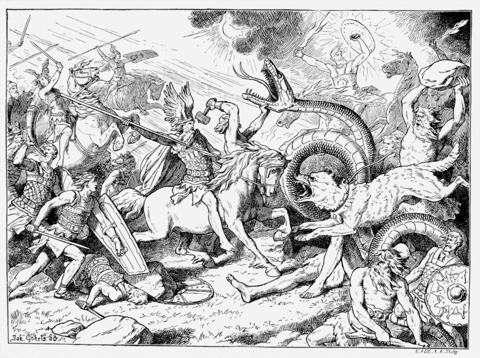
The Twilight of the Gods. The prophesied end: a killing winter, the breaking of every bond, a battle no one survives — and an earth that rises again.
The stronghold of the AEsir. A walled citadel of halls at the top of the world tree, reached by the rainbow bridge and built on a bargain the gods broke.
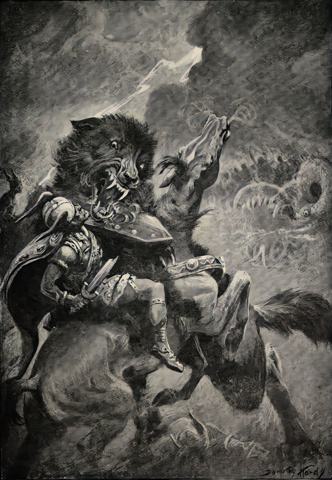
The Bound Wolf. Loki's son, raised among the gods and chained by a trick that cost Tyr his hand — until Ragnarok, when he devours Odin.
God of Light. The most beloved of the Aesir, made immune to all harm but one plant — and killed by it, which set the world's ending in motion.
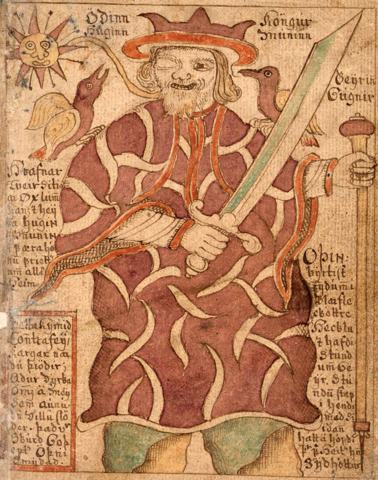
The Allfather. God of war, poetry and the dead who traded an eye for wisdom and hanged himself on the world tree to win the runes.
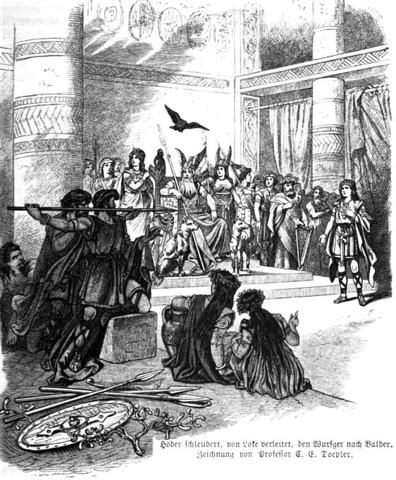
The blind god who threw the dart that killed Baldr, guided by Loki's hand — Norse myth's clearest case of a killer who may not be the guilty party.
Sources & Further Reading
- 1.Poetic Edda — Voluspa and Grimnismal (Codex Regius, 13th century).
- 2.Snorri Sturluson, Prose Edda — Gylfaginning and Skaldskaparmal (c. 1220).
- 3.Lindow, John. Norse Mythology — A Guide to the Gods, Heroes, Rituals, and Beliefs. Oxford University Press, 2001.
- 4.Simek, Rudolf. Dictionary of Northern Mythology. Trans. Angela Hall. D.S. Brewer, 1993.
- 5.Turville-Petre, E.O.G. Myth and Religion of the North — The Religion of Ancient Scandinavia. Weidenfeld & Nicolson, 1964.
- 6.Orchard, Andy. Dictionary of Norse Myth and Legend. Cassell, 1997.
Spot an error or have a source to suggest? Write to info@viseterna.com. We cite primary sources and modern scholarship, and we correct fast.