
Seidr (Norse Magic)
Norse trance magic of prophecy and fate-shaping, taught by Freyja to the gods and practised by wandering seeresses — powerful, gendered, and socially dangerous.
Volva, Odin, Sleipnir and Helhund, Lorenz Frolich, 1895 · Public domain · source
What Seidr Was
Seidr is the Old Norse name for a body of ritual magic aimed at seeing and shaping fate: prophecy, weather-working, calling luck or misfortune onto a target, and drawing information out of trance 4,5. A female practitioner was a volva ("staff-bearer"), seidkona, or visendakona ("wise woman"); a male one was a seidmadr, a term the sources treat as much riskier to hold 4,6.
Distinct from the everyday charms and herb-craft available to most households, seidr required trained specialists, purpose-built equipment, and often an audience, and the sagas describe it as something a community would travel to consult, not a private skill 4,5.
Freyja, the Vanir, and Odin
Snorri states plainly, in Ynglinga saga, that seidr came to the Aesir from the Vanir, and that Freyja — a Vanir goddess herself — was the one who taught it to them, Odin included 2. That origin story matters for how the sources judge the practice: seidr is Freyja's art before it is anyone else's, and Odin's mastery of it is presented as an acquisition, not a birthright 2,4.
It came at a cost to his reputation. In the flyting-poem Lokasenna, Loki throws Odin's seidr back in his face as ergi — shameful, unmanly, coded as sexually passive — and the accusation stands unanswered in the text, a real tension in the sources rather than an insult that gets corrected 3. The same charge attaches to seidr-working men generally; Price reads it as evidence that the practice was understood as women's proper domain, so that a man who took it up crossed a gender line the culture policed hard 4.
The Volva's Ritual in Eiriks Saga Rauda
The fullest surviving description of seidr in action is not myth but saga realism. Eiriks saga rauda describes a famine in Greenland relieved by consulting Thorbjorg, a travelling volva known as "the little prophetess", the last of nine sisters who had all practised the craft 1. She arrives dressed for the part: a blue cloak set with stones to the hem, a staff with a brass-bound, gem-set knob, a headdress of black lambskin lined with white catskin, and catskin gloves, and she carries a pouch of the charms her work requires 1.
Seated on a high platform built for the purpose, she requires a woman who knows the Vardlokkur, the warding songs needed to summon the spirits she consults; only Gudrid, a Christian settler reluctant to sing anything that might count as pagan ritual, knows them, and is persuaded to help despite her hesitation 1. The spirits come, Thorbjorg declares the famine will lift and gives Gudrid a detailed prophecy of her own future, and the saga treats the whole episode as ordinary, expected procedure rather than as something extraordinary happening for the first time 1.
Under the Cloak: Seidr and the Conversion
Jon Hnefill Adalsteinsson has argued for a subtler seidr connection at Iceland's official conversion to Christianity in the year 1000. The lawspeaker Thorgeir, tasked with deciding whether Iceland would adopt the new religion, is said to have lain under a cloak for a day and a night in silence before delivering his ruling; Adalsteinsson reads this withdrawal as structurally close to a seidr trance used for reaching a binding decision, rather than simple private deliberation 8. The interpretation is his own reading of thin evidence, not a settled fact, and it is offered here as exactly that — an argument, not a certainty 8.
Archaeology and Reception
Modern archaeology has given the mythological picture unexpected physical support. A cluster of Viking Age graves — a woman buried at Fyrkat in Denmark and a similarly equipped burial at Birka in Sweden among them — contain iron staffs, unusual seating arrangements, and sometimes narcotic plant remains, and are widely, though not universally, read as the graves of seidr practitioners 4,5. The staffs themselves may be the origin of the volva's name 7.
Modern Heathenry and neo-shamanic movements have taken up seidr enthusiastically, and Jenny Blain's ethnography treats contemporary practitioners' revival seriously as its own phenomenon, distinct from — and openly modelled on, rather than continuous with — the medieval practice the sagas describe 6. The line between the two is worth keeping clear: what Thorbjorg did on her platform was a specific, costumed, community ritual with its own equipment and etiquette, and what survives of it is a description, not a manual 1,4.
Continue Exploring
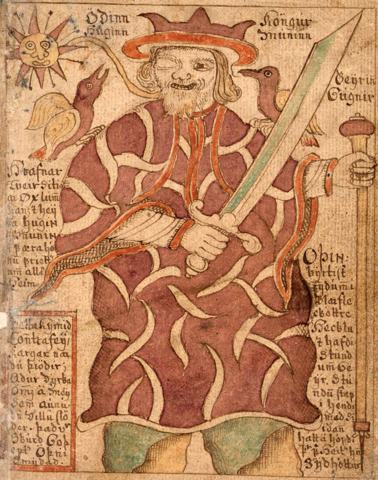
The Allfather. God of war, poetry and the dead who traded an eye for wisdom and hanged himself on the world tree to win the runes.
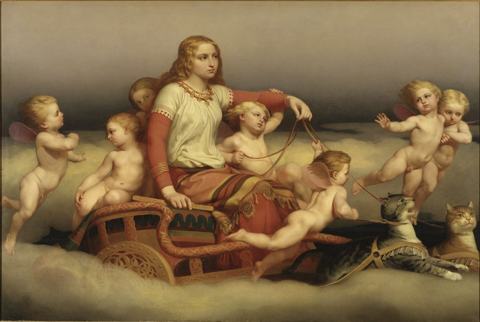
Lady of the Vanir. Goddess of love, war, gold and seidr magic — often spelled Freya — who claims half of the battle-slain for her own hall.
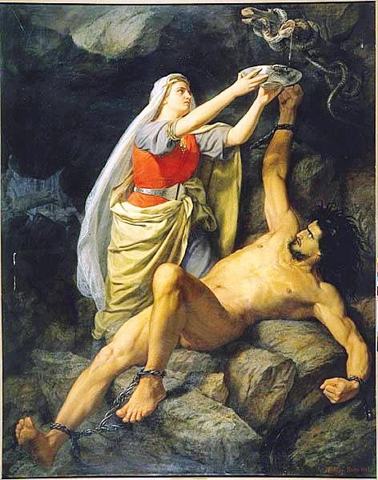
The Trickster. Shape-shifter of giant blood counted among the gods — their cleverest ally, the father of monsters, and the spark of Ragnarok.
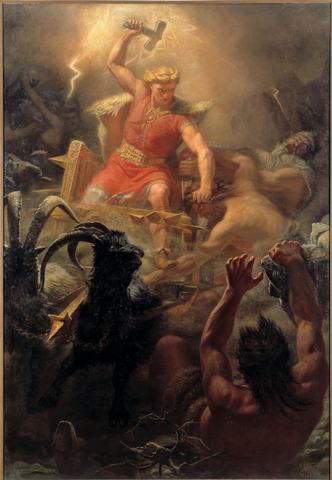
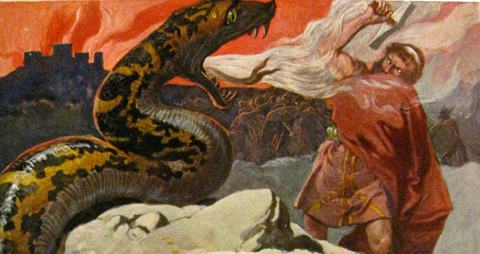
God of Thunder. Son of Odin and the earth, wielder of Mjolnir, and the gods' front line against the giants — fated to fall with the World Serpent.
Hammer of Thor. Dwarf-forged, short in the handle, it strikes like lightning, hallows oaths and the dead, and always returns to the hand that throws it.
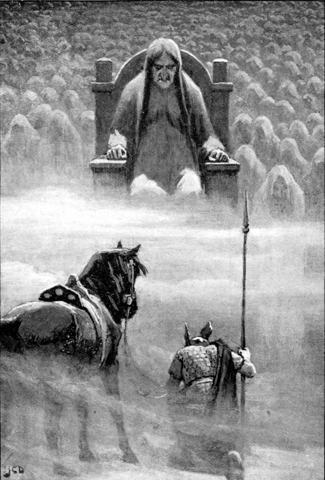
Queen of the Dead. Half living woman and half corpse, Loki's daughter rules the cold realm where those who die of sickness and age must go.
Sources & Further Reading
- 1.Eiriks saga rauda, chapter 4 (Iceland, 13th century). Trans. J. Sephton, 1880.
- 2.Snorri Sturluson, Ynglinga saga, in Heimskringla (c. 1230).
- 3.Poetic Edda — Voluspa and Lokasenna (Codex Regius, 13th century).
- 4.Price, Neil. The Viking Way: Magic and Mind in Late Iron Age Scandinavia. 2nd ed., Oxbow Books, 2019.
- 5.DuBois, Thomas A. Nordic Religions in the Viking Age. University of Pennsylvania Press, 1999.
- 6.Blain, Jenny. Nine Worlds of Seid-Magic: Ecstasy and Neo-Shamanism in North European Paganism. Routledge, 2002.
- 7.Heide, Eldar. "Spinning Seidr." In Old Norse Religion in Long-Term Perspectives, edited by Anders Andren, Kristina Jennbert and Catharina Raudvere. Nordic Academic Press, 2006.
- 8.Jon Hnefill Adalsteinsson. Under the Cloak: A Pagan Ritual Turning Point in the Conversion of Iceland. 2nd ed., University of Iceland Press, 1999.
Spot an error or have a source to suggest? Write to info@viseterna.com. We cite primary sources and modern scholarship, and we correct fast.