
Ullr
The Norse god of the bow, the ski and the shield. Almost no myth about him survives, yet place-names suggest he was once worshipped everywhere.
Uller, Friedrich Wilhelm Heine, 1882 (from Wilhelm Waegner, Nordisch-germanische Goetter und Helden) · Public domain · source
The God Who Lost His Myths
Ullr (Old Norse Ullr, anglicised Ull or Uller) is one of the strangest figures in the Norse pantheon: a god the medieval texts treat as important and then almost entirely decline to tell stories about. Snorri lists him among the Aesir and says he is so fine an archer and so fast on skis that no one can rival him, that he is beautiful to look at and has "the character of a warrior" — and then moves on 2. Not a single narrative myth featuring Ullr survives in either Edda 5,6.
The name itself is a clue that this silence is a loss rather than an absence. Ullr descends from Proto-Germanic *wulþuz, "glory", the same word behind Gothic wulþus and Old English wuldor. That root is old, and it is the kind of word that gets attached to a major god rather than a minor one 6,7. Scholars generally read Ullr as a deity who was once central to Germanic religion and whose cult had already faded, or been absorbed, by the time Icelandic authors began writing the myths down 5,7.
What the Eddas Preserve
Grimnismal names his dwelling in its catalogue of divine halls: Ydalir, "yew-dales" — and yew is the wood a Norse bow was made from, so the hall's name is effectively the god's weapon 1,8. Later in the same poem, in a stanza that reads like a household blessing, Odin promises "Ullr's favour and all the gods'" to whoever first lifts the kettle from the fire 1,8. That Ullr is singled out by name in a domestic formula, alongside "all the gods" as a collective, suggests his blessing was a real and familiar thing to invoke.
Snorri makes him the son of Sif and thus the stepson of Thor; his father is never named 2. He is called the ski-god, bow-god, hunting-god and shield-god, and Snorri adds that he is "good to call on in single combat" 2. The shield connection is preserved independently in skaldic diction, where a shield can be called "Ullr's ship" — a kenning that may point to a lost myth in which the god crossed water on his shield, or simply to the flat board a skier stands on 3,5.
Oaths, Duels and the Ring
The most suggestive surviving reference is legal rather than mythological. In the heroic poem Atlakvida, an oath is sworn "on Ullr's ring" 1,8. Ring-oaths are attested elsewhere in Old Norse sources as the binding form of promise, sworn on an arm-ring kept at a temple; that Ullr's name is the one attached to the ritual formula here implies he had a recognised role as a guarantor of sworn faith 5,7. Combined with Snorri's note that he is good to invoke in a duel, the picture is of a god presiding over the formal, rule-bound confrontations of Norse society — the oath and the holmganga — rather than over the open battlefield that belonged to Odin and Tyr 5,7.
Saxo's Ollerus
The Danish historian Saxo Grammaticus preserves what may be a fragment of a real myth, heavily rationalised. In Book 3 of the Gesta Danorum, the gods depose Othinus (Odin) for a disgraceful act and put a magician named Ollerus in his place; Ollerus takes the name Odin and rules for about ten years before the real Odin returns, drives him out to Sweden, and has him killed 4. Saxo also says Ollerus could cross the sea on a bone marked with spells, as though it were a ship 4.
Scholars treat this cautiously. Saxo is writing Christian dynastic history and routinely converts gods into kings and sorcerers, so the story cannot be read as a straightforward Norse myth 5,6. But the bone-that-is-a-boat is hard to invent by accident: it looks like a garbled memory of the skiing or shield-sailing god, and the substitution motif may preserve a genuine tradition in which Ullr held sovereignty for a season 5,7.
The Evidence in the Ground
Where the literature is nearly silent, geography is loud. Sweden alone has more than twenty places built on Ullevi, "Ullr's sanctuary", concentrated around Lake Malaren in Uppland, Vastmanland and Sodermanland; eastern Norway adds Ullinshof, Ullensaker and many variants, some built on an alternative form of the name, Ullinn 5,6,7. Ullr's names cluster with those of Freyr and Njord (Old Norse Njorðr) in the same districts, which some scholars read as evidence of a linked cult of land, fertility and the hunt 7.
A far older trace may survive on the Thorsberg chape, a Roman Iron Age scabbard-fitting from Schleswig inscribed owlþuþewaz, plausibly "servant of the glorious one" — and if that glorious one is Ullr, it is the earliest and southernmost reference to him anywhere. The reading is widely cited but not certain, and some scholars prefer to treat the word simply as a personal name 6,7.
Winter, Skis and the Modern Ullr
Because the surviving descriptions attach him to snow, yew bows and the hunt, Ullr has been adopted in the twentieth and twenty-first centuries as an unofficial patron of skiers, complete with medallions and "Ullr Fests" in alpine towns. That devotion is a modern invention and should not be read back into the sources, though it is at least built on the one thing the medieval texts actually say about him 5,6.
What remains is a god defined by his gaps. Ullr belongs to the same world as Asgard and the ash Yggdrasil, but where the great myths of Ragnarok tell us how nearly every major god dies, Ullr is not mentioned at the end of the world at all — an absence that scholars debate, and that may simply mean his stories were gone before the poets who shaped the surviving corpus started work 5,6,7.
Continue Exploring
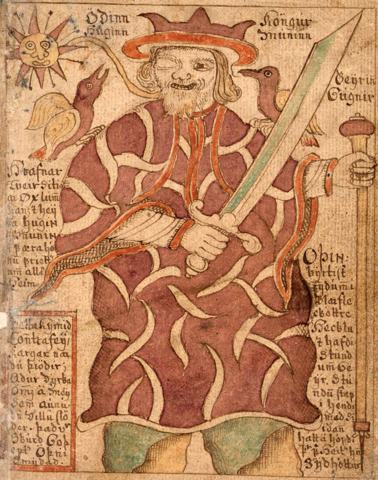
The Allfather. God of war, poetry and the dead who traded an eye for wisdom and hanged himself on the world tree to win the runes.
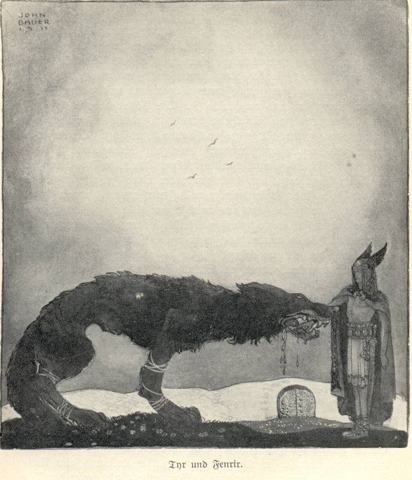
God of Sacred Law. Once perhaps the sky-father of the north, remembered chiefly for putting his sword hand into a wolf's mouth and losing it.
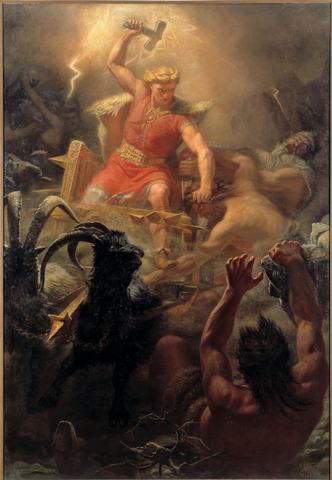
God of Thunder. Son of Odin and the earth, wielder of Mjolnir, and the gods' front line against the giants — fated to fall with the World Serpent.
The stronghold of the AEsir. A walled citadel of halls at the top of the world tree, reached by the rainbow bridge and built on a bargain the gods broke.
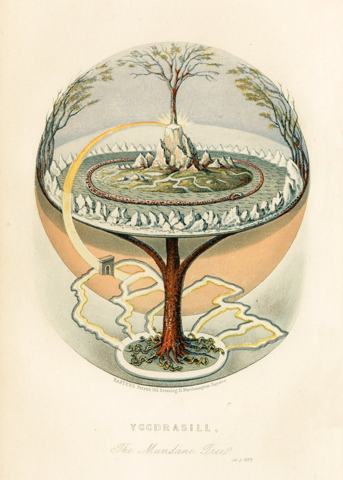
The World Tree. The great ash whose roots reach three wells and nine worlds, tended by the norns, eaten from every side, and still standing when the sky burns.
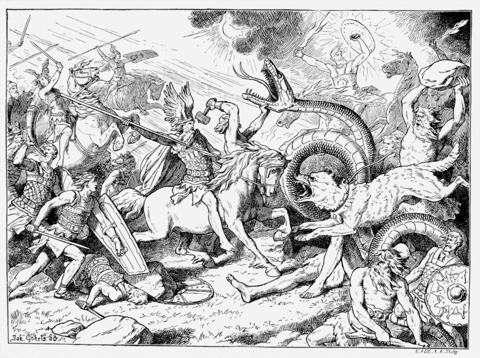
The Twilight of the Gods. The prophesied end: a killing winter, the breaking of every bond, a battle no one survives — and an earth that rises again.
Sources & Further Reading
- 1.Poetic Edda — Grimnismal and Atlakvida (Codex Regius, 13th century).
- 2.Snorri Sturluson, Prose Edda — Gylfaginning (c. 1220).
- 3.Snorri Sturluson, Prose Edda — Skaldskaparmal (c. 1220).
- 4.Saxo Grammaticus, Gesta Danorum, Book 3 (c. 1200).
- 5.Lindow, John. Norse Mythology — A Guide to the Gods, Heroes, Rituals, and Beliefs. Oxford University Press, 2001.
- 6.Simek, Rudolf. Dictionary of Northern Mythology. Trans. Angela Hall. D.S. Brewer, 1993.
- 7.Turville-Petre, E.O.G. Myth and Religion of the North — The Religion of Ancient Scandinavia. Weidenfeld & Nicolson, 1964.
- 8.Larrington, Carolyne (trans.). The Poetic Edda. Rev. ed., Oxford World's Classics, 2014.
Spot an error or have a source to suggest? Write to info@viseterna.com. We cite primary sources and modern scholarship, and we correct fast.