
Blot (Norse Sacrifice)
The Old Norse sacrifice: an animal killed, its blood sprinkled on altar and idols, its meat boiled and shared in a hall feast to buy the gods' favour.
Midvinterblot (Midwinter Sacrifice), Carl Larsson, 1915 (Nationalmuseum, Stockholm) · Public domain · source
What a Blot Was
Blot (Old Norse blot, related to a verb meaning to strengthen or worship) was the central act of pre-Christian Norse religion: an animal — most often a horse, pig, or ox — was killed, its blood caught and sprinkled with twigs called hlautteinar onto altars, idols, walls and the assembled people, and its meat boiled in pits of heated stones for a communal feast 4,5. It was not a private prayer but a transaction, carried out to buy specific things from specific powers: til árs ok friðar, "for a good season and peace", is the formula the sources use again and again 5,6.
Toasts structured the feast as much as the killing did. Cups were raised and drained to Odin for victory and to the king's power, to Freyr and Njord for good harvests and peace, and to dead kinsmen for their memory, and refusing a toast was itself a political act 1,6. The whole sequence — kill, sprinkle, boil, drink, remember — recurs across the sources with enough consistency to count as a shared ritual grammar rather than a single ceremony 5,6.
Where It Happened
Sacrifice took place both indoors and out. Wealthy farms and royal estates kept a hof, a hall built or set aside for the purpose, with a horgr — a stone altar or cairn — sometimes standing separately in the open, at a spring, a grove, or a waterfall 4,6,7. Archaeology has confirmed the pattern rather than merely illustrating it: excavation at Hofstadir in northern Iceland uncovered a large hall with an unusually dense deposit of cattle skulls positioned for display, widely read as physical evidence of feasting sacrifice rather than ordinary slaughter 5,7.
Frequency varied by scale and stakes. Smaller blots marked the turning points of the farming year — seedtime, midsummer, and above all the great sacrifice at Yule — while the grandest, such as the nine-yearly ceremony Adam of Bremen reports at the Temple at Uppsala, were royal or regional events on a different scale of both violence and spectacle 4,5.
Hakon the Good's Dilemma
The single most detailed account of a blot in progress is also a story about a king caught between two religions. Hakon the Good, raised Christian at the English court, returned to rule Norway and tried at first to keep his faith quietly. At a Yule sacrifice at Lade, the assembled chieftains pressed him to eat horse-meat and drink the ritual toasts; Snorri's Heimskringla describes him yielding under pressure, gaping his mouth over the steam of the horse-liver broth with a cloth wrapped round the handle so his lips never touched it, and making the sign of the cross over his drinking horn, which his earl Sigurd smoothed over to the crowd as merely "the sign of Thor's hammer" 1. Hakon's Christianity did not survive politically; the sagas make his later reign a story of quiet, unresolved compromise 1.
The King as Offering
The logic of exchange had a darker edge in legend. Ynglinga saga tells of King Domalde of Sweden, whose reign began with famine so severe that the assembly first sacrificed oxen, then men, without relief; in the third year they turned on the king himself, reddening the altars with his blood, and the harvests recovered 2. Whether this reflects an actual historical practice of royal sacrifice or a later legendary explanation for a king's violent death is genuinely unresolved, and most modern scholars treat it with real caution rather than as a literal record — Snorri was writing origin-legend about the Yngling dynasty two centuries after any such event could have occurred, if it occurred at all 2,5.
Law, Conversion, and Survival
Blot did not end cleanly. The Older Gulathing Law explicitly criminalises sacrifice to landvaettir and heathen gods alongside other pagan practice, evidence that the authorities who wrote the law still expected people to be doing it 3,6. Iceland's formal conversion in the year 1000 is remembered as a negotiated compromise rather than a clean break: the lawspeaker's ruling that decided the assembly allowed continued private worship of the old gods for a transitional period, provided it stayed out of public view 6,7. The practice faded rather than vanished at any single moment, folding into folk custom long after its theology had lost official standing 6,7.
Legacy
What the medieval sources describe as blot bears only a loose resemblance to the animal-free, candle-and-toast ceremonies modern Asatru and Heathen groups now call by the same name; contemporary practitioners are explicit that theirs is a reconstruction for a different legal and ethical context, not a continuation 5,7. The historical rite was blood, fire, boiled meat and a hard-nosed bargain with powers who were expected to answer only if properly paid — and the sources, when they let a king or a starving farmstead speak, never pretend otherwise 4,6.
Continue Exploring
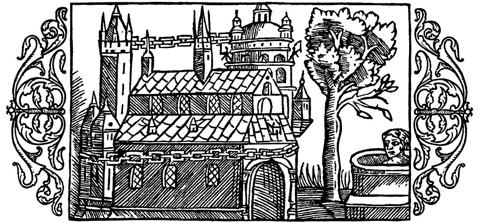
A golden temple with statues of Thor, Odin and Freyr, described by Adam of Bremen c. 1075 — a real cult site, but archaeology and legend disagree on its form.
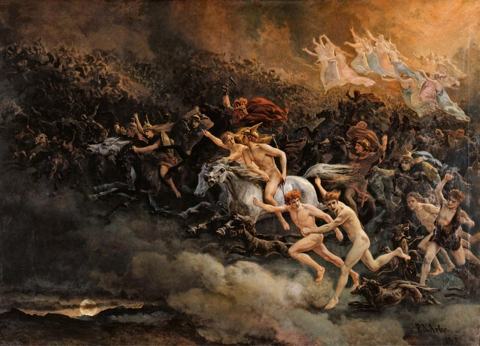
The Norse and wider Germanic midwinter festival of feasting, sacrifice and oath-swearing — later fixed to Christmas by royal decree, not by simple continuity.
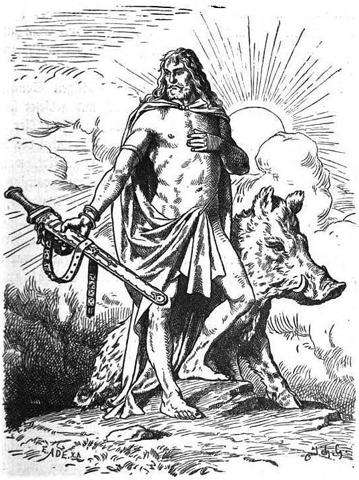
Vanir god of harvest, peace and kingship. Owner of the golden boar Gullinbursti, he traded away his sword for love and pays for it at Ragnarok.
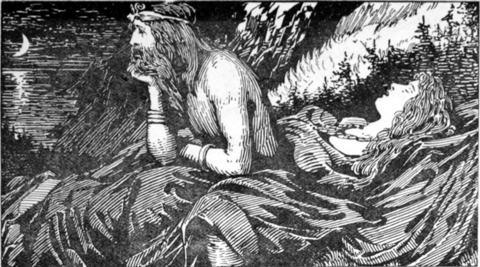
Vanir god of harbours, wind and wealth. Sent to the Aesir as a hostage; father of Freyr and Freyja; husband of a mountain giantess, briefly.
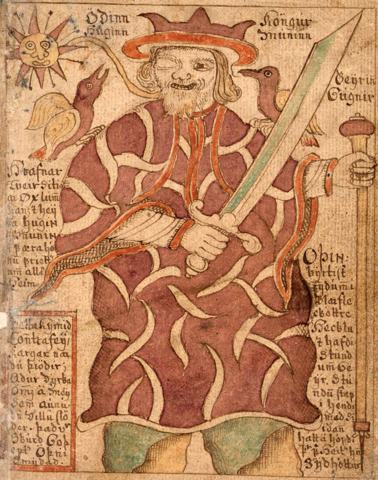
The Allfather. God of war, poetry and the dead who traded an eye for wisdom and hanged himself on the world tree to win the runes.
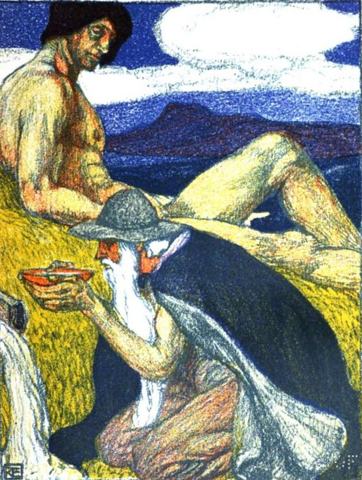
The being who keeps the well of wisdom beneath Yggdrasil — beheaded in a botched peace treaty, and consulted by Odin as a severed head ever after.
Sources & Further Reading
- 1.Heimskringla — Hakonar saga goda (Snorri Sturluson, c. 1230).
- 2.Snorri Sturluson, Ynglinga saga, in Heimskringla (c. 1230).
- 3.The Older Gulathing Law (Den eldre Gulatingslova), medieval Norwegian law code.
- 4.Adam of Bremen. Gesta Hammaburgensis Ecclesiae Pontificum, Book IV (c. 1075). Trans. Francis J. Tschan as History of the Archbishops of Hamburg-Bremen. Columbia University Press, 1959 (repr. 2002).
- 5.Sundqvist, Olof. An Arena for Higher Powers: Ceremonial Buildings and Religious Strategies for Rulership in Late Iron Age Scandinavia. Brill, 2015.
- 6.Nordberg, Andreas. "Continuity, Compatibility, and the Case of Blot." In Old Norse Religion in Long-Term Perspectives, edited by Anders Andren, Kristina Jennbert and Catharina Raudvere. Nordic Academic Press, 2006.
- 7.DuBois, Thomas A. Nordic Religions in the Viking Age. University of Pennsylvania Press, 1999.
Spot an error or have a source to suggest? Write to info@viseterna.com. We cite primary sources and modern scholarship, and we correct fast.