
Midgard
The middle enclosure. The human world, built from a murdered giant's body, fenced by his eyebrows, and ringed by a serpent that will one day let go of its tail.
Odin and his brothers create the world, Lorenz Frolich, 1895 · Public domain · source
A Word Older Than Norse
Midgardr means "the middle enclosure", and it is one of the very few mythological terms that can be traced across the whole Germanic family. Old English has middangeard, Old Saxon middilgard, Old High German mittilgart, and Gothic — recorded in the fourth century — has midjungards, used in Wulfila's Bible translation for the inhabited world into which Christ came 5,7.
That distribution tells us the concept is older than any surviving Norse poem. Long before Voluspa was written down, Germanic speakers described the human world as a fenced middle ground, and the -gard element carried its ordinary farming sense: a yard, a boundary, land you have enclosed and can defend. Midgard is not a planet. It is a smallholding 5,6.
Made from a Body
The creation account is unusually physical. Grimnismal states it as a list, and Snorri expands it in Gylfaginning: the sons of Bor killed the primeval giant Ymir and made the world from him. His flesh became the earth, his blood the sea and lakes, his bones the mountains, his teeth and jaw the rocks and scree, his skull the sky — held up at its four corners by the dwarfs Nordri, Sudri, Austri and Vestri — and his brains the clouds. Maggots in his flesh, given wit and human shape, became the dwarfs 2,3,8.
Then the detail that names the realm. From Ymir's eyebrows the gods made a fortification around the middle of the earth, against the hostility of the giants, and called it Midgard 2,3. The human world is defined by its wall before it is defined by its people, and the wall is made of the enemy 4,6.
The first people follow. Voluspa has three gods — Odin, Hoenir and Lodurr — finding two pieces of driftwood on a shore, Ask and Embla, ash and elm, with no fate, no breath, no blood and no colour, and giving them spirit, sense and warmth 1,8. Snorri names the trio as Odin and his brothers Vili and Ve, and adds that the sons of Bor gave them the world inside the fence to live in 3. Humanity in this mythology begins as salvaged timber, inside a stockade, on land made of a corpse.
Inside the Fence, Outside the Fence
Modern scholarship reads the whole Norse cosmos through this opposition — innangards, inside the enclosure, versus utangards, outside it. Inside is law, kinship, cultivated land and sworn obligation. Outside is Jotunheim, the wilderness, and the giants who are not evil so much as prior: older than the gods, related to them by blood and marriage, and permanently on the wrong side of a fence the gods installed 6.
The pattern reaches everywhere. Journeys away from Midgard are always eastward or downward. Exchanges across the boundary are always uneven — gods take giant brides, giants never get goddesses, and every attempt on Freyja ends in a corpse 6. Even Asgard shares the grammar: the gods' realm is another gardr, and the human one sits between it and the wild, which is precisely what "middle" is doing in the name 4,6.
The Serpent in the Sea
Around the edge of the world lies its second boundary, and this one is alive. Snorri tells how Odin threw the serpent child of Loki into the deep sea that circles all lands, and how it grew until it lay round the whole of Midgard and bit its own tail — hence Jormungandr's other name, the Midgard Serpent 3,4.
It surfaces twice in the myths, and both times Thor is holding the other end. In Hymiskvida and again in Snorri, Thor rows past the giant Hymir's fishing grounds with an ox head for bait, hooks the serpent, and hauls it to the gunwale before the line is cut 3,5. The scene was carved on stones at Altuna in Sweden and Gosforth in England, which suggests it was one of the best-known stories in the Norse world 4,5.
The theology is neat. Midgard is fenced on the land side by a dead giant's eyebrows and on the sea side by a living monster, and the god who defends it is the one repeatedly trying, and failing, to kill that monster early 4,6.
The Flood and the Green Land
At Ragnarok the fences give out. Voluspa has the serpent writhing in giant rage and churning the waves; Snorri says it comes ashore spraying venom over the sky and sea, and the ocean floods the land as it moves. Thor kills it and walks nine paces before the venom drops him 1,3,8. Surtr's fire finishes the rest, and the earth sinks into the sea.
Then the poem does something the fire does not lead you to expect. The earth rises a second time out of the water, green, and the eagle hunts fish from the cliffs, and the fields grow unsown 1,8. Snorri adds that two humans, Lif and Lifthrasir, survived the burning sheltered inside Yggdrasil and that all mankind descends from them 3.
There is no second wall. The renewed Midgard in Voluspa has no giant's eyebrows around it and no serpent in the water — which is either the whole point of the ending or an omission the poet never thought about. The Old Norse leaves both open 4,6.
Continue Exploring
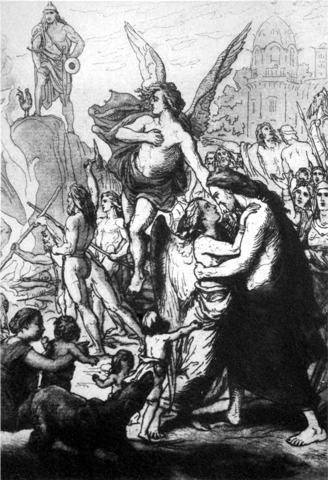
The stronghold of the AEsir. A walled citadel of halls at the top of the world tree, reached by the rainbow bridge and built on a bargain the gods broke.
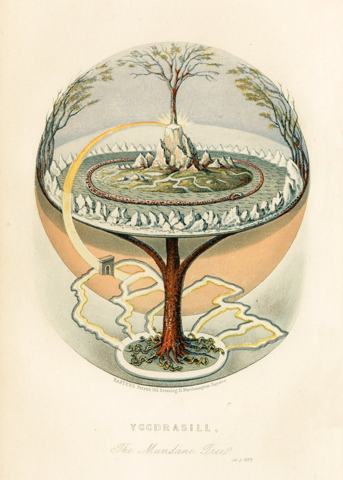
The World Tree. The great ash whose roots reach three wells and nine worlds, tended by the norns, eaten from every side, and still standing when the sky burns.
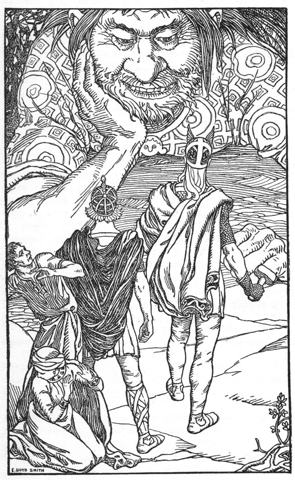
Land of the giants. The wild country east of the fence, older than the gods, holding the wisdom and the brides the AEsir keep going out to take.
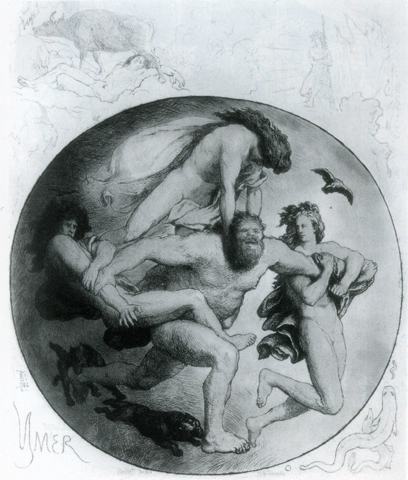
The frost-giant who came first, out of the meeting of fire and ice — killed by Odin and his brothers, his body split apart to build the world.
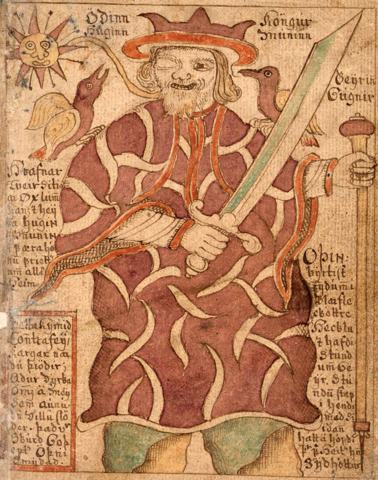
The Allfather. God of war, poetry and the dead who traded an eye for wisdom and hanged himself on the world tree to win the runes.
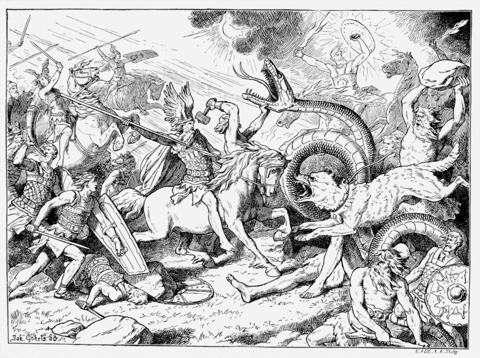
The Twilight of the Gods. The prophesied end: a killing winter, the breaking of every bond, a battle no one survives — and an earth that rises again.
Also mentioned inBifrost (The Rainbow Bridge)MuspelheimNidhoggr
Sources & Further Reading
- 1.Poetic Edda — Voluspa (Codex Regius, 13th century).
- 2.Poetic Edda — Grimnismal and Vafthrudnismal (Codex Regius, 13th century).
- 3.Snorri Sturluson, Prose Edda — Gylfaginning (c. 1220).
- 4.Lindow, John. Norse Mythology — A Guide to the Gods, Heroes, Rituals, and Beliefs. Oxford University Press, 2001.
- 5.Simek, Rudolf. Dictionary of Northern Mythology. Trans. Angela Hall. D.S. Brewer, 1993.
- 6.Clunies Ross, Margaret. Prolonged Echoes — Old Norse Myths in Medieval Northern Society, vol. 1: The Myths. The Viking Collection 7. Odense University Press, 1994.
- 7.Orchard, Andy. Cassell Dictionary of Norse Myth and Legend. Cassell, 1997.
- 8.Larrington, Carolyne (trans.). The Poetic Edda. Rev. ed., Oxford World's Classics, 2014.
Spot an error or have a source to suggest? Write to info@viseterna.com. We cite primary sources and modern scholarship, and we correct fast.