
The Aesir-Vanir War
Voluspa calls it the first war in the world. Gullveig burned three times, Odin cast the first spear, and the truce reshaped the Norse pantheon.
Loke finner Gullveigs hjarta (Loki finds Gullveig's heart), John Bauer, 1911 · Public domain · source
The First War in the World
Norse mythology has two divine families. The Aesir are the war-and-sovereignty gods of Asgard — Odin, Thor, Tyr, Heimdall — and the Vanir are associated with fertility, wealth, the sea and prophecy: Njord (Old Norse Njorðr), his son Freyr, and his daughter Freyja 6,7. The two groups fought, made peace, exchanged hostages, and thereafter functioned as one pantheon. Voluspa calls the conflict folkvig fyrst i heimi, the first war in the world 1,8.
The war is therefore not a side story. It is the Norse account of how the gods came to be the group they are, and everything from the mead of poetry to the presence of Freyr and Freyja in Asgard depends on it 6,7.
Gullveig, Three Times Burned
Voluspa opens the sequence with a figure who arrives and will not die. Gullveig — a name usually read as something like "gold-drunk" or "gold-power" — is speared by the host and burned in Odin's hall, three times burned and three times reborn; and still, the poem says, she lives 1,8. She is then called Heid, a name used elsewhere for wandering seeresses, and described going from house to house working seidr, the magic of trance and prophecy, and being welcomed by wicked women 1,8.
The next stanza has the gods take counsel over whether the Aesir should pay tribute, or whether all the gods should share in the sacrifices. Then Odin casts his spear over the host, and the war begins 1,8. Snorri never retells the Gullveig episode, and the poem never says outright that she is a Vanir emissary — but the sequence (a gold-associated seeress abused by the Aesir, then a war) is the standard reading, with most scholars treating her burning as the provocation and the tribute question as the dispute 6,7.
Odin's spear-cast is more than an opening move. Dedicating an enemy army to Odin by throwing a spear over it is attested elsewhere in Old Norse literature as a real battlefield rite, and Voluspa is showing the practice being invented 6,7.
How It Ended
The poem is compressed on the fighting: the wall of Asgard was broken, and the Vanir, prescient in war, trampled the field 1,8. There is no clear victor. Neither side wins the war; both sides end it.
Snorri supplies the settlement in Skaldskaparmal and again, in euhemerised form, in Ynglinga saga. The gods held a peace meeting and exchanged hostages. The Vanir sent Njord and Freyr — Freyja goes with them in the Ynglinga saga account — and the Aesir sent Hoenir, tall and handsome, together with the wise Mimir 2,3. Vafthrudnismal and Lokasenna both refer to Njord's hostage status independently of Snorri, which is useful confirmation that the exchange is genuinely traditional and not Snorri's invention 1,8.
The exchange went badly for the Vanir. They made Hoenir a chief, but discovered that whenever Mimir was not beside him to answer, Hoenir would only say "let others decide". Feeling cheated, they beheaded Mimir and sent the head to Odin, who embalmed it with herbs, sang spells over it, and thereafter consulted it for hidden knowledge 3,6. The most famous of Odin's oracles is therefore a casualty of the peace treaty.
Kvasir and the Mead
Skaldskaparmal preserves the other half of the truce. To seal it, all the gods of both families spat into a single vat; and rather than discard the token, they made a man out of it — Kvasir, wisest of all beings, who could answer any question asked of him 2.
Kvasir is later murdered by dwarfs, who drain his blood and brew it with honey into the mead of poetry, which passes through a giant's keeping until Odin steals it back and brings it to Asgard 2,6. The chain runs directly from the peace settlement to the existence of poetry itself, which makes the Aesir-Vanir war the origin story for Norse verse as well as for the pantheon 2,6,7.
What Scholars Make of It
The most influential interpretation is Georges Dumezil's. On his trifunctional model of Indo-European religion, the Aesir represent the first and second functions (sovereignty and war) and the Vanir the third (fertility, wealth, pleasure); the war and its unresolved truce dramatise the necessary integration of all three into a complete society, and Dumezil compared it to the Roman legend of the Sabine war and to episodes in Indic myth 4,7. That reading dominated the twentieth century and is still the starting point for most discussions 4,6.
Older scholarship often proposed a historical reading instead: a clash between an incoming cult of Odin and an established fertility cult, remembered as a war between god-families 7. This is largely out of favour, since the archaeological evidence for such a displacement is thin 6,7.
More recently the category itself has been challenged. Rudolf Simek has argued that "Vanir" as a distinct family of gods is chiefly Snorri's construction — that the word is rare in the older poetry, that Snorri worked associatively from a handful of references to build a second divine race, and that the war may be less a preserved myth than a medieval systematisation 5. The argument prompted direct published responses defending the term's currency in skaldic verse, and the debate is ongoing 5,6.
What is not in dispute is the effect. However the story came together, the surviving mythology treats Njord, Freyr and Freyja as fully resident in Asgard, fighting and dying alongside the Aesir at Ragnarok, and the war is the reason given 1,6.
Continue Exploring
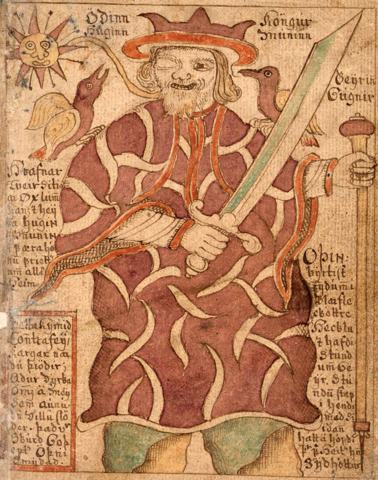
The Allfather. God of war, poetry and the dead who traded an eye for wisdom and hanged himself on the world tree to win the runes.
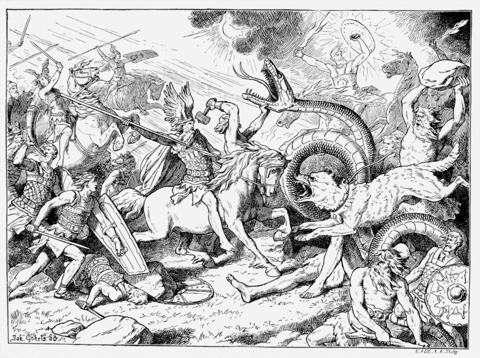
The Twilight of the Gods. The prophesied end: a killing winter, the breaking of every bond, a battle no one survives — and an earth that rises again.
The stronghold of the AEsir. A walled citadel of halls at the top of the world tree, reached by the rainbow bridge and built on a bargain the gods broke.
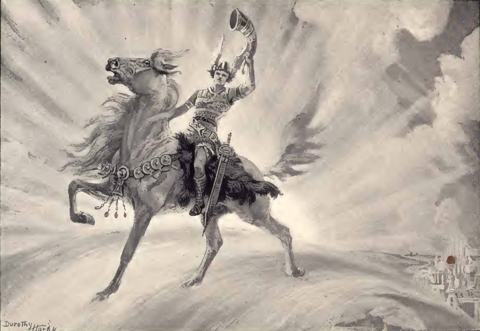
Watchman of the Gods. Born of nine mothers, he guards the rainbow bridge, hears wool grow on sheep, and will sound the horn that begins the end.
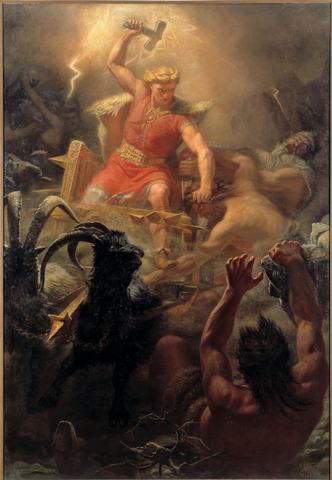
God of Thunder. Son of Odin and the earth, wielder of Mjolnir, and the gods' front line against the giants — fated to fall with the World Serpent.
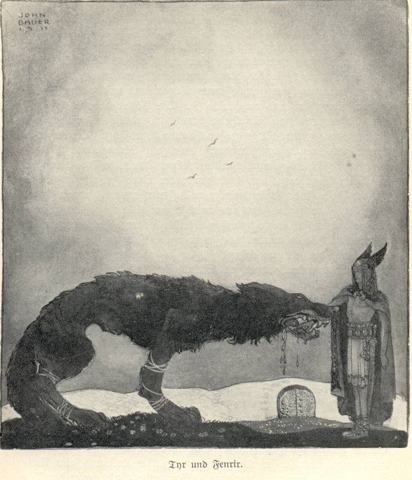
God of Sacred Law. Once perhaps the sky-father of the north, remembered chiefly for putting his sword hand into a wolf's mouth and losing it.
Also mentioned inHuginn and Muninn
Sources & Further Reading
- 1.Poetic Edda — Voluspa, Vafthrudnismal and Lokasenna (Codex Regius, 13th century).
- 2.Snorri Sturluson, Prose Edda — Skaldskaparmal (c. 1220).
- 3.Snorri Sturluson, Heimskringla — Ynglinga saga (c. 1230).
- 4.Dumezil, Georges. Gods of the Ancient Northmen. Ed. Einar Haugen. University of California Press, 1973.
- 5.Simek, Rudolf. "The Vanir - An Obituary." Retrospective Methods Network Newsletter 1 (2010), 10-19.
- 6.Lindow, John. Norse Mythology — A Guide to the Gods, Heroes, Rituals, and Beliefs. Oxford University Press, 2001.
- 7.Turville-Petre, E.O.G. Myth and Religion of the North — The Religion of Ancient Scandinavia. Weidenfeld & Nicolson, 1964.
- 8.Larrington, Carolyne (trans.). The Poetic Edda. Rev. ed., Oxford World's Classics, 2014.
Spot an error or have a source to suggest? Write to info@viseterna.com. We cite primary sources and modern scholarship, and we correct fast.