
Ragnarok
The Twilight of the Gods. The prophesied end: a killing winter, the breaking of every bond, a battle no one survives — and an earth that rises again.
Der letzte Kampf (The Last Battle), Johannes Gehrts, 1888 · Public domain · source
What the Word Means
The Old Norse term is ragnarok, and it means roughly "the fate — or doom — of the powers". The familiar English rendering "twilight of the gods" comes from a variant, ragnarokkr, which Snorri Sturluson uses and which substitutes rokkr, "twilight", for rok, "fate" 3,5. It may be Snorri's own reinterpretation or an older poetic pun; either way it is the version that reached Wagner as Götterdämmerung and, through him, most of modern culture 5,7. Modern translators generally render the older form as "the doom" or "the fate of the gods", keeping the sense of an appointment rather than a nightfall 8.
The two main sources differ in temperament. Voluspa — a seeress's prophecy delivered to Odin — is compressed, allusive and terrifying. Snorri's Gylfaginning retells the same material as ordered narrative, filling gaps and smoothing contradictions, and much of what people "know" about Ragnarok is Snorri's arrangement rather than the older poetry's 4,7.
The Signs
The end announces itself. Brothers will fight and kill each other, kinship will count for nothing, and Voluspa names the era in three hammer-blows: an axe age, a sword age, a wolf age 1. Then comes Fimbulvetr, the mighty winter — three winters running with no summer between them, snow from every direction, and the world starving before anything supernatural has happened at all 3.
The wolves catch what they have been chasing since the beginning: one swallows the sun, another the moon, and the stars go out. Yggdrasil shudders. The hound Garmr howls at the cave-mouth Gnipahellir, every chain and fetter in the cosmos snaps, and the rooster crows in three worlds at once 1,3.
The Muster
Fenrir runs free with his jaws stretched from earth to sky. Jormungandr rises out of the sea and comes ashore spraying venom over air and water. Loki, released from his bindings, steers Naglfar — the ship built from the untrimmed nails of the dead — with the host of Hel aboard, and the frost-giants sail with him 1,3.
From the south comes Surtr with a sword brighter than the sun, leading the fire-powers of Muspell. The rainbow bridge Bifrost breaks under their weight. Heimdall rises and blows the Gjallarhorn so hard it is heard in every world, and the Einherjar of Valhalla — the whole hoard Odin has been assembling for exactly this — march out through five hundred and forty doors onto the plain of Vigrid, a hundred leagues on every side 1,2,3.
The Fall of the Gods
The battle is a sequence of paired deaths, and almost nobody wins theirs cleanly. Odin goes against Fenrir and is swallowed; his son Vidarr avenges him immediately, setting one reinforced boot in the wolf's lower jaw and tearing it apart 1,3. Thor kills the World Serpent and manages nine steps before the venom drops him 1. Freyr, who gave away his sword for love, meets Surtr without it and falls. Tyr and Garmr destroy each other. Heimdall and Loki destroy each other 1,3.
Then Surtr flings fire across the Nine Realms, and Voluspa watches the sun go black, the land sink into the sea, and steam roar up against the sky 1.
Rebirth
The prophecy does not stop there, and that is its most remarkable feature. The earth rises a second time out of the water, green, with waterfalls and an eagle hunting fish. The surviving gods gather on the field of Idavoll and find the old golden gaming pieces lying in the grass. Baldr returns from the dead and is reconciled with the blind brother who killed him. Thor's sons Modi and Magni come carrying Mjolnir. And two humans, Lif and Lifthrasir, who sheltered inside the world tree and lived on morning dew, walk out to repopulate the world 1,2,3.
Voluspa ends with a hall roofed in gold and, in one much-argued stanza, a powerful figure who "comes from above" to rule — a line many scholars read as Christian influence on a poem composed at the boundary of conversion, and others defend as native 4,6,7.
How to Read It
Ragnarok is not a moral judgement. Nobody is punished for sin; the gods do not lose because they were wrong, and Odin has known the whole script since Voluspa began. What the myth stages is a universe where fate is genuinely fixed, foreknowledge changes nothing, and the only available response is to prepare anyway and meet it on your feet 4,6.
Scholars are divided on how much of the surviving shape is pre-Christian. The eschatology has structural parallels in Christian apocalyptic and possibly in Iranian material, and the extant poems were written down two centuries after conversion by authors who knew both traditions 5,6,7. What is not in doubt is that the tenth-century carvers already knew the story: the Gosforth Cross in Cumbria, a Christian monument, shows a bound figure with a woman holding a bowl above him and a god thrusting into a monster's jaw 4,6.
Continue Exploring
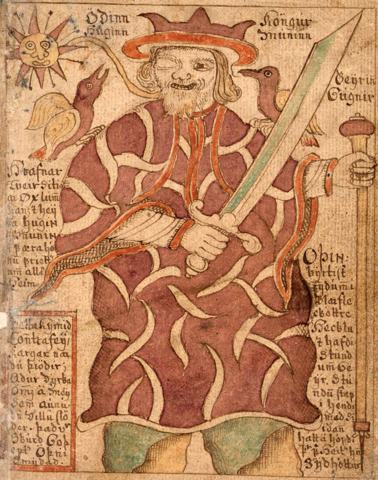
The Allfather. God of war, poetry and the dead who traded an eye for wisdom and hanged himself on the world tree to win the runes.
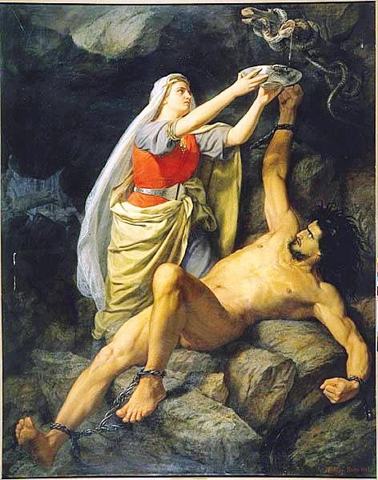
The Trickster. Shape-shifter of giant blood counted among the gods — their cleverest ally, the father of monsters, and the spark of Ragnarok.
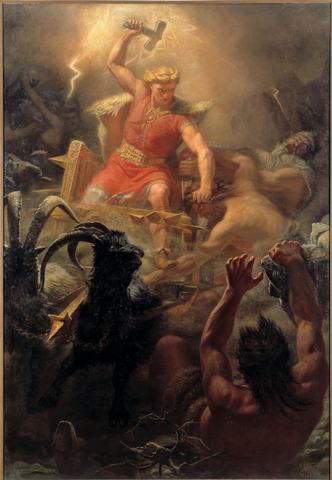
God of Thunder. Son of Odin and the earth, wielder of Mjolnir, and the gods' front line against the giants — fated to fall with the World Serpent.
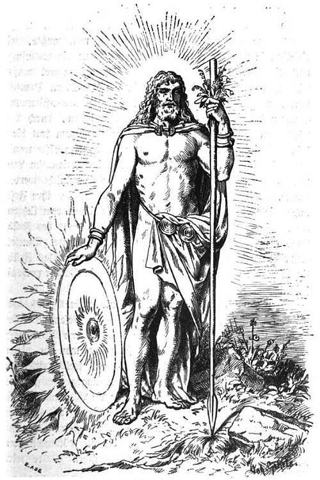
God of Light. The most beloved of the Aesir, made immune to all harm but one plant — and killed by it, which set the world's ending in motion.
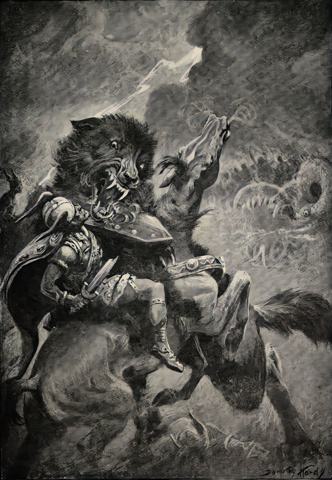
The Bound Wolf. Loki's son, raised among the gods and chained by a trick that cost Tyr his hand — until Ragnarok, when he devours Odin.
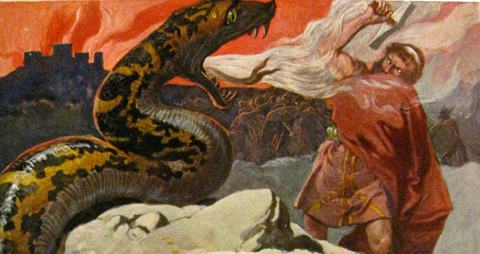
Hammer of Thor. Dwarf-forged, short in the handle, it strikes like lightning, hallows oaths and the dead, and always returns to the hand that throws it.
Also mentioned inAsgardBifrost (The Rainbow Bridge)BragiDraugr (Norse Undead)DraupnirGleipnirGungnirHeimdall (Heimdallr)HelHelheimHodr (Hod)Huginn and MuninnIdunn (Idun)JormungandrJotunheimMidgardMimirNidhoggrNjord (Njörðr)SleipnirSurtrThe Aesir-Vanir WarThe Death of BaldrThe NornsThe Poetic EddaThe Prose EddaTyrUllrValkyriesVidarWyrdYggdrasil
Sources & Further Reading
- 1.Poetic Edda — Voluspa (Codex Regius, 13th century).
- 2.Poetic Edda — Vafthrudnismal and Grimnismal (Codex Regius, 13th century).
- 3.Snorri Sturluson, Prose Edda — Gylfaginning (c. 1220).
- 4.Lindow, John. Norse Mythology — A Guide to the Gods, Heroes, Rituals, and Beliefs. Oxford University Press, 2001.
- 5.Simek, Rudolf. Dictionary of Northern Mythology. Trans. Angela Hall. D.S. Brewer, 1993.
- 6.Turville-Petre, E.O.G. Myth and Religion of the North — The Religion of Ancient Scandinavia. Weidenfeld & Nicolson, 1964.
- 7.Abram, Christopher. Myths of the Pagan North — The Gods of the Norsemen. Continuum, 2011.
- 8.Larrington, Carolyne (trans.). The Poetic Edda. Rev. ed., Oxford World's Classics, 2014.
Spot an error or have a source to suggest? Write to info@viseterna.com. We cite primary sources and modern scholarship, and we correct fast.