
Huginn and Muninn
Thought and Memory. Odin's two ravens fly the whole world each day and report at his ear - and he admits he fears losing Memory more.
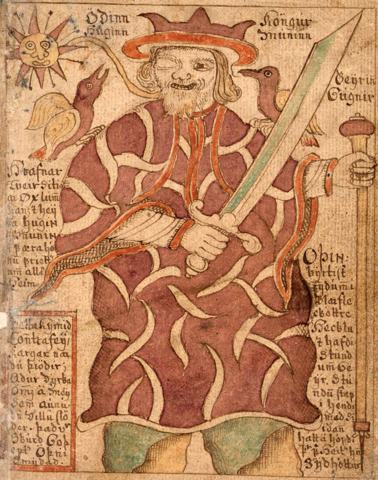
Odin with the ravens Huginn and Muninn, SAM 66 (Edda oblongata), Iceland, 1765-66 (Arni Magnusson Institute, Reykjavik) · Public domain · source
Thought and Memory
Huginn and Muninn are the two ravens that sit on Odin's shoulders and bring him the news of the world. Their names are not decoration: Huginn is built on Old Norse hugr, mind or thought, and Muninn on munr, memory or mind-in-the-sense-of-desire 5,6. Naming a god's informants Thought and Memory is a piece of deliberate mythmaking — the Allfather's intelligence network is his own cognition, sent out and brought back 5,6,7.
Snorri gives the daily routine plainly. At dawn Odin sends them out; they fly over the whole world and return in time for the morning meal, and from them he learns of many things. This, Snorri says, is why he is called Hrafnagud, raven-god 2. The corresponding kennings in Skaldskaparmal work the same way: Odin can be named as the ravens' god, their burden-bearer, or their feeder 3.
The Line That Makes the Myth
The single most quoted stanza about them is in Grimnismal, where Odin, in disguise and hanging between two fires, lists the furniture of his world. Huginn and Muninn fly out over the wide earth every day; and then he adds that he fears Huginn may not come home, but that his care for Muninn is greater still 1,8.
That admission has been read hard by modern scholars, because it is the only place in the corpus where Odin confesses a fear about his own faculties. Some take it as a hint that the ravens are genuinely detachable parts of the god — that losing them would be losing thought and memory themselves — and connect it to the wider Norse idea of a soul or fylgja that can leave the body 5,7. Others caution that the stanza belongs to a poem full of catalogue and riddle, and that reading a whole psychology out of two lines risks over-interpretation 5,6. The half-line about Memory mattering more has nevertheless become one of the most durable images in Norse literature.
Ravens on the Battlefield
Behind the mythology lies an entirely practical observation. Ravens follow armies, and Old Norse and Old English poetry both have a stock scene in which raven, eagle and wolf gather to feed after a battle. Because Odin is the god who decides who falls, the birds that arrive to eat the fallen are naturally his 5,7.
The skaldic poem Haraldskvaedi, also called Hrafnsmal, composed for Harald Fairhair around the year 900, is built as a dialogue between a valkyrie and a raven that has followed Harald since it hatched and can report on his battles 4,7. That poem is roughly three centuries older than the Eddas, which makes it useful evidence that the link between a lord, a raven and the news of war was already conventional in the Viking Age and not a late literary invention 5,7.
The connection ran into real politics as well. Viking-age leaders in England and Ireland are described as fighting under a raven banner, the hrafnsmerki, and the Valkyries who choose the slain occupy the same battlefield imagery 5,7. When the birds of a war god become a flag, the mythology and the military have merged.
The Archaeological Trail
Depictions of a helmeted figure flanked by two birds appear across the Germanic world well before the Eddas were written. Migration Period gold bracteates from Scandinavia show a head with birds beside it, and pressed-metal helmet plates from Vendel and Valsgarde in Sweden show riders and warriors accompanied by birds of prey or corvids 5,6,7.
Whether these images depict Odin with Huginn and Muninn specifically is contested. The names are attested only in Icelandic manuscripts, and scholars debate how far back the pairing can be pushed; some argue the bracteate imagery is a direct ancestor of the Eddic ravens, while others treat the two-bird motif as a broader Germanic convention for divine or royal authority 5,6. What is not disputed is that a god flanked by two birds was a familiar image for a very long time.
A God Who Depends on Two Birds
The theological point of Huginn and Muninn is that Odin's power is informational. He does not simply know; he gathers. The ravens work in the same register as the rest of his apparatus for acquiring knowledge at a price — the eye he gives up at Mimir's well, the nine nights on Yggdrasil, the head of Mimir he preserves and consults after the Aesir-Vanir War, and the eight-legged Sleipnir that carries him between worlds 2,5. Each is a mechanism for reach.
That reach is also a vulnerability, which is precisely what the Grimnismal stanza dramatises. The god who knows everything is the god most exposed to forgetting, and Voluspa has him going into Ragnarok already knowing how it ends 1,5. The ravens do not save him. They only make sure that when it comes, he sees it coming.
Their modern afterlife is considerable — as heraldic devices, as the names of ships and satellites, and as a permanent fixture of any illustration of Odin, including the 18th-century Icelandic manuscript image on this page, where a scribe has helpfully labelled both birds 5,6.
Continue Exploring
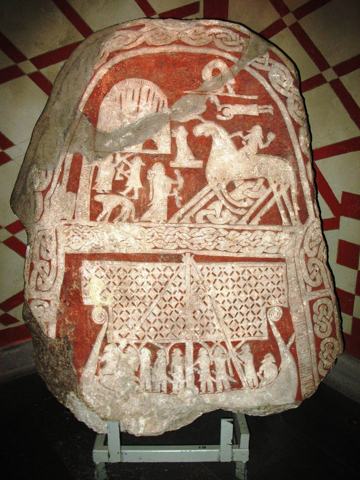
The grey eight-legged horse Loki bore as a mare. Best of all steeds, Odin's mount between the worlds, and the only horse to jump the gate of Hel.
The Allfather. God of war, poetry and the dead who traded an eye for wisdom and hanged himself on the world tree to win the runes.
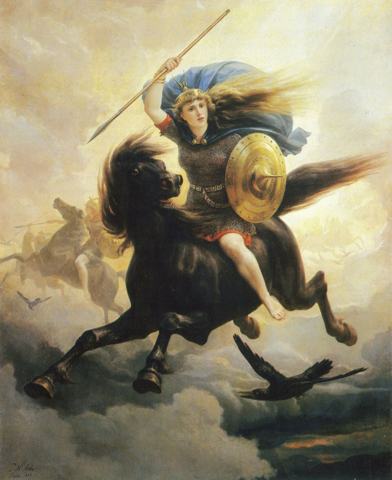
Choosers of the Slain. Odin's riders who decide who dies in battle and carry the chosen to Valhalla — battlefield spirits before they were shieldmaidens.
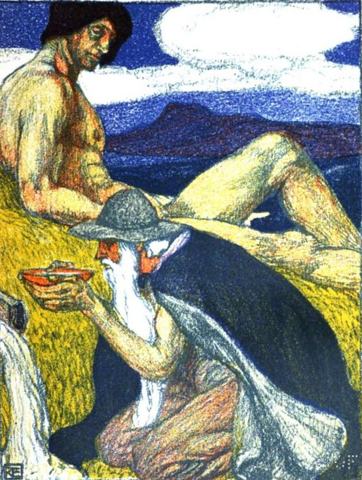
The being who keeps the well of wisdom beneath Yggdrasil — beheaded in a botched peace treaty, and consulted by Odin as a severed head ever after.
Voluspa calls it the first war in the world. Gullveig burned three times, Odin cast the first spear, and the truce reshaped the Norse pantheon.
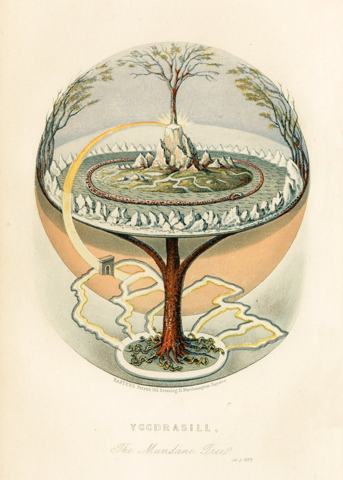
The World Tree. The great ash whose roots reach three wells and nine worlds, tended by the norns, eaten from every side, and still standing when the sky burns.
Sources & Further Reading
- 1.Poetic Edda — Grimnismal (Codex Regius, 13th century).
- 2.Snorri Sturluson, Prose Edda — Gylfaginning (c. 1220).
- 3.Snorri Sturluson, Prose Edda — Skaldskaparmal (c. 1220).
- 4.Thorbjorn Hornklofi, Haraldskvaedi (Hrafnsmal), c. 900, preserved in Fagrskinna and Heimskringla.
- 5.Lindow, John. Norse Mythology — A Guide to the Gods, Heroes, Rituals, and Beliefs. Oxford University Press, 2001.
- 6.Simek, Rudolf. Dictionary of Northern Mythology. Trans. Angela Hall. D.S. Brewer, 1993.
- 7.Turville-Petre, E.O.G. Myth and Religion of the North — The Religion of Ancient Scandinavia. Weidenfeld & Nicolson, 1964.
- 8.Larrington, Carolyne (trans.). The Poetic Edda. Rev. ed., Oxford World's Classics, 2014.
Spot an error or have a source to suggest? Write to info@viseterna.com. We cite primary sources and modern scholarship, and we correct fast.