
The Nine Realms
The Worlds of Yggdrasil. Norse sources count nine worlds on the world tree — but no medieval text ever lists them, and the familiar roster is modern.
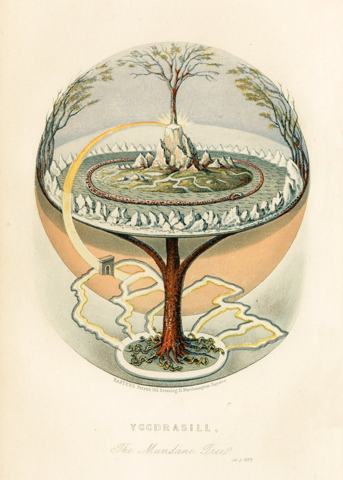
Yggdrasill and the worlds, AM 738 4to, c. 1680 (Arni Magnusson Institute, Reykjavik) · Public domain · source
Nine Worlds, Never Named
The phrase is genuinely old. In the second stanza of Voluspa the seeress declares that she remembers nine worlds — niu heimar — and nine wood-dwelling giantesses, and the great tree before it grew from the ground. Vafthrudnismal has the giant boast that he has travelled through all nine worlds, down as far as Niflhel below 1.
And that is the whole of it. No surviving medieval Norse source ever enumerates the nine. Neither Eddic poem lists them, Snorri never compiles them, and the tidy roster familiar from modern books, games and films is a reconstruction assembled by later scholars and popularisers out of scattered place-names 4,5,7. Lindow and Simek both make the point directly: the number is traditional, the contents are not 4,5.
Nine is in any case the sacred number of the North. Odin hangs nine nights on the tree; Hermod rides nine nights to Hel; sacrifices at Uppsala and Lejre are reported at nine-year intervals with nine of each creature; Thor walks nine paces before he falls; Heimdall has nine mothers 1,2,6. "Nine worlds" may simply mean "all the worlds there are" 4,5.
The Places the Sources Do Name
What the texts give instead is a scatter of named locations, at inconsistent scales and never gathered into a system.
Asgard, the stronghold of the Aesir, reached across the rainbow bridge Bifrost 2. Midgard, the enclosure of humankind, built from Ymir's eyebrows and ringed by Jormungandr 2. Jotunheim — or Utgard, "the outyards" — the giants' country beyond the fence, which functions less as a place on a map than as the direction of everything hostile 2,4.
Vanaheim, home of the Vanir, named in Vafthrudnismal as where Njord was raised 1. Alfheim, given to the god Freyr as a teething-gift, and inhabited by the light-elves; Snorri contrasts them with the dark elves who live below and are, confusingly, more or less the dwarves 1,2. Nidavellir, "the dark fields", named in Voluspa as a place of dwarves, and Svartalfheim, which appears in Snorri as where the dwarves forge 1,2,3.
Muspell or Muspelheim, the fire-region in the south from which Surtr comes, and Niflheim, the freezing mist-world in the north. In Snorri's creation account these two are the poles whose meeting across the void Ginnungagap generates everything else 2. Hel or Niflhel lies furthest down, under a root of Yggdrasil 1,2.
Count them and you can reach nine, but only by choosing which duplicates to merge — Nidavellir with Svartalfheim, Hel with Niflheim — and the choices are modern 4,5,7.
A Tree, Not a Layer Cake
The popular diagram of nine tidy discs stacked on a trunk is also a modern convenience. The medieval cosmology is inconsistent about whether the worlds are above and below one another or beside one another, and it uses both spatial languages freely — Asgard is up, but you also ride there; Jotunheim is east, but also outward; Hel is down, but reached along a road 4,6.
Grimnismal complicates it further by listing twelve or thirteen dwellings of individual gods — Thrudheim, Ydalir, Valaskjalf, Sokkvabekk, Gladsheim, Thrymheim, Breidablik, Himinbjorg, Folkvangr, Glitnir, Noatun, Vidi — which are halls and estates, not worlds, but sit in the same descriptive register 1,8.
What holds it together is the tree. Three roots reach to three wells: the well of Urd where the Norns shape fate, Mimir's well of wisdom where Odin paid an eye, and Hvergelmir among the dead. An eagle sits at the crown, the dragon Nidhoggr gnaws below, and the squirrel Ratatoskr runs up and down carrying insults between them 1,2. The cosmos is organised by a living thing, and the connections that matter are branches and roots rather than borders 4,6.
Why the Modern List Persists
The standardised nine — Asgard, Vanaheim, Alfheim, Midgard, Jotunheim, Svartalfheim, Muspelheim, Niflheim, Helheim — is useful, memorable, and now effectively canonical outside academia. It gives storytellers a map, and the twentieth-century media that popularised Norse myth needed one 5,7.
Knowing that it is a reconstruction does not spoil it, but it changes what the sources are for. The medieval material is not a defective map missing its legend. It is a set of overlapping accounts of a world whose regions blur into one another — which is exactly what you would expect from a cosmology transmitted in verse, by people who never needed it to be consistent, and finally written down by a Christian antiquarian doing his best with what he had 4,5,6.
Continue Exploring
The World Tree. The great ash whose roots reach three wells and nine worlds, tended by the norns, eaten from every side, and still standing when the sky burns.
The alfar of Old Norse belief: sacrificed to at the alfablot, ranked beside the gods in poetry, and never quite pinned down by Snorri's own tidy scheme.
Queen of the Dead. Half living woman and half corpse, Loki's daughter rules the cold realm where those who die of sickness and age must go.
The Allfather. God of war, poetry and the dead who traded an eye for wisdom and hanged himself on the world tree to win the runes.
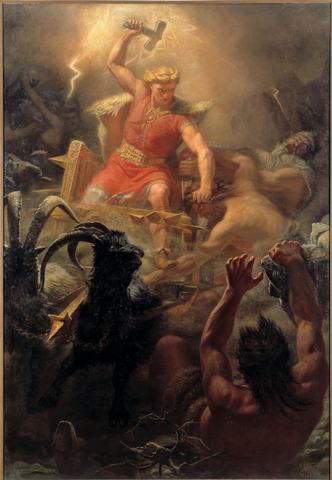
God of Thunder. Son of Odin and the earth, wielder of Mjolnir, and the gods' front line against the giants — fated to fall with the World Serpent.
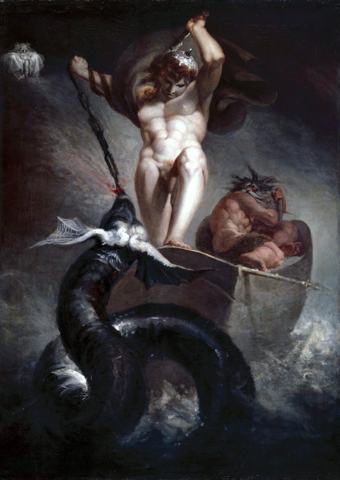
The World Serpent. Loki's monstrous child, cast into the ocean until it grew to ring all Midgard and bite its own tail. Thor's appointed enemy.
Also mentioned inAegir and RanThe Poetic Edda
Sources & Further Reading
- 1.Poetic Edda — Voluspa, Vafthrudnismal, Grimnismal and Alvissmal (Codex Regius, 13th century).
- 2.Snorri Sturluson, Prose Edda — Gylfaginning (c. 1220).
- 3.Snorri Sturluson, Prose Edda — Skaldskaparmal (c. 1220).
- 4.Lindow, John. Norse Mythology — A Guide to the Gods, Heroes, Rituals, and Beliefs. Oxford University Press, 2001.
- 5.Simek, Rudolf. Dictionary of Northern Mythology. Trans. Angela Hall. D.S. Brewer, 1993.
- 6.Turville-Petre, E.O.G. Myth and Religion of the North — The Religion of Ancient Scandinavia. Weidenfeld & Nicolson, 1964.
- 7.Orchard, Andy. Cassell's Dictionary of Norse Myth and Legend. Cassell, 1997.
- 8.Larrington, Carolyne (trans.). The Poetic Edda. Rev. ed., Oxford World's Classics, 2014.
Spot an error or have a source to suggest? Write to info@viseterna.com. We cite primary sources and modern scholarship, and we correct fast.