
Baldr
God of Light. The most beloved of the Aesir, made immune to all harm but one plant — and killed by it, which set the world's ending in motion.
Baldur, Johannes Gehrts, 1901 · Public domain · source
The Best of the Gods
Baldr is the son of Odin and Frigg, husband of Nanna and father of Forseti, the god who settles disputes. Snorri describes him in superlatives and then admits they are useless: he is so beautiful that light shines from him, so wise and eloquent that none of his judgements can be made to hold — the one detail in the portrait with any edge to it 1. His hall is Breidablik, "broad-gleaming", where Grimnismal says nothing impure can be 2.
He is defined almost entirely by his death. There is no myth in which Baldr does anything; there is only the myth in which something is done to him, and it is the pivot on which the whole Norse cosmos turns 4,5.
The Dreams and the Oaths
It begins with nightmares. Baldr dreams of his own death, and in Baldrs draumar Odin rides down to the underworld and wakes a dead seeress to ask why the benches there are strewn with gold and the ale brewed — she tells him the hall is prepared for Baldr, and that Hodr will bring him low 2.
Frigg's response is to go through the world extracting oaths from everything in it — fire and water, iron and every metal, stones, earth, trees, sicknesses, beasts, birds, poisons and serpents — that none will harm her son 1. It works. The gods make a sport of it, throwing weapons and stones at Baldr in the assembly and watching them glance off, which they find hilarious.
But Frigg passed over one plant as too young to swear: mistletoe. Loki, in the shape of a woman, gets that out of her in conversation, cuts the shoot, and brings it to the blind god Hodr — who is standing at the edge of the game because he cannot see to join in. Loki offers to guide his aim. Baldr falls dead on the spot 1.
The Funeral
Snorri's account of the pyre is one of the great scenes in medieval literature, and its strangeness is the point. The gods carry Baldr to his ship Hringhorni, the largest ever built, and cannot launch it. They send to Jotunheim for the giantess Hyrrokkin, who arrives riding a wolf bridled with vipers and shoves the ship out with one push so hard that fire springs from the rollers and the earth shakes; Thor has to be talked out of killing her 1.
Nanna sees her husband's body and dies of grief, and is laid on the pyre beside him. Baldr's horse goes on with all its harness. Odin lays his ring Draupnir on the fire and stoops to whisper something in his dead son's ear — a secret the sources never disclose, and which is later used as an unanswerable riddle. And Thor, consecrating the flames with Mjolnir, notices a dwarf named Litr underfoot and kicks him into the fire, apparently for being there 1.
Hermod's Ride
Odin's son Hermod rides Sleipnir nine nights down dark valleys to Hel, clears her gate at a jump, and finds Baldr already seated in the high seat of her hall. Hel makes a bargain: if every thing in the world, living and dead, weeps for Baldr, she will release him.
Messengers go out and everything weeps — people, animals, earth, stones, trees, metals, exactly the list Frigg had sworn. Except a giantess sitting in a cave, who calls herself Thokk and says she will weep dry tears and that Hel may keep what she has. Snorri ends the chapter with the flattest sentence in the Prose Edda: people think that was Loki 1.
A Different Baldr
Saxo Grammaticus, writing Latin history in Denmark around 1200, tells the same names as an entirely different story. His Balderus is a demigod and Hotherus a mortal prince, and they are rivals for Nanna, who is a king's daughter with a preference. Hotherus obtains a special sword capable of killing his rival, defeats him in the field after a run of battles, and Balderus dies of the wound days later 3.
There is no mistletoe, no oath, no trickster and no grief — it is a war over a woman, with the sympathetic party being the killer. Whether Saxo is preserving an older, more martial Scandinavian tradition or rationalising a myth he found embarrassing is one of the standing arguments in the field, and there is no settled answer 4,6,7.
How to Read the Death
Nineteenth- and early twentieth-century scholarship liked Baldr as a dying-and-rising vegetation god in the manner of Frazer's Golden Bough, and that reading is now largely abandoned; the textual support is thin and the parallels were forced 4,6,7. Christian influence has also been proposed — an innocent beloved son, killed, mourned by all creation, returning after the world's end — and cannot be ruled out for texts written down by Christians 6,7.
Lindow's monograph on the subject moved the argument onto Norse ground by reading the story as a feud narrative. A killing inside a family creates an obligation of vengeance; here the killer is a blind kinsman, the instigator cannot be expelled without destroying the household, and the case is unsettleable. Odin's response is to father Vali on the giantess Rindr for the sole purpose of vengeance — a son who is one night old when he kills Hodr, unwashed and uncombed 5,2.
That, in the end, is why Baldr's death is the beginning of Ragnarok. It is not that the gods lost their best member. It is that they were left with a debt no procedure could clear 5,4.
Return
Voluspa gives him the last word anyway. After the fire and the flood, when the earth rises green a second time and the surviving gods gather at Idavoll, Baldr comes back from the dead — and Hodr comes with him, and they live together, and the feud is simply over 2,1.
Continue Exploring
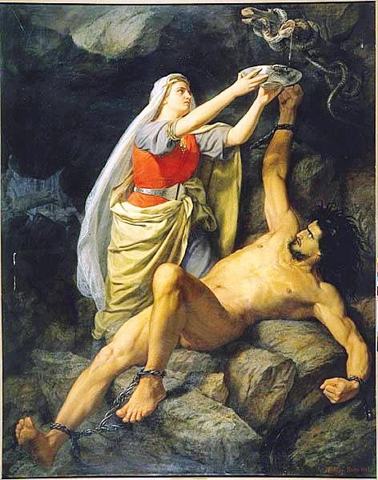
The Trickster. Shape-shifter of giant blood counted among the gods — their cleverest ally, the father of monsters, and the spark of Ragnarok.
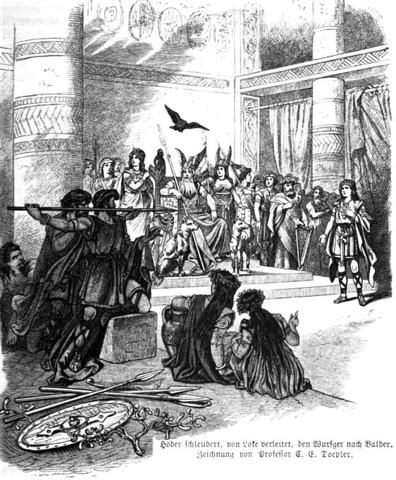
The blind god who threw the dart that killed Baldr, guided by Loki's hand — Norse myth's clearest case of a killer who may not be the guilty party.
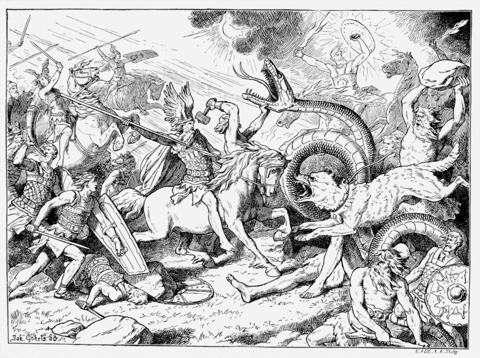
The Twilight of the Gods. The prophesied end: a killing winter, the breaking of every bond, a battle no one survives — and an earth that rises again.
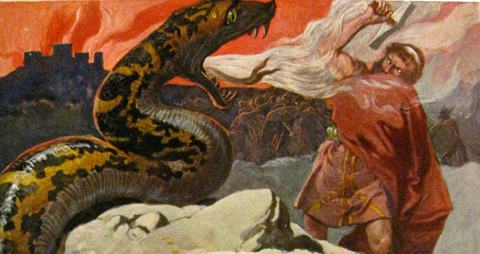
Hammer of Thor. Dwarf-forged, short in the handle, it strikes like lightning, hallows oaths and the dead, and always returns to the hand that throws it.
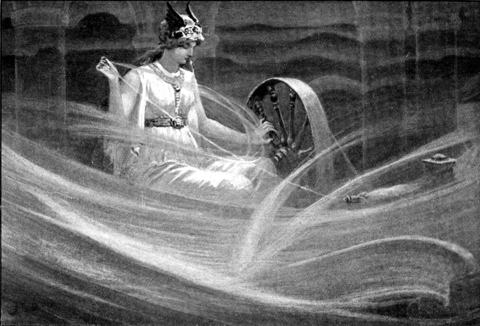
Odin's wife and the highest-ranking goddess of the Aesir — keeper of foreknowledge she will not speak, and the mother whose oaths could not save Baldr.
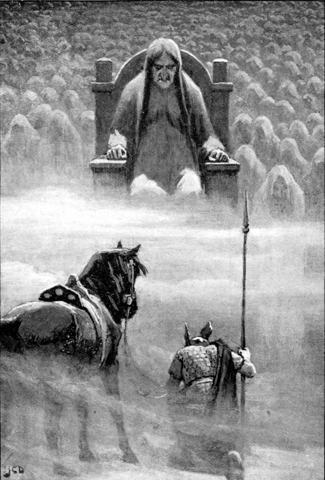
Queen of the Dead. Half living woman and half corpse, Loki's daughter rules the cold realm where those who die of sickness and age must go.
Also mentioned inAsgardHelheimJotunheimMimirNidhoggrNjord (Njörðr)Skadi (Skaði)The Death of BaldrVidar
Sources & Further Reading
- 1.Snorri Sturluson, Prose Edda — Gylfaginning (c. 1220).
- 2.Poetic Edda — Voluspa, Baldrs draumar and Lokasenna (Codex Regius, 13th century).
- 3.Saxo Grammaticus, Gesta Danorum, Book III (c. 1200).
- 4.Lindow, John. Norse Mythology — A Guide to the Gods, Heroes, Rituals, and Beliefs. Oxford University Press, 2001.
- 5.Lindow, John. Murder and Vengeance among the Gods — Baldr in Scandinavian Mythology. FF Communications 262, Academia Scientiarum Fennica, 1997.
- 6.Simek, Rudolf. Dictionary of Northern Mythology. Trans. Angela Hall. D.S. Brewer, 1993.
- 7.Turville-Petre, E.O.G. Myth and Religion of the North — The Religion of Ancient Scandinavia. Weidenfeld & Nicolson, 1964.
Spot an error or have a source to suggest? Write to info@viseterna.com. We cite primary sources and modern scholarship, and we correct fast.