
Sigurd (Siegfried)
The Volsung hero who slew the dragon Fafnir, tasted its heart-blood, and rode straight into the tragedy of Brynhild and the Niflungs.
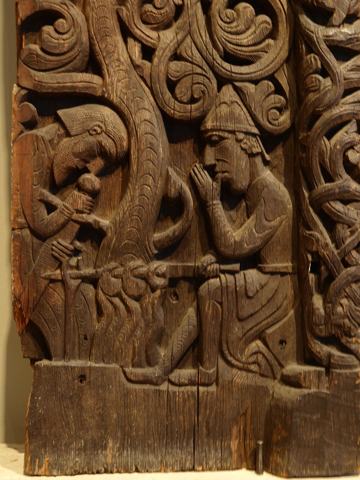
Ramsund carving (So 101), Sodermanland, Sweden, c. 1030 · CC BY 2.5 · source
Name and the Missing Poems
Old Norse Sigurdr travels into German legend as Siegfried and into English as the hero of a story most people now meet secondhand, through Wagner or through Tolkien's dragon-sickness. In Iceland he is the central figure of the Volsung cycle, the semi-legendary history of a family descended from Odin through Sigi, Rerir and Volsung, and the single most-told heroic story to survive from the Norse Middle Ages 1,2,6.
The manuscript record has a hole exactly where the story turns tragic. Codex Regius, the 13th-century collection that preserves the Poetic Edda, is missing a gathering of leaves right after Sigrdrifumal — a gap scholars call the Great Lacuna — and the missing pages are thought to have carried the poem, or poems, telling how Sigurd wooed Brynhild in Gunnar's shape and how the Gjukungs came to kill him for it. Reginsmal and Fafnismal, which cover his youth and the killing of the dragon, both survive substantially intact earlier in the same manuscript, well before the gap 1,6. The 13th-century prose Volsunga Saga was written by someone with access to those now-lost poems, and it is largely thanks to that saga that the missing chapter of Sigurd's life — his path to Brynhild's vengeance — can be reconstructed at all 2,4.
Fostered by a Dwarf, Forging Gram
Sigurd's father Sigmund dies in battle before his birth, and the boy is raised at a foreign court by the smith Regin, who is — pointedly — the dwarf brother of the dragon Sigurd will eventually kill. Regin tests the boy twice, forging swords that shatter against an anvil, before Sigurd insists on the shards of his father's blade Gram; reforged, it splits the anvil in one stroke and shears a lock of wool carried down a stream 1,2. Regin's motive is not affection. He wants Fafnir's hoard and needs a fighter reckless enough to get it for him.
Killing Fafnir, Tasting the Blood
Fafnismal stages the killing as an ambush rather than a duel. Sigurd digs a pit in the track Fafnir uses to crawl to water and hides in it; when the dragon passes overhead, Sigurd drives Gram up into its heart from below. Snorri credits Odin with the tactic, appearing in disguise to advise digging several trenches so the dragon's blood has somewhere to drain besides the hero's hiding place 1,3. As Fafnir dies he talks at length — about the Norns, about the curse riding on the gold, about what is coming for Sigurd too — and the hero listens rather than gloating, which the poem treats as wisdom rather than mercy 1,5.
Regin has Sigurd roast the heart and asks to be told when it is done. Testing it with a finger, Sigurd burns himself, puts the finger in his mouth, and finds he can suddenly understand the birds overhead — who are saying, plainly, that Regin means to kill him for the gold the moment his guard is down. Sigurd beheads his foster-father first, eats some of the heart himself, and rides off with the whole hoard on his horse Grani, whose bloodline the sources trace back to Sleipnir 1,2,4.
Brynhild, Gudrun, and the Curse Doing Its Work
The gold Sigurd now carries was cursed at its source, wrung from the dwarf Andvari by Loki as weregild for Regin and Fafnir's murdered father — every source agrees the treasure will destroy whoever holds it, and the rest of Sigurd's life is that promise being kept 1,2. He rides through a wall of flame to wake the valkyrie Brynhild, and the two swear to marry; then, at the hall of the Gjukungs, he is given a potion that erases the memory of that oath, marries Gudrun instead, and — wearing Gunnar's shape by an exchange of forms — wins Brynhild for his new brother-in-law 2,4,8. Brynhild learns the trick, and her fury sets the saga's second half in motion: Sigurd is murdered in his bed, and the same hoard passes on to destroy the Gjukungs in turn when Atli comes for it 2,8.
Reading Sigurd
The story survived because it traveled well outside Iceland. Germany kept its own branch as the Nibelungenlied, England carved fragments of it onto stone crosses, and Sweden's Ramsund carving — a full two centuries before Volsunga Saga was written down — already shows the pit, the heart, the birds, and Grani in the right order, proof the legend's shape was fixed well before anyone wrote it in prose 1,2,6,7. Andersson's close study of the Brynhild material argues the doomed-love triangle was reworked repeatedly across that transmission, which is one reason the surviving Norse and German versions disagree on details even while agreeing on the bones 8. What holds constant is the shape of the tragedy: a hero brave enough to kill a dragon is still not immune to a curse he never asked for, and the gold he thought he had won outright turns out to have only been on loan 1,2,6,7.
Continue Exploring
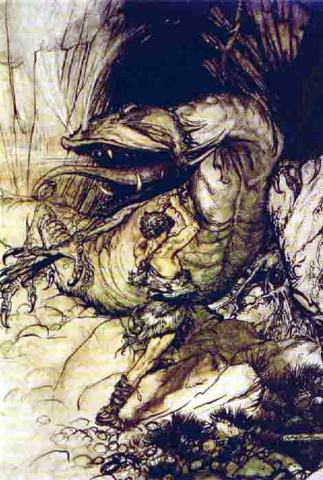
The dwarf-born son who murdered his father for cursed gold, turned into a dragon to guard it alone, and was killed from a pit by Sigurd.
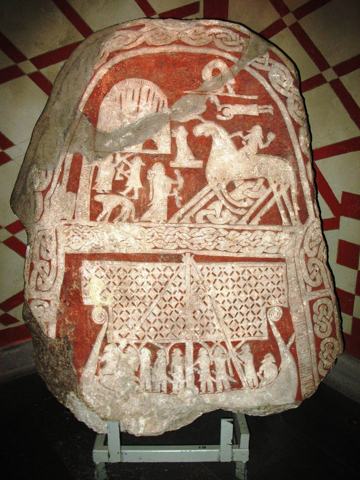
The grey eight-legged horse Loki bore as a mare. Best of all steeds, Odin's mount between the worlds, and the only horse to jump the gate of Hel.
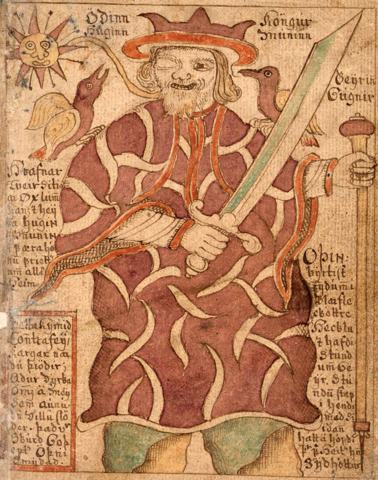
The Allfather. God of war, poetry and the dead who traded an eye for wisdom and hanged himself on the world tree to win the runes.
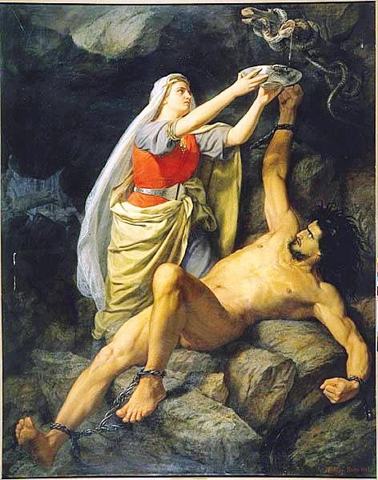
The Trickster. Shape-shifter of giant blood counted among the gods — their cleverest ally, the father of monsters, and the spark of Ragnarok.
Anonymous Old Norse poems on gods and heroes, preserved in one 13th-century manuscript — the primary source for most of what survives of Norse myth.
The 13th-century Icelandic saga that turns scattered eddic poems about Sigurd, Brynhild and cursed gold into one continuous, doom-laden family history.
Sources & Further Reading
- 1.Poetic Edda — Reginsmal, Fafnismal and Sigrdrifumal (Codex Regius, 13th century).
- 2.Volsunga Saga (13th century).
- 3.Snorri Sturluson, Prose Edda — Skaldskaparmal (c. 1220).
- 4.Byock, Jesse L., trans. The Saga of the Volsungs: The Norse Epic of Sigurd the Dragon Slayer. University of California Press, 1990.
- 5.Larrington, Carolyne (trans.). The Poetic Edda. Rev. ed., Oxford World's Classics, 2014.
- 6.Lindow, John. Norse Mythology — A Guide to the Gods, Heroes, Rituals, and Beliefs. Oxford University Press, 2001.
- 7.Simek, Rudolf. Dictionary of Northern Mythology. Trans. Angela Hall. D.S. Brewer, 1993.
- 8.Andersson, Theodore M. The Legend of Brynhild. Islandica 43. Cornell University Press, 1980.
Spot an error or have a source to suggest? Write to info@viseterna.com. We cite primary sources and modern scholarship, and we correct fast.