
Sleipnir
The grey eight-legged horse Loki bore as a mare. Best of all steeds, Odin's mount between the worlds, and the only horse to jump the gate of Hel.
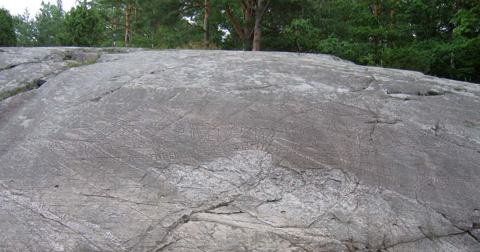
Tjangvide picture stone (G 110), Gotland, 8th-9th century; photo by Berig, 2008 (Swedish History Museum, Stockholm) · CC BY-SA 4.0 · source
Best of All Horses
Grimnismal runs a catalogue of superlatives — the best tree, the best ship, the best of the gods — and in it Sleipnir is the best of steeds, as Yggdrasil is the best of trees and Odin the greatest of gods 1,8. Snorri agrees and adds the detail everyone remembers: Sleipnir is grey, he has eight legs, and he is Odin's own 2. The name is usually derived from a root meaning "to slip" or "to glide", giving something like "the slipper" or "the smooth-goer" 5,6.
Where an ordinary horse in Norse myth is transport, Sleipnir is access. He is the animal that carries Odin between the worlds — down to the dead, out over the sea, across whatever boundary the story needs crossed — and the texts consistently reach for him when a journey is supposed to be impossible 2,5,7.
The Wall, the Mare, and the Foal
Sleipnir's birth is one of the great set pieces of Gylfaginning. A builder comes to the gods offering to raise a wall around Asgard strong enough to keep out giants, and to do it in a single winter. His price is the sun, the moon, and Freyja. On Loki's advice the gods accept, on terms they believe impossible, and allow him the help of his stallion Svadilfari 2.
The stallion turns out to do the heavy hauling, dragging enormous stones by night, and with days left the wall is nearly finished. The gods, facing catastrophe, turn on Loki and threaten him with death unless he fixes it. He fixes it: he takes the form of a mare, lures Svadilfari away from the work, and vanishes into the woods with the stallion after him. The builder, revealed as a giant, is killed by Thor 2.
Some time later Loki returns and gives birth to a grey foal with eight legs, and gives him to Odin 2. The story is doing two things at once. It explains where the finest horse in the world came from, and it establishes something the rest of the mythology never lets go of: the god of order rides an animal fathered by a giant's stallion and mothered by the trickster 5,7. The best thing in Asgard is a product of a bad bargain and a shapeshift.
Rider of the Road to Hel
Sleipnir's defining journey is the ride to the underworld after Baldr's death. Hermod borrows Odin's horse and rides nine nights through dark valleys until he reaches the river Gjoll and its bridge; then, at the gate of Hel's realm, he puts spurs to Sleipnir and the horse jumps the gate outright, clearing it so completely that it does not touch it 2. No other creature in the corpus does this.
Odin makes the trip himself in Baldrs draumar, saddling Sleipnir and riding down to Niflhel to wake a dead seeress and ask her what Baldr's dreams mean 1,8. The pattern in both cases is the same: when the question can only be answered on the far side of death, the horse is how you get there and, crucially, back.
Sigrdrifumal adds an odd, memorable detail to the runic lore the valkyrie teaches Sigurd: among the places where victory-runes were carved is Sleipnir's teeth 1,8. The horse is not only transport but an inscribed object, part of the apparatus of magical knowledge that Odin accumulates alongside Huginn and Muninn and the head of Mimir 5,7.
Ten Feet, Three Eyes, One Tail
Hervarar saga ok Heidreks preserves a riddle contest in which Odin, disguised as Gestumblindi, asks King Heidrek about a pair who run on ten feet, have three eyes between them and only one tail 4. The answer is Odin one-eyed on eight-legged Sleipnir, and the riddle only works because both the count and the god's disguise are common knowledge — evidence that the eight legs were a fixed, popular image and not an obscure learned detail 4,5.
Stone, Speed, and the Bier
Two Gotlandic picture stones, Tjangvide (G 110) and Ardre VIII, both from roughly the eighth to ninth centuries, show a rider on a horse with eight legs, greeted by a figure holding out a drinking horn, above a ship under sail 5,6,7. If the identification is right — and most scholars accept it — these are the oldest surviving depictions of Sleipnir, older than the written myths by three hundred years or more, and they place him firmly in a scene of arrival in the next world, of the kind associated with Valhalla and the Valkyries 5,7.
What the eight legs mean is debated. The simplest reading is speed: twice the legs, twice the horse 6. A second, argued at length by H.R. Ellis Davidson and others, connects Sleipnir to funeral imagery and to shamanic horse traditions from Siberia and Central Asia, where an eight-legged animal carries the soul; on this reading the eight legs may echo a bier carried by four bearers 7. A third position holds that the motif is simply an artistic convention for a supernatural mount and needs no external source 5,6. Scholars have not settled it, and the picture stones do not say.
Sleipnir is never given a death. Snorri has Odin ride out first when the gods arm for Ragnarok, helmed and carrying Gungnir, and there the sources simply stop following the horse 2,5. Later tradition does give him descendants: Sigurd's horse Grani is said to be of Sleipnir's stock, so the eight-legged foal of a trickster becomes, eventually, ancestry 3,5.
Continue Exploring
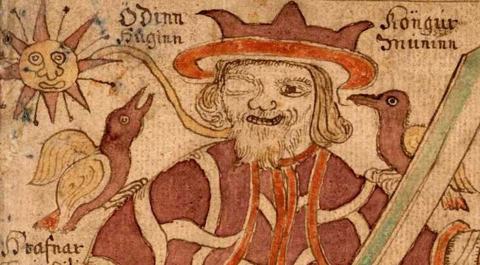
Thought and Memory. Odin's two ravens fly the whole world each day and report at his ear - and he admits he fears losing Memory more.
The Volsung hero who slew the dragon Fafnir, tasted its heart-blood, and rode straight into the tragedy of Brynhild and the Niflungs.
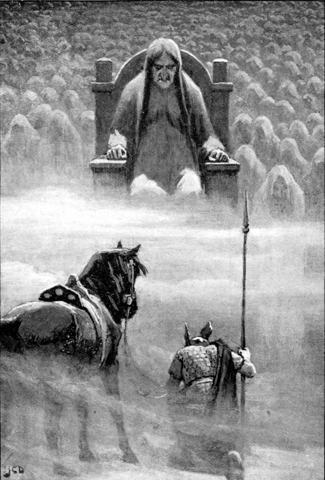
Queen of the Dead. Half living woman and half corpse, Loki's daughter rules the cold realm where those who die of sickness and age must go.
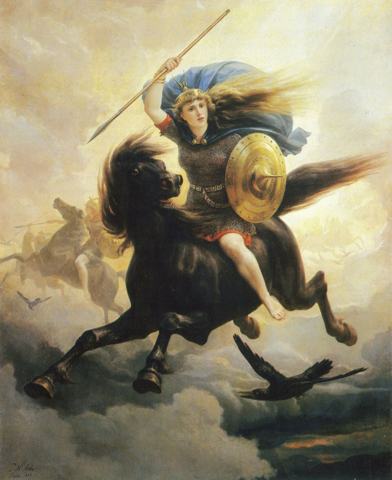
Choosers of the Slain. Odin's riders who decide who dies in battle and carry the chosen to Valhalla — battlefield spirits before they were shieldmaidens.
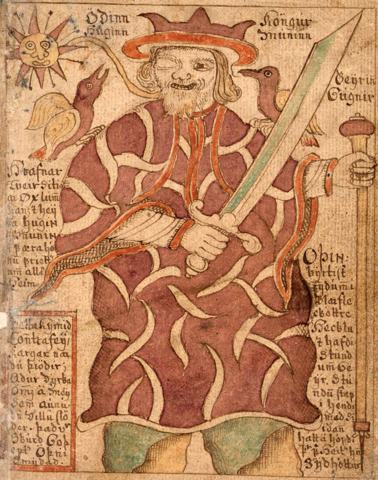
The Allfather. God of war, poetry and the dead who traded an eye for wisdom and hanged himself on the world tree to win the runes.
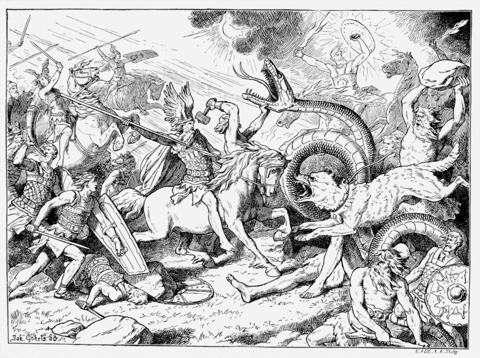
The Twilight of the Gods. The prophesied end: a killing winter, the breaking of every bond, a battle no one survives — and an earth that rises again.
Also mentioned inBifrost (The Rainbow Bridge)The Runes
Sources & Further Reading
- 1.Poetic Edda — Grimnismal, Baldrs draumar and Sigrdrifumal (Codex Regius, 13th century).
- 2.Snorri Sturluson, Prose Edda — Gylfaginning (c. 1220).
- 3.Snorri Sturluson, Prose Edda — Skaldskaparmal (c. 1220).
- 4.Hervarar saga ok Heidreks — the riddles of Gestumblindi (13th century).
- 5.Lindow, John. Norse Mythology — A Guide to the Gods, Heroes, Rituals, and Beliefs. Oxford University Press, 2001.
- 6.Simek, Rudolf. Dictionary of Northern Mythology. Trans. Angela Hall. D.S. Brewer, 1993.
- 7.Ellis Davidson, H.R. Gods and Myths of Northern Europe. Penguin, 1964.
- 8.Larrington, Carolyne (trans.). The Poetic Edda. Rev. ed., Oxford World's Classics, 2014.
Spot an error or have a source to suggest? Write to info@viseterna.com. We cite primary sources and modern scholarship, and we correct fast.