
Draupnir
The dripping ring. Odin's gold arm-ring, which sheds eight more of its own weight every ninth night — burned on Baldr's pyre, and sent back from Hel.
Gold arm-ring with animal-head terminals, Viking Age, 800-1099, Östergötland, Sweden (Statens historiska museum) · CC BY 2.5 · source
The Dripper
Draupnir comes from drjupa, to drip, and is best translated simply as "the dripper" 5. It is the least dramatic name of all the great Norse treasures and describes the plainest mechanism: an arm-ring of gold from which, every ninth night, eight rings of equal weight fall 1,2.
No fighting, no thunder, no prophecy. Draupnir is a machine for making wealth, and in a society whose entire political structure ran on a lord's ability to hand out gold, that made it arguably the most powerful object Odin owned 4,7.
Made in the Wager
Draupnir is one of the six treasures produced in the dwarf-smithing contest told in Skaldskaparmal. Loki, having shaved Sif's head, buys his life with a promise of golden hair, gets it from the sons of Ivaldi along with the ship Skidbladnir and the spear Gungnir, and then wagers his own head that the dwarf Brokkr's brother cannot match the work 1.
Brokkr's side produces the boar Gullinbursti, the ring Draupnir, and — despite Loki biting the smith in the form of a fly — the hammer Mjolnir. At the judgement the gods award Draupnir to Odin and Mjolnir to Thor, declaring the hammer the best treasure because it defends Asgard from the giants 1.
The ranking is worth pausing on. The gods choose the weapon over the money supply, which is a very Norse decision and also a slightly short-sighted one: Mjolnir will hold the wall, but Draupnir is what makes the hall worth defending 4,7.
Nine Nights and Eight Rings
The ring's arithmetic — eight offspring every ninth night, each of the same weight as the parent — gives the object an unmistakable meaning in a Viking Age context. Gold and silver arm-rings were the standard medium of aristocratic obligation: a lord bound retainers by giving them rings, and the standard poetic titles for a king are baugbroti and hringbroti, ring-breaker, from the practice of cutting an arm-ring apart to pay out shares. The Old English Beowulf uses the same formula, beaga brytta, giver of rings 4,6.
Draupnir is that system made literal and infinite. A ring that spawns eight more of itself is a lord who never runs out of generosity, and generosity is the only currency of loyalty in the sources. Nine is also the recurring Norse ritual number — nine nights on the tree, nine worlds, nine-yearly sacrifices at Uppsala reported by Adam of Bremen — which places the ring's cycle in the rhythm of cult rather than commerce 5,6.
Silver and gold ring-hoards from across Scandinavia, and the Icelandic tradition of the temple ring on which oaths were sworn, show the same object doing sacred and economic work at once 6,7.
On the Pyre, and Back
Draupnir's one appearance in a narrative is at a funeral. After the death of Baldr, the gods build a pyre on Baldr's ship Hringhorni; his wife Nanna dies of grief and is laid beside him; Thor hallows the fire with the hammer. Then Odin steps forward and lays Draupnir on the pyre 2.
Snorri does not explain the gesture, and it is the single most interesting thing Odin does in the whole episode. The Allfather burns his source of gold with his son. Read as grave-goods it is the grandest offering in the mythology; read as economics it is a king destroying his treasury; read as a father it needs no gloss at all 4,7.
The ring comes back. When Hermodr rides down to Helheim and finds Baldr seated in the high seat, Baldr gives him Draupnir to carry to Odin as a keepsake — til minja, as a remembrance 2. The gift that was supposed to be destroyed is returned from the dead as a token, and the return is the closest thing to comfort the gods get, since Hel's condition for releasing Baldr will fail.
Gerd's Refusal
The ring appears once outside Snorri, in the Eddic poem Skirnismal, and the appearance is a rejection. Freyr's servant Skirnir, sent east to win the giant's daughter Gerd, offers her eleven golden apples, and then offers the ring that was burned with Odin's young son, promising it will drip eight of equal weight every ninth night 3,8.
Gerd refuses both. She says she has no lack of gold in her father's courts and will not take the ring, and the negotiation only succeeds when Skirnir switches from bribery to a carved curse 3,8. It is a pointed scene: the most valuable object in the cosmos is worthless to someone from outside the system it runs on, and the gods' wealth turns out not to be persuasive in Jotunheim at all 4,7.
Reading Draupnir
The ring has no role at Ragnarok and is not mentioned in the surviving prophecies of the world's end, which is consistent: it belongs to the peacetime economy of gift and obligation, not the battlefield 4,5.
What it preserves is a genuine glimpse of the values behind the poetry. Norse mythology gives its chief god a weapon that dedicates the slain, a throne that sees everything, and a ring that makes gold, and of those three the ring is the one he burns. The mythology's most generous object is last seen going into a fire and coming back out of the underworld, carrying a message that is not hope but memory 4,7.
Continue Exploring
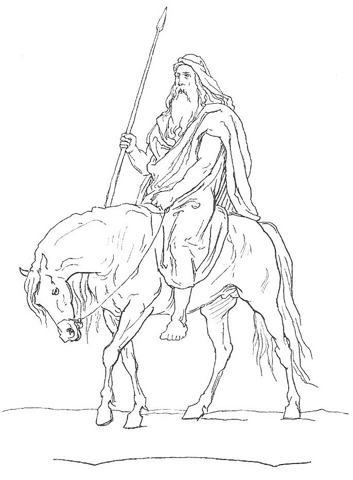
Odin's spear. Dwarf-made, rune-carved, and thrown over an army to hand it to the god of the hanged — the weapon that starts the first war in the world.
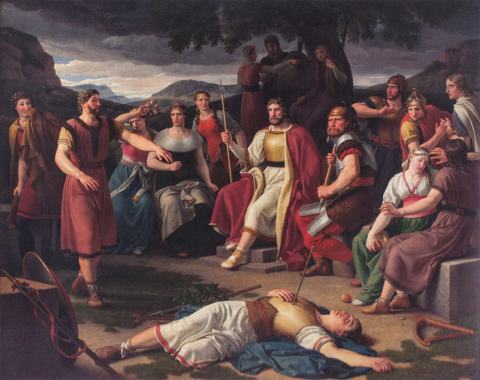
The first tragedy. A god made invulnerable by oath, killed by the one plant nobody asked — the murder that starts the clock on Ragnarok and cannot be undone.
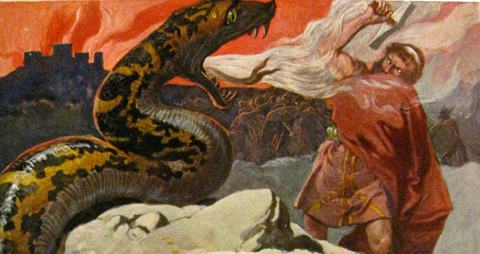
Hammer of Thor. Dwarf-forged, short in the handle, it strikes like lightning, hallows oaths and the dead, and always returns to the hand that throws it.
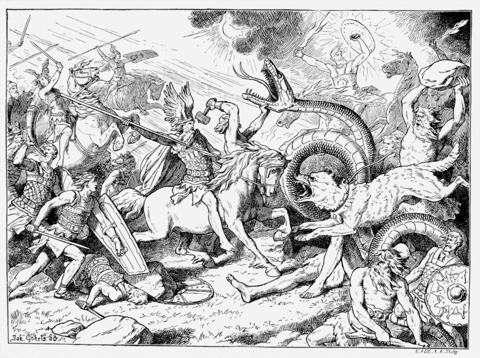
The Twilight of the Gods. The prophesied end: a killing winter, the breaking of every bond, a battle no one survives — and an earth that rises again.
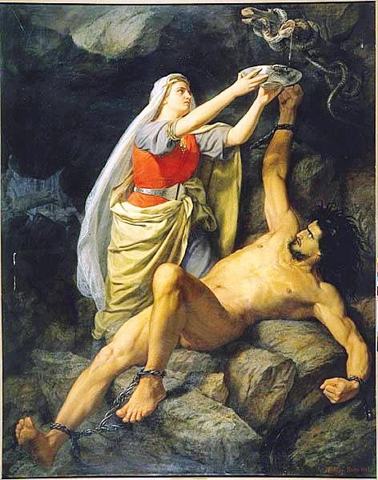
The Trickster. Shape-shifter of giant blood counted among the gods — their cleverest ally, the father of monsters, and the spark of Ragnarok.
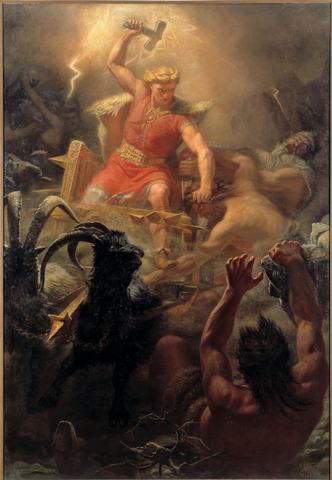
God of Thunder. Son of Odin and the earth, wielder of Mjolnir, and the gods' front line against the giants — fated to fall with the World Serpent.
Also mentioned inDwarves (Dvergar)Freyr (Frey)SifSvartalfheim
Sources & Further Reading
- 1.Snorri Sturluson, Prose Edda — Skaldskaparmal (c. 1220).
- 2.Snorri Sturluson, Prose Edda — Gylfaginning (c. 1220).
- 3.Poetic Edda — Skirnismal (Codex Regius, 13th century).
- 4.Lindow, John. Norse Mythology — A Guide to the Gods, Heroes, Rituals, and Beliefs. Oxford University Press, 2001.
- 5.Simek, Rudolf. Dictionary of Northern Mythology. Trans. Angela Hall. D.S. Brewer, 1993.
- 6.Turville-Petre, E.O.G. Myth and Religion of the North — The Religion of Ancient Scandinavia. Weidenfeld & Nicolson, 1964.
- 7.Clunies Ross, Margaret. Prolonged Echoes — Old Norse Myths in Medieval Northern Society, vol. 1: The Myths. The Viking Collection 7. Odense University Press, 1994.
- 8.Larrington, Carolyne (trans.). The Poetic Edda. Rev. ed., Oxford World's Classics, 2014.
Spot an error or have a source to suggest? Write to info@viseterna.com. We cite primary sources and modern scholarship, and we correct fast.