
Hodr (Hod)
The blind god who threw the dart that killed Baldr, guided by Loki's hand — Norse myth's clearest case of a killer who may not be the guilty party.
Hoder schleudert, von Loke verleitet, den Wurfspeer nach Balder, Carl Emil Doepler, 1882 · Public domain · source
A God Known for One Thing
Hodr survives in Old Norse literature almost entirely as the answer to a question: who kills Baldr? Snorri's introduction to him in Gylfaginning is a single flat sentence — he is one of the Aesir, blind, very strong, but a god "whose name it were well that men should not have need to use," because what he does will be remembered forever 3. No myth outside the Baldr complex gives him a wife, a hall, or a deed of his own; he is defined entirely by an act the sources agree he did not choose 3,6.
The Blind Hand
The killing itself belongs more properly to Baldr and Loki's entries, but its mechanics bear directly on who Hodr is. Every god in the Aesir has sworn Baldr immune to harm at Frigg's request, except mistletoe, judged too young to ask. The Aesir turn the immunity into a game, throwing weapons at Baldr for sport, while Hodr stands apart from the circle because he cannot see to join in. Loki, disguised as a woman, learns the one gap from Frigg, cuts the mistletoe, and finds Hodr on the outside of the ring. He offers to aim for him. Hodr throws. Baldr falls dead 3.
Snorri gives no indication that Hodr understood what he was doing, and the scene is built so that he could not have: he lacks the sight to recognize either the plant or the malice guiding his hand. John Lindow's study of the episode as a feud narrative treats this as the story's central legal problem rather than an incidental detail — Norse custom needed an instigator and a doer, and here the doer is blameless by any ordinary standard while the instigator escapes because the killing happens inside a peace-bound assembly where no one may retaliate 5,6. Hodr's blindness is not decoration. It is the mechanism that makes the killing possible and the mechanism that makes blame impossible to settle cleanly.
Killed by a One-Night-Old Avenger
Baldrs draumar has Odin already know the answer before it happens: riding to the underworld to question a dead seeress, he learns that Hodr will carry the branch that kills Baldr, and that Baldr's avenger will be a son of Odin, one night old, who will not wash his hands or comb his hair until he has brought his brother's killer to the pyre 1. That son is Vali, born to Odin and the giantess Rindr for the sole purpose of vengeance. He kills Hodr without ceremony and without the sources recording a word from either of them 1,6. The instrument is punished; in Lokasenna, staged after the killing, it is Loki — the one who aimed him — who sits at the gods' table entirely unpunished until the poem itself turns on him 2.
Hother the Rival, in Saxo
Saxo Grammaticus, writing Latin history in Denmark around 1200, tells a story under the same two names, Hotherus and Balderus, that shares almost nothing else with the Icelandic version. Hotherus is a skilled warrior and musician, foster son of a Danish king, competing with the demigod Balderus for the hand of Nanna. He obtains an invincible sword from a wood-dwelling being named Miming — a figure some scholars connect, cautiously, with Mimir — wounds Balderus in open battle, and Balderus dies of the wound days later. Hotherus himself is later killed by Bous, a son Othinus fathers on Rinda for that express purpose, the same revenge structure as Vali in the Icelandic sources wearing different names 4,6. There is no blindness, no mistletoe, and no accident in Saxo's telling: Hotherus is a sighted rival who wins a fair, if magically assisted, fight. Which version is closer to older tradition is unsettled, and the difference is usually read as proof that no single, stable Baldr-myth existed before it reached the writers who wrote it down 4,6,7.
A Name That May Predate the Myth
Hodr's own name is generally connected by philologists to an Old Norse word for battle or warfare, hǫð, found in poetic compounds for weapons and combat rather than as an ordinary noun on its own 7,8. That has led some scholars to propose that a war-god or a war-word lies behind the figure now known chiefly as blind and unlucky, with the blindness itself a comparatively late narrative device built to explain how an innocent could be made to strike the fatal blow — though the proposal cannot be tested against any earlier, unblinded version of Hodr, because none survives 7,8.
Return After the End
The one point where the two rival portraits of Hodr agree is the ending. Voluspa looks past the fire and flood of Ragnarok to the gods who return to the green earth, and among them Baldr comes back — with Hodr beside him. The poem gives no explanation and stages no reconciliation scene; it simply seats killer and killed together in Odin's halls, as though the feud had never happened 1. It is the only unambiguous act of restored kinship in the entire mythology, and it is reserved for a god the sources otherwise treat as barely worth naming 1,5.
Continue Exploring
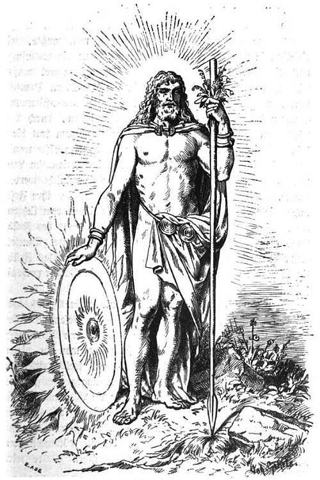
God of Light. The most beloved of the Aesir, made immune to all harm but one plant — and killed by it, which set the world's ending in motion.
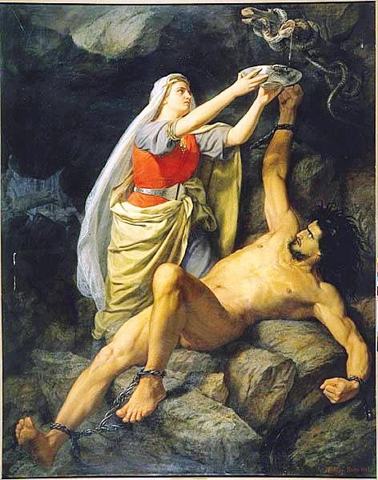
The Trickster. Shape-shifter of giant blood counted among the gods — their cleverest ally, the father of monsters, and the spark of Ragnarok.
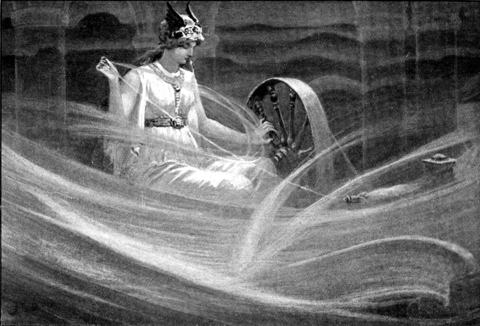
Odin's wife and the highest-ranking goddess of the Aesir — keeper of foreknowledge she will not speak, and the mother whose oaths could not save Baldr.
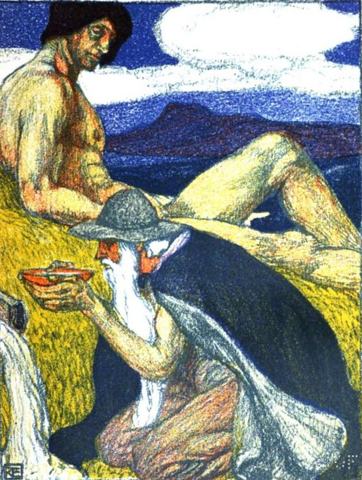
The being who keeps the well of wisdom beneath Yggdrasil — beheaded in a botched peace treaty, and consulted by Odin as a severed head ever after.
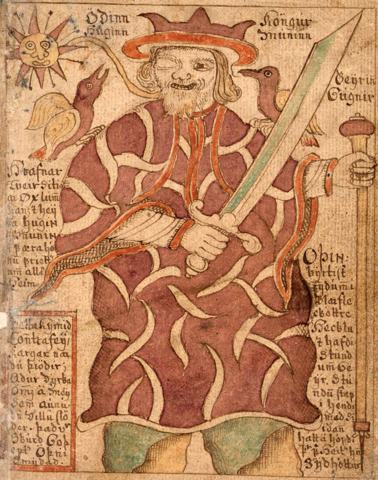
The Allfather. God of war, poetry and the dead who traded an eye for wisdom and hanged himself on the world tree to win the runes.
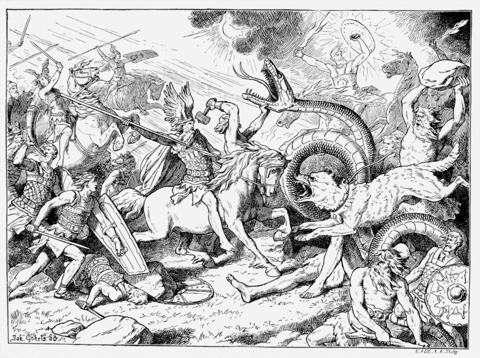
The Twilight of the Gods. The prophesied end: a killing winter, the breaking of every bond, a battle no one survives — and an earth that rises again.
Also mentioned inThe Death of BaldrVidar
Sources & Further Reading
- 1.Poetic Edda — Voluspa and Baldrs draumar (Codex Regius and AM 748 I 4to, 13th-14th century).
- 2.Poetic Edda — Lokasenna (Codex Regius, 13th century).
- 3.Snorri Sturluson, Prose Edda — Gylfaginning (c. 1220).
- 4.Saxo Grammaticus, Gesta Danorum, Book 3 (c. 1200).
- 5.Lindow, John. Murder and Vengeance Among the Gods — Baldr in Scandinavian Mythology. FF Communications 262, Academia Scientiarum Fennica, 1997.
- 6.Lindow, John. Norse Mythology — A Guide to the Gods, Heroes, Rituals, and Beliefs. Oxford University Press, 2001.
- 7.Simek, Rudolf. Dictionary of Northern Mythology. Trans. Angela Hall. D.S. Brewer, 1993.
- 8.Turville-Petre, E.O.G. Myth and Religion of the North — The Religion of Ancient Scandinavia. Weidenfeld & Nicolson, 1964.
Spot an error or have a source to suggest? Write to info@viseterna.com. We cite primary sources and modern scholarship, and we correct fast.