
Wyrd
The weave of fate. The Germanic idea that what happens has already turned — laid down at a well by the norns, binding gods and men alike.
Die Nornen, Johannes Gehrts, 1889 · Public domain · source
A Word That Means "Has Turned"
Wyrd is the Old English form; the Old Norse cognate is urdr. Both descend from a Germanic root meaning to turn or to become — the same root that gives modern German werden, "to become", and that lies behind English -ward 7. Grammatically it is a noun formed from the past of that verb, so its literal sense is closer to "that which has turned out" than to "destiny".
The distinction is not pedantic. Classical fatum is something spoken in advance; wyrd is something that has already happened, pressing on the present. It is the accumulated weight of what is done. The Norse texts pair it with orlog, usually parsed as "primal layers" or "first laws" — fate as sediment, laid down course by course 5,7.
The Norns at the Well
The mythological personification is the norns. Voluspa describes three maidens coming from the lake under the tree, deeply wise, called Urd, Verdandi and Skuld: they carved on wooden slips, they laid down laws, they chose lives for the children of men and spoke their fates 1,8. Snorri adds that they live in a hall at Urd's well beneath one root of Yggdrasil, and that they draw water and white clay from it every day to pour over the tree so that its limbs will not rot 2.
Their names are usually glossed as past, present and future, but that is a scholarly convenience laid over uncertain ground. Urdr is the past-formed noun described above; Verdandi is a present participle, "becoming"; Skuld is from the verb "shall", meaning obligation or debt — closer to "what is owed" than "what will be" 5,7. Fate in this scheme is a ledger.
There are also more than three. Fafnismal states plainly that the norns are of many kindreds and not of one race, some descended from the gods, some from elves, some from dwarfs, and Snorri repeats that norns come to every child born, to shape its life 1,2. The three at the well are the cosmic ones; everyone else gets local ones, of variable quality.
Weaving, and Why to Be Careful With It
Popular accounts describe the norns spinning and weaving the threads of fate, and cutting them. That image is largely an import. Karen Bek-Pedersen's study of the Old Norse evidence argues that the sources connect norns primarily with law and with water — carving slips, laying down decrees, tending a well — and that the spinning, weaving and thread-cutting attributed to them owes more to the Greek Moirai and to nineteenth-century synthesis than to the Norse texts 5.
Where textile imagery genuinely does appear, it belongs to a different group of women. In Darradarljod, embedded in Njals saga, a man looks through a window on the morning of the Battle of Clontarf in 1014 and sees twelve figures at a loom: the warp is weighted with human heads, the weft is entrails, the shuttle is an arrow and the beaters are swords, and the weavers are valkyries singing the coming slaughter as they work 4.
That is one of the most disturbing poems in medieval European literature, and its logic is exact. The battle is being made on the loom, not predicted by it. Fate is a fabric because a fabric is a thing produced by labour, in order, one row at a time, and once beaten down it cannot be lifted out 5,6.
Fate Goes Ever as It Must
The Old English material shows how the concept worked outside mythology, in a converted Christian society still using the old vocabulary. Beowulf states in a half-line that fate goes always as it must, and elsewhere that wyrd often spares the undoomed man whose courage holds — two claims that flatly contradict each other and sit twenty lines apart, because the poem is not doing theology 3. The Wanderer opens its reflection on exile with the observation that wyrd is wholly inexorable 3.
By the time these were written, Christian authors were translating Latin fatum with wyrd and carefully subordinating it to providence: in the Old English version of Boethius, wyrd becomes an instrument God directs rather than a power in its own right 3,7. The word survived the conversion by being demoted.
It survived again in literature. Shakespeare's "weird sisters" in Macbeth are wyrd made flesh in the older sense, three women who state what has already turned; from that association the adjective drifted through "uncanny" to the modern, thoroughly weakened "weird" 7.
Living Under It
What makes wyrd distinctive is not fatalism but the attitude it licenses. If the outcome is settled, the only thing left in a person's control is conduct, and the sources are consistent about what conduct is worth: Havamal observes that cattle die and kinsmen die and you yourself will die, and that the one thing that never dies is the reputation of the dead 1,8. The Icelandic sagas turn this into a whole aesthetic — the hero who is told he will die and goes anyway, without comment.
The gods are inside the same system. Odin knows how Ragnarok ends and spends the entire mythology preparing for a battle he is certain to lose; he gathers the einherjar into Valhalla knowing they will not be enough. Norse myth has no authority above fate that can be appealed to, which is precisely why its chief god is a collector of information rather than a legislator 6,8.
Related personal concepts fill out the picture: hamingja, a family's luck, an almost substantial thing that can be lent or inherited; gaefa, good fortune as a quality a person has or lacks; the fylgja, a following spirit attached to a lineage 6,7. None of them can be argued with. All of them can be lived up to, and that distinction is the whole of the Norse moral position 6.
Continue Exploring
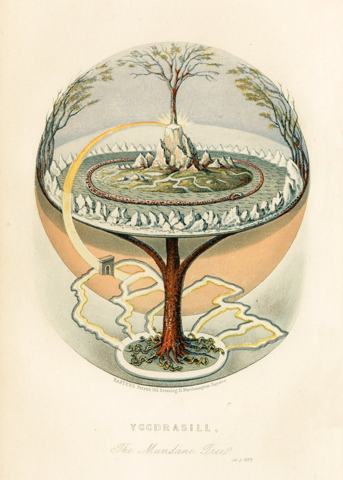
The World Tree. The great ash whose roots reach three wells and nine worlds, tended by the norns, eaten from every side, and still standing when the sky burns.
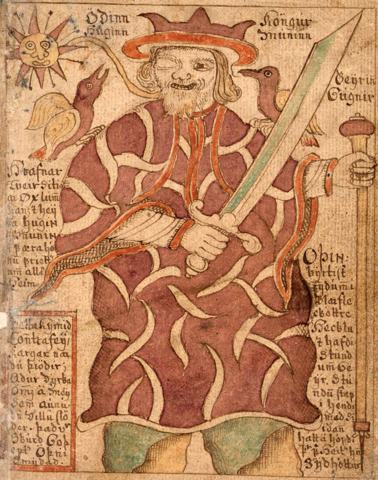
The Allfather. God of war, poetry and the dead who traded an eye for wisdom and hanged himself on the world tree to win the runes.
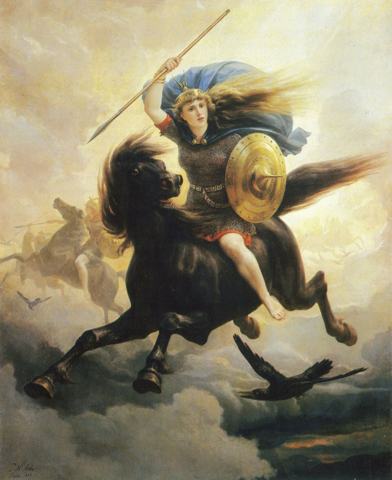
Choosers of the Slain. Odin's riders who decide who dies in battle and carry the chosen to Valhalla — battlefield spirits before they were shieldmaidens.
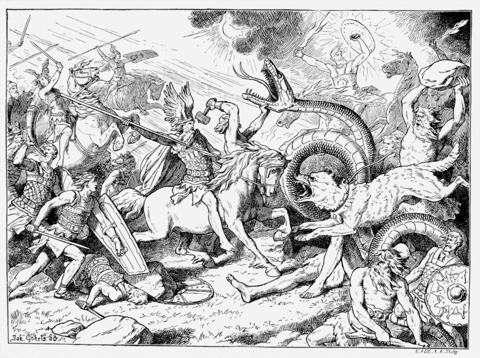
The Twilight of the Gods. The prophesied end: a killing winter, the breaking of every bond, a battle no one survives — and an earth that rises again.
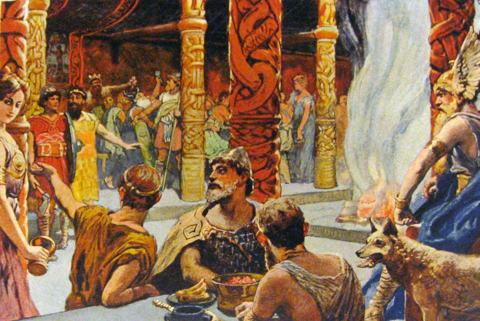
Hall of the Slain. Odin's roof of shields where the chosen dead feast, fight, and are healed each night — an army kept in reserve for Ragnarok.
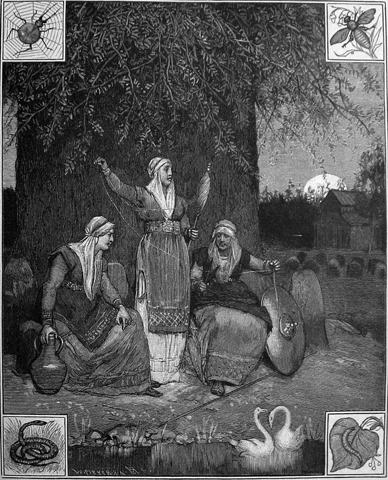
Urd, Verdandi and Skuld, the three women who tend Yggdrasil's well and lay down the fates of gods and men — plus the lesser norns who visit every birth.
Sources & Further Reading
- 1.Poetic Edda — Voluspa, Havamal and Fafnismal (Codex Regius, 13th century).
- 2.Snorri Sturluson, Prose Edda — Gylfaginning (c. 1220).
- 3.Beowulf and The Wanderer (Old English, Cotton Vitellius A.xv and the Exeter Book, c. 1000).
- 4.Darradarljod, in Njals saga, chapter 157 (Iceland, late 13th century).
- 5.Bek-Pedersen, Karen. The Norns in Old Norse Mythology. Dunedin Academic Press, 2011.
- 6.Lindow, John. Norse Mythology — A Guide to the Gods, Heroes, Rituals, and Beliefs. Oxford University Press, 2001.
- 7.Simek, Rudolf. Dictionary of Northern Mythology. Trans. Angela Hall. D.S. Brewer, 1993.
- 8.Turville-Petre, E.O.G. Myth and Religion of the North — The Religion of Ancient Scandinavia. Weidenfeld & Nicolson, 1964.
Spot an error or have a source to suggest? Write to info@viseterna.com. We cite primary sources and modern scholarship, and we correct fast.