
Draugr (Norse Undead)
The Icelandic sagas' reanimated corpse: physically solid, superhumanly strong, and dangerous mainly to the farm it refuses to leave.
The Deacon of Myrka, engraved by Theodore Meyer-Heine after Jules Worms, 1864, in Icelandic Legends · Public domain · source
A Body, Not a Ghost
A draugr (plural draugar, verb form ganga aftr, "to walk again") is not a spirit in the ordinary sense. The Icelandic sagas describe a corpse that keeps its physical bulk, weight, and appetite for violence, typically described as nableikr or hel-blar — corpse-pale or death-blue — and often swollen far past its living size 1,2,6. It can be wrestled, stabbed, and beheaded, because it is still, stubbornly, a body; this solidity is exactly what separates it from the thin, moral haunting of Nastrond, where the dishonoured dead are punished rather than allowed to walk the farm they died on 4,6.
Ármann Jakobsson's study of the type stresses how little the sagas agree on rules for it: a draugr may be confined to its burial mound (a haugbui) or roam the district by night, may retain the dead person's grudges or acquire new and pettier ones, and is defined less by a fixed biology than by the discomfort it causes the living who now have to share space with it 5. What is constant is the motive. Saga draugar are almost never possessed by cosmic evil; they are usually just unpleasant people who got worse at dying, still guarding a hoard, still angry at a neighbour, still unwilling to lie still 1,2,5.
Glamr in Grettis Saga
The most fully told case is Glamr, a bad-tempered, godless shepherd hired to work a haunted farm in Iceland. He is found dead and grotesquely bruised after a fight with something on the property, and after his burial he begins riding the farmhouse roof at night, driving off the household and killing livestock and at least one man outright 1. The outlaw hero Grettir wrestles him to a standstill inside the hall — and Glamr, pinned and dying a second time, curses Grettir with a doom: he will never grow stronger than he is that night, and Glamr's own eyes will haunt him whenever he is alone in the dark 1. Jakobsson reads the curse scene as a moment of genuine horror precisely because Glamr, while a corpse, is still recognisably articulate and cruel — the story's real threat is not decay but personality that has outlived its reasons for restraint 5.
Thorolf Twist-Foot in Eyrbyggja Saga
Eyrbyggja Saga supplies the other classic case. Thorolf Twist-Foot dies furious after a land dispute, and his ghost first appears as a heavy blue-black shape that kills a shepherd, then begins slaughtering the district's cattle from inside his own burial mound 2. His son has the body moved to a more isolated grave, which only delays the problem; a formal "door-doom," a court held at the mound to legally banish him, eventually stops the immediate haunting, but the corpse is only rendered fully harmless when it is exhumed again, burned, and its ashes scattered — after which a cow that licks the burnt bones gives birth to an ox that grows into a fresh menace of its own 2,6. Eyrbyggja's draugr problem is treated as an administrative one as much as a supernatural one: farms have legal remedies for a neighbour who will not stay buried.
Putting One Down
The sagas are consistent enough about method to imply a working folk procedure. A corpse suspected of walking is carried out through a hole broken in the wall rather than through the door, so it cannot find its own way back in; graves are sited with care, and a returning draugr may be reburied further off, decapitated with the head placed at the buttocks, or, in the most stubborn cases, dug up and burned with the ashes thrown into the sea so nothing is left to reanimate 1,2,4. Ellis Davidson connects these precautions to a wider Norse anxiety about the physically dead re-entering the world of the living, distinct from the ordinary, expected journey to Hel — even the detail that a corpse's nails should be trimmed before burial, so as not to feed the nail-built ship Naglfar, belongs to the same nervousness about matter that will not stay where it is put 4.
After the Sagas
The type did not end with the medieval saga corpus. Jon Arnason's 19th-century collection of Icelandic folk legends preserves the story of the Deacon of Myrka, a young clergyman who dies crossing a flooded river on his way to fetch his fiancee and returns, still riding, to bring her back with him — a tale usually read as a later, more romantic descendant of the same walking-corpse tradition, though it is a distinct 19th-century legend rather than saga-era material and should not be mistaken for it 3,7. Lecouteux places the whole Scandinavian draugr complex within a broader medieval European unease about the recently dead, arguing the corpse-that-will-not-stay-buried long predates, and is considerably more physical than, the later literary vampire it sometimes gets compared to 7.
Continue Exploring
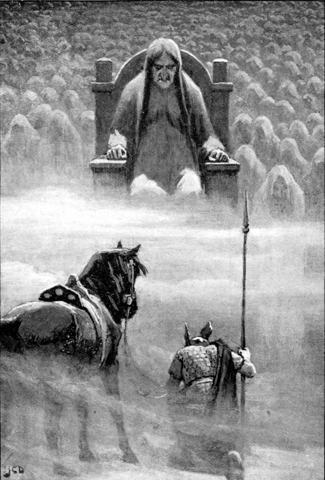
Queen of the Dead. Half living woman and half corpse, Loki's daughter rules the cold realm where those who die of sickness and age must go.
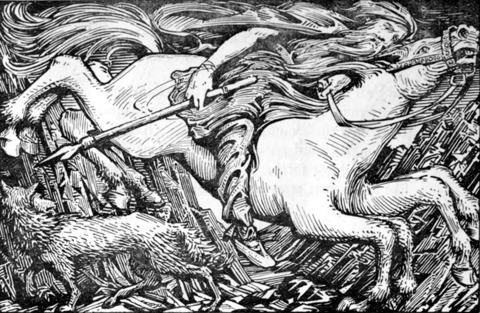
The cold underworld. Down and to the north, past a gold-roofed bridge and a gate that does not open twice, the hall where most of the Norse dead actually go.
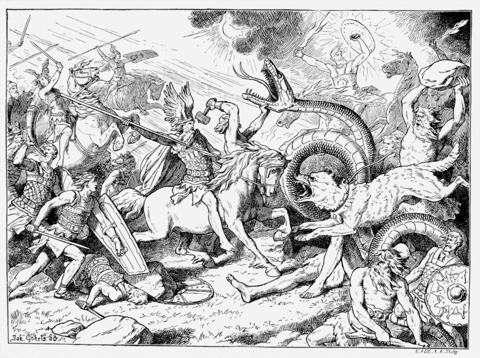
The Twilight of the Gods. The prophesied end: a killing winter, the breaking of every bond, a battle no one survives — and an earth that rises again.
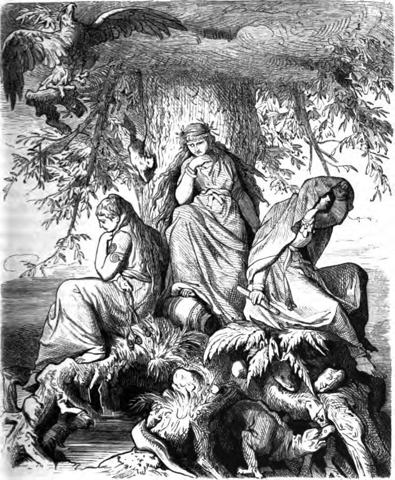
Gnawer of roots. The dragon chewing the world tree from below, feeding on oath-breakers, and flying up out of the dark in the last stanza of Voluspa.
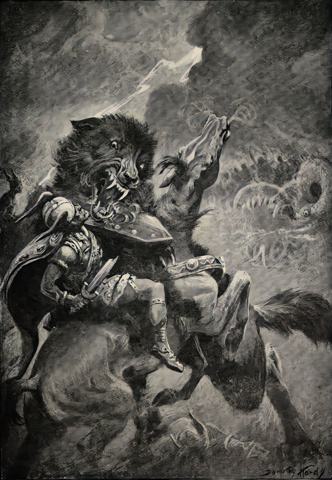
The Bound Wolf. Loki's son, raised among the gods and chained by a trick that cost Tyr his hand — until Ragnarok, when he devours Odin.
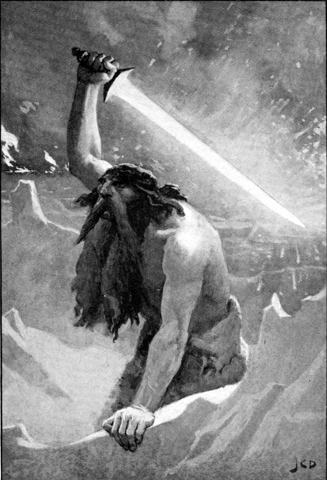
The Black One. The fire-giant who comes from the south at Ragnarok with a sword brighter than the sun, and burns the whole world to the ground behind him.
Sources & Further Reading
- 1.Grettis saga (Grettir's Saga), trans. Bernard Scudder. Penguin Classics, 2005.
- 2.Eyrbyggja Saga, trans. Hermann Palsson and Paul Edwards. Penguin Classics, 1989.
- 3.Jon Arnason, comp. Icelandic Legends. Trans. George E.J. Powell and Eirikur Magnusson. Richard Bentley, 1864.
- 4.Ellis Davidson, H.R. The Road to Hel: A Study of the Conception of the Dead in Old Norse Literature. Cambridge University Press, 1943.
- 5.Jakobsson, Armann. "The Fearless Vampire Killers: A Note about the Icelandic Draugr and Demonic Contamination in Grettis Saga." Folklore 120 (2009).
- 6.Simek, Rudolf. Dictionary of Northern Mythology. Trans. Angela Hall. D.S. Brewer, 1993.
- 7.Lecouteux, Claude. The Return of the Dead: Ghosts, Ancestors, and the Transparent Veil of the Pagan Mind. Trans. Jon E. Graham. Inner Traditions, 2009.
Spot an error or have a source to suggest? Write to info@viseterna.com. We cite primary sources and modern scholarship, and we correct fast.