
Asgard
The stronghold of the AEsir. A walled citadel of halls at the top of the world tree, reached by the rainbow bridge and built on a bargain the gods broke.
Idun Brought Back to Asgard, Lorenz Frolich, 1906 · Public domain · source
An Enclosure, Not a Kingdom
Asgardr is built from ass — a member of the AEsir, the ruling family of gods — and gardr, which means a fence, a yard, an enclosed piece of ground. The same element sits in Midgard, "the middle enclosure", and in Utgard, "the outer enclosure", and it survives in English yard and garden 6.
That vocabulary is the whole cosmology in miniature. The Norse imagined their world as a farm: an enclosed and cultivated inside, a hostile and unfenced outside, and a wall doing the work of distinguishing them. Asgard is the innermost enclosure, the gods' home field, and everything that threatens it comes from beyond a boundary — which is why so many myths are about something crossing one 5,7.
The Halls on the Plain
Grimnismal is essentially a tour. Odin, bound between two fires and refusing to speak, finally recites the dwellings of the gods one by one: Ydalir, the yew-dales, where Ullr made his hall; Alfheim, given to Freyr as a teething-gift; Valaskjalf, roofed with silver, which a god thatched in ancient days; Sokkvabekkr, where Odin and Saga drink from golden cups; Gladsheim, gold-bright, where Valhalla stands wide; Thrymheim in the rocks, where Skadi lives; Breidablik, where Baldr built a hall in which nothing unclean can be; Himinbjorg, where Heimdallr drinks good mead at the bridge's end; Folkvangr, where Freyja chooses half the slain each day; Glitnir with its pillars of gold; Noatun, Njord's shipyard hall; and Landvidi, where Vidar's brushwood grows 2,8.
Snorri collects these and adds the geography around them: the plain Idavoll at the centre, where the gods first built their forges and their temples and played at draughts with golden pieces; the hall Gladsheim with twelve high seats for the gods and Valaskjalf with the throne Hlidskjalf, from which Odin sees into every world 3. The whole is joined to Midgard by Bifrost, the burning rainbow bridge, which Heimdallr guards and which the gods ride across daily to sit in judgement at the well of Urd, at the root of Yggdrasil 3,5.
Note where the court is. The gods live at the top of the tree and hold their assembly at the bottom of it, beside the well of fate. Authority in Asgard is not located in Asgard 5,7.
The Wall and the Broken Bargain
The single most consequential Asgard story is about the wall itself. In Gylfaginning, a builder arrives and offers to raise a fortification strong enough to keep out the giants, in one winter, demanding as payment the sun, the moon, and Freyja. On Loki's advice the gods agree, setting an impossible deadline and forbidding help from any man — then discover the builder's stallion Svadilfari hauling stone at a rate that will finish the job in time 3.
Facing the loss of the sun, the gods threaten Loki, who turns himself into a mare, lures the stallion away for a night, and stalls the work. The builder loses his temper, reveals himself as a giant, and Thor kills him with the hammer despite the oaths sworn on the deal. Loki later bears Sleipnir, the eight-legged horse Odin rides 3,5.
Scholars have read this as the founding hypocrisy of Asgard. The wall separating gods from giants is built by a giant, paid for with a fraud, and completed by a murder that voids a sworn contract — and the gods know it. Voluspa says as much in a bitter half-stanza: oaths were broken, words and pledges, all the solemn agreements that had passed between them 1,5,7. The wall holds. The credit does not.
Troy on the Sea of Ice
The Prose Edda also contains an entirely different account. In his Prologue and in Ynglinga saga, Snorri explains the gods as human migrants — Asian nobles from Troy, whose city Asgard was, who travelled north, impressed the local people with their skills and were remembered as divine 4,5.
This is euhemerism, the standard medieval technique for handling pagan gods without either believing in them or losing the poetry that depended on them. Snorri was a Christian who needed the mythology preserved because Icelandic verse was unreadable without it, and the Trojan frame gave him a licence to write it all down 5,6,7. Readers should treat Asgard-as-Troy as thirteenth-century apologetics, not as tradition — but it is a reminder that everything we have about Asgard reaches us through a writer with an agenda.
The Fall and the Field Afterwards
At Ragnarok, the defences fail in order. The cock Gullinkambi wakes the warriors in Valhalla; Heimdallr blows the Gjallarhorn; the sons of Muspell ride out and Bifrost breaks beneath them; the wall is irrelevant because the enemy no longer needs a gate 1,3,8. Odin falls to Fenrir, Thor to the venom of Jormungandr, and Surtr burns what is left.
The last word on Asgard is quiet. Voluspa has the surviving gods — Vidar, Vali, Modi and Magni, Baldr returned from Helheim — meeting again on Idavoll, talking over the great events, and finding in the grass the golden gaming pieces that the AEsir had owned in the beginning 1,8.
The stronghold is gone and nobody rebuilds it. What comes back is the plain, the conversation, and the toys.
Continue Exploring
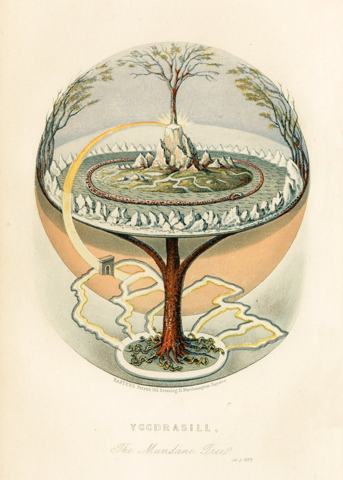
The World Tree. The great ash whose roots reach three wells and nine worlds, tended by the norns, eaten from every side, and still standing when the sky burns.
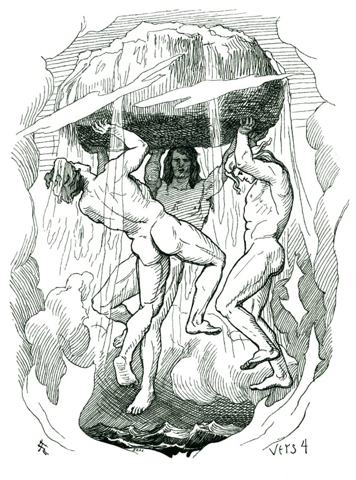
The middle enclosure. The human world, built from a murdered giant's body, fenced by his eyebrows, and ringed by a serpent that will one day let go of its tail.
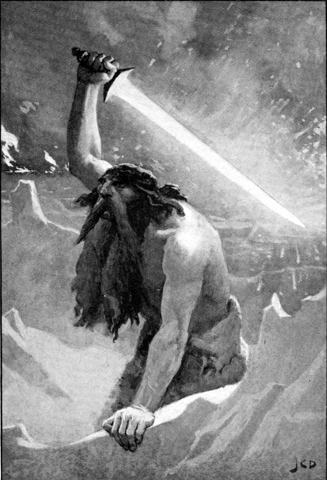
The Black One. The fire-giant who comes from the south at Ragnarok with a sword brighter than the sun, and burns the whole world to the ground behind him.
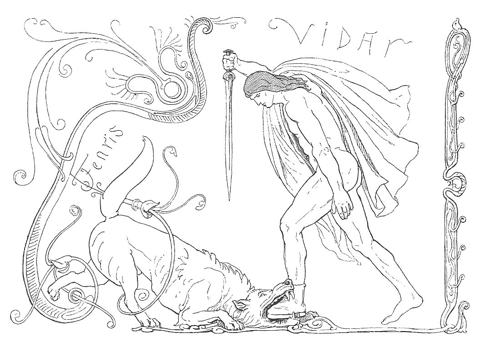
Odin's silent, giant-born son, second in strength only to Thor — kept in reserve since before the world began to avenge his father on the wolf Fenrir.
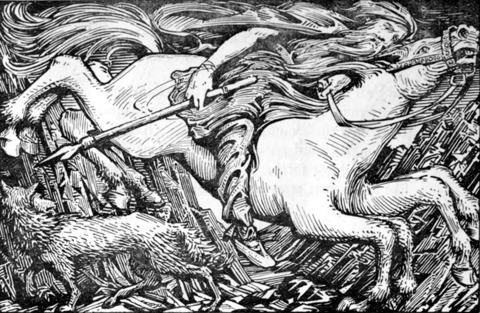
The cold underworld. Down and to the north, past a gold-roofed bridge and a gate that does not open twice, the hall where most of the Norse dead actually go.
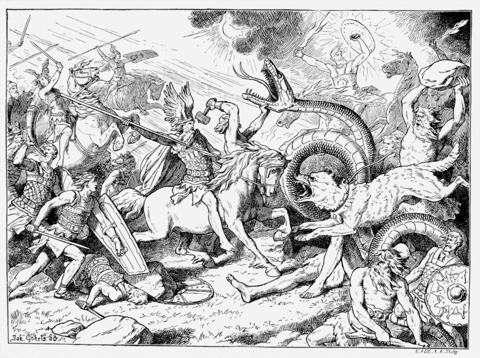
The Twilight of the Gods. The prophesied end: a killing winter, the breaking of every bond, a battle no one survives — and an earth that rises again.
Also mentioned inAegir and RanBifrost (The Rainbow Bridge)BrisingamenDraupnirGleipnirGungnirIdunn (Idun)JotunheimMuspelheimNjord (Njörðr)SifSkadi (Skaði)SleipnirSvartalfheimThe Aesir-Vanir WarUllrVanaheim
Sources & Further Reading
- 1.Poetic Edda — Voluspa (Codex Regius, 13th century).
- 2.Poetic Edda — Grimnismal (Codex Regius, 13th century).
- 3.Snorri Sturluson, Prose Edda — Gylfaginning (c. 1220).
- 4.Snorri Sturluson, Prose Edda — Prologue and Skaldskaparmal (c. 1220).
- 5.Lindow, John. Norse Mythology — A Guide to the Gods, Heroes, Rituals, and Beliefs. Oxford University Press, 2001.
- 6.Simek, Rudolf. Dictionary of Northern Mythology. Trans. Angela Hall. D.S. Brewer, 1993.
- 7.Clunies Ross, Margaret. Prolonged Echoes — Old Norse Myths in Medieval Northern Society, vol. 1: The Myths. The Viking Collection 7. Odense University Press, 1994.
- 8.Larrington, Carolyne (trans.). The Poetic Edda. Rev. ed., Oxford World's Classics, 2014.
Spot an error or have a source to suggest? Write to info@viseterna.com. We cite primary sources and modern scholarship, and we correct fast.