
Jotunheim
Land of the giants. The wild country east of the fence, older than the gods, holding the wisdom and the brides the AEsir keep going out to take.
I am the giant Skrymir, Elmer Boyd Smith, 1902 · Public domain · source
Giants Who Are Not Giants
The English word "giant" does the Norse jotunn a disservice. Size is rarely the point: jotnar appear as beautiful women, as farmers, as sea-lords and as kings with courts, and they are as often out-thought as out-fought. The word itself probably derives from the root meaning "to eat" — the devourers, the great consumers — and the other terms used for them, thurs and risi, carry different shades again 6,8.
What defines the jotnar is priority. They are older than the gods, and the gods are descended from them: Odin's mother Bestla is a giant's daughter, Thor's mother is the earth personified, and Ymir, whose murdered body became Midgard, was the first being of all 3,5. Jotunheim is therefore not a demonic realm opposed to a divine one. It is the older family, on the wrong side of a fence the younger family built 7.
East of the River
The realm is Jotunheimr — often plural, Jotunheimar, "the giant-worlds", which suggests it was never conceived as one tidy country. Snorri also uses Utgard, "the outer enclosure", for the same region, setting it against Asgard and Midgard by name 3,6.
Its direction is east, sometimes north, and always outward. Vafthrudnismal names the river Ifing, which separates the sons of the giants from the gods and never freezes over — the one boundary that cannot be crossed by simply waiting for winter 1,8. Beyond it lie the Ironwood where a hag breeds wolves, the halls of Thrymheim high in the rocks, the courts of Geirrod and Gymir, and the fortress of Utgarda-Loki 1,3,4.
Anyone travelling there goes on purpose and comes back changed. There is no story of a giant casually visiting Asgard that ends well, and no story of a god visiting Jotunheim that does not involve either theft, marriage, or a contest of knowledge 5,7.
The Journeys
Four of the best stories in the corpus are Jotunheim expeditions.
Thor's journey to Utgarda-Loki is the longest sustained narrative Snorri wrote. Thor and Loki travel east with the servants Thjalfi and Roskva, sleep in what turns out to be a giant's glove, and reach a fortress so tall they have to bend their necks to see the top. Inside they are set tasks and lose them all: Loki loses an eating contest to a competitor who is wildfire, Thjalfi loses a footrace to thought itself, and Thor fails to drain a horn whose far end is the sea, fails to lift a cat that is Jormungandr, and is wrestled to one knee by an old woman who is old age. The king admits the deceptions as he shows them out, then vanishes with his castle 3,5.
Thrymskvida runs the other way. The giant Thrym steals Mjolnir and demands Freyja as the price, so Thor is dressed in the bridal veil with Loki as his maid, sent to Jotunheim, and hands the hammer back to himself at the wedding feast 1,8.
Skirnismal is a courtship and a threat. Freyr sees the giant's daughter Gerd from Odin's high seat, sends his servant Skirnir east to win her, and Skirnir does it by working through gifts, then bribery, then a carved curse of such viciousness that she consents in nine nights' time. The price Freyr pays is his sword — which is why he has nothing to hold at Ragnarok 1,5.
Skaldskaparmal supplies the abduction of Idunn, whom the giant Thjazi carries off with her apples, ageing the gods until Loki retrieves her in falcon form. Thjazi is killed in the pursuit, and his daughter Skadi comes to Asgard armed, demanding compensation. She is given a husband, chosen by looking only at feet, and picks the wrong pair — the sea-god Njord instead of Baldr — after which neither can bear the other's country 4,5.
A One-Way Exchange
Set those stories side by side and a pattern emerges that modern scholarship treats as the key to Norse mythology's social logic. Gods take wives, mistresses and knowledge from Jotunheim constantly: Njord marries Skadi, Freyr wins Gerd, Odin sleeps with Gunnlod to steal the mead of poetry, Thor is himself half a giant. Giants who ask for a goddess — Thrym, the master builder who wants Freyja and the sun and moon, Hrungnir — are killed 3,4,7.
Margaret Clunies Ross called this negative reciprocity: an exchange system that only runs in one direction, in which the gods take and never repay. On that reading, Ragnarok is the account finally being settled, which is why the giants arrive at it as creditors rather than as monsters 7. Jotunheim also supplies the raw materials of divine power — dwarves and giants make the weapons, giants hold the mead of poetry and the wisdom Odin needs — and the AEsir have no way to manufacture any of it themselves 5,7.
The Muster
At the end, Jotunheim empties. Voluspa has the ship Naglfar breaking loose with Hrym steering from the east and the giants riding with him; the rock-giants are on the road, the sky splits, and the mountains crash together 2,8. Snorri adds the frost-giants marching over the broken bridge Bifrost with the sons of Muspell 3.
The fence built out of Ymir's eyebrows to keep the giants out lasts exactly as long as the story needs it to, and then the outside comes in. What follows Surtr's fire, in the poem, is a green earth with no wall mentioned on it at all 2,7.
Continue Exploring
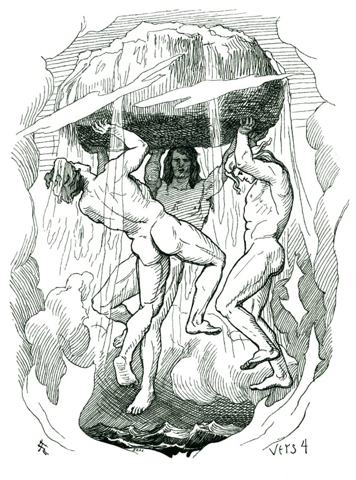
The middle enclosure. The human world, built from a murdered giant's body, fenced by his eyebrows, and ringed by a serpent that will one day let go of its tail.
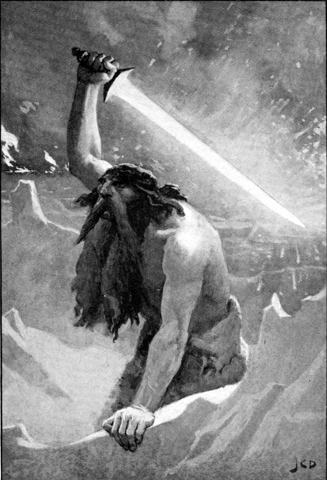
The Black One. The fire-giant who comes from the south at Ragnarok with a sword brighter than the sun, and burns the whole world to the ground behind him.
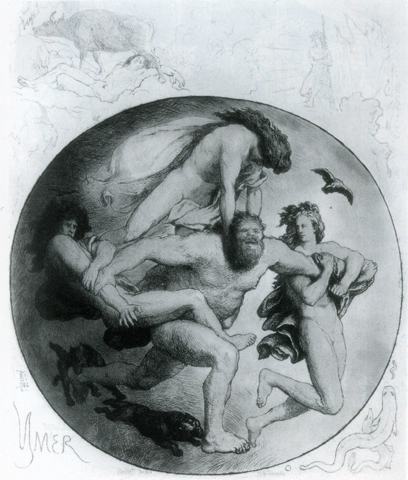
The frost-giant who came first, out of the meeting of fire and ice — killed by Odin and his brothers, his body split apart to build the world.
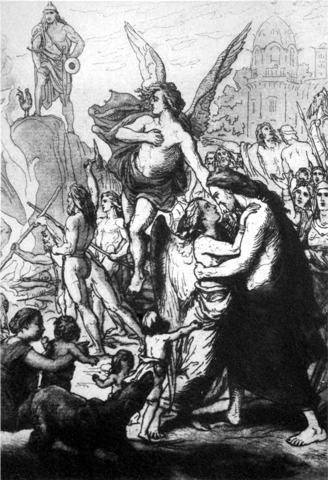
The stronghold of the AEsir. A walled citadel of halls at the top of the world tree, reached by the rainbow bridge and built on a bargain the gods broke.
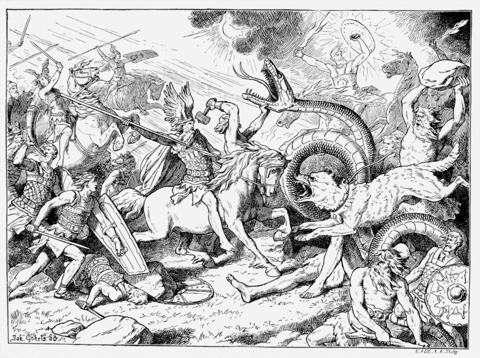
The Twilight of the Gods. The prophesied end: a killing winter, the breaking of every bond, a battle no one survives — and an earth that rises again.
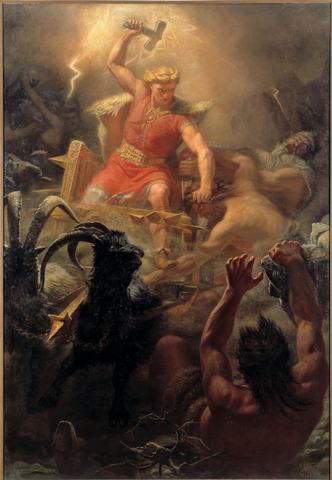
God of Thunder. Son of Odin and the earth, wielder of Mjolnir, and the gods' front line against the giants — fated to fall with the World Serpent.
Also mentioned inAlfheimDraupnirMuspelheimNiflheimSvartalfheimThe Death of BaldrVanaheimYggdrasil
Sources & Further Reading
- 1.Poetic Edda — Vafthrudnismal, Skirnismal and Thrymskvida (Codex Regius, 13th century).
- 2.Poetic Edda — Voluspa and Hymiskvida (Codex Regius, 13th century).
- 3.Snorri Sturluson, Prose Edda — Gylfaginning (c. 1220).
- 4.Snorri Sturluson, Prose Edda — Skaldskaparmal (c. 1220).
- 5.Lindow, John. Norse Mythology — A Guide to the Gods, Heroes, Rituals, and Beliefs. Oxford University Press, 2001.
- 6.Simek, Rudolf. Dictionary of Northern Mythology. Trans. Angela Hall. D.S. Brewer, 1993.
- 7.Clunies Ross, Margaret. Prolonged Echoes — Old Norse Myths in Medieval Northern Society, vol. 1: The Myths. The Viking Collection 7. Odense University Press, 1994.
- 8.Larrington, Carolyne (trans.). The Poetic Edda. Rev. ed., Oxford World's Classics, 2014.
Spot an error or have a source to suggest? Write to info@viseterna.com. We cite primary sources and modern scholarship, and we correct fast.