
Nidhoggr
Gnawer of roots. The dragon chewing the world tree from below, feeding on oath-breakers, and flying up out of the dark in the last stanza of Voluspa.
Die Nornen unter der Welteiche Yggdrasil, Ludwig Burger, 1882 · Public domain · source
The Name
Old Norse Nidhoggr (Níðhöggr) joins two hard words. Nid is not ordinary malice: in Icelandic law and custom it is the specific, actionable slander that strips a man of his standing, the insult that makes him a nidingr, an outcast beneath honour. Hoggva is to hew, to strike with an edge. Translators render the compound "malice-striker", "hewer of hate", or "the one who strikes full of hatred" — every version keeping the sense that this creature's biting is a moral act as much as a physical one 5,6. That is worth holding onto, because everything Nidhoggr does in the sources sits on the boundary between decay and disgrace.
He is called a dreki, a dragon, and also simply a serpent. Norse literature does not police the line between the two, and the beast that flies in the last stanza of Voluspa is the same one described elsewhere as coiled among roots and springs 4,5.
Beneath the Roots of the World Tree
Nidhoggr's home is the underside of Yggdrasil. Grimnismal places him at the tree's lowest root and insists that the ash suffers more hardship than any man knows: a hart bites its crown, its trunk rots at the sides, and Nidhoggr tears at it from below 2. The same poem adds that more serpents lie under the tree "than any fool imagines", and names six of them — Goinn, Moinn, Grabakr, Grafvolludr, Ofnir and Svafnir — gnawing at the branches 2,7.
Snorri Sturluson, systematising two centuries later, gives Yggdrasil three roots and assigns Nidhoggr the one that reaches over Niflheim, down to the boiling spring Hvergelmir, where so many snakes lie with him that no tongue can count them 3. Snorri's map is tidier than the poems he was working from — the older material puts the roots in different places and does not always agree with itself — but the picture he fixed became the one everyone inherited 4,5.
The structural point is easy to miss. The world tree is the axis holding the cosmos in order, and it is being eaten continuously, from the top by grazing deer and from the bottom by a dragon, while the norns pour water and white clay over it daily to keep the rot at bay 1,3,8. Norse cosmology does not describe a stable world under temporary threat. It describes a structure that is losing, slowly, all the time.
Ratatoskr and the Feud with the Eagle
The most quoted detail is also the strangest. An eagle sits in Yggdrasil's highest branches, and between the two of them runs the squirrel Ratatoskr, carrying words up and down the trunk — specifically, carrying the eagle's words down to Nidhoggr and Nidhoggr's back up 2. The verb bera ordi here means to bear a message, and the medieval audience would have heard exactly what kind of message: nid, the ruinous slander that keeps a feud alive.
So the tree is host to a running quarrel it cannot escape, conducted through a messenger who profits from the traffic. Scholars have read the squirrel as a small joke on the mechanics of Icelandic feud, in which insult travels faster than anyone can contain it, and the parties never meet 4,6. It is also the only comic touch in an otherwise grim complex of images.
Nastrond and the Punishment of Oath-Breakers
Voluspa gives Nidhoggr a second role, in the underworld rather than at the root. The seeress describes a hall on Nastrond, the Corpse-Shore, standing far from the sun, woven of serpents' spines with venom dripping through the roof-vent. Wading the heavy poison-streams there are murderers, oath-breakers, and men who seduced other men's wives — and Nidhoggr sucks the bodies of the dead while a wolf tears them 1,7.
This is the closest thing in the Eddic corpus to a doctrine of moral punishment after death, and it is precisely the passage most suspected of Christian colouring. Voluspa was recorded in a converted Iceland, and the three crimes named are the three the new church and the old law both condemned. Whether the stanza preserves a pagan belief or a poet's late synthesis is unresolved; what is clear is that Nidhoggr is not scavenging indiscriminately, but consuming the specifically dishonoured dead — which returns the nid in his name to the centre of the picture 4,5,8. The realm those dead belong to is Helheim, whose ruler Hel receives those who die of sickness and age; Nastrond is the worst quarter of it.
The Last Stanza
The Codex Regius text of Voluspa ends with an image that has never been fully settled. After the new earth rises green from the sea, after the surviving gods return and Baldr comes back, the seeress sees a dark dragon flying, the shining serpent, coming up from the dark peaks of Nidafjoll, bearing corpses in his wings — and then she sinks 1,7.
Read one way, this is a shadow across the reborn world: even after Ragnarok, the old hunger comes back. Read another, it is Nidhoggr leaving, carrying the last of the dead away from a world that no longer needs him. The Old Norse will support either, and the fact that the poem sinks its narrator immediately afterwards suggests the ambiguity is deliberate 4,5,8. Snorri, characteristically, declines the problem and does not quote the stanza in Gylfaginning.
Reading Nidhoggr
Comparative work has linked Nidhoggr to a wide family of root-dwelling serpents and to the general Indo-European motif of a monster at the base of the cosmic tree, though the specific Norse form — a dragon whose gnawing is framed in the vocabulary of legal dishonour — looks local 5,6. He is distinct in function from Jormungandr, the serpent encircling Midgard: the World Serpent is a boundary, an outer limit that will one day snap, while Nidhoggr is an interior process, attrition working upward from underneath.
Between them they express the same conviction from two directions. The Norse cosmos is fenced, and it is also being chewed, and neither the fence nor the tree is expected to hold forever 8.
Continue Exploring
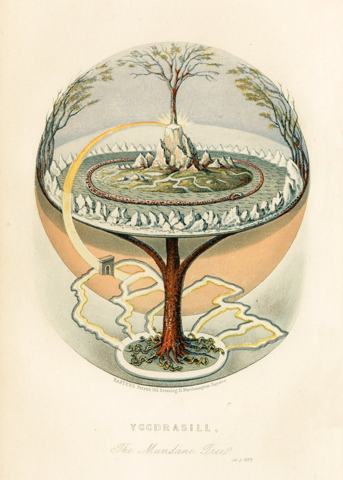
The World Tree. The great ash whose roots reach three wells and nine worlds, tended by the norns, eaten from every side, and still standing when the sky burns.
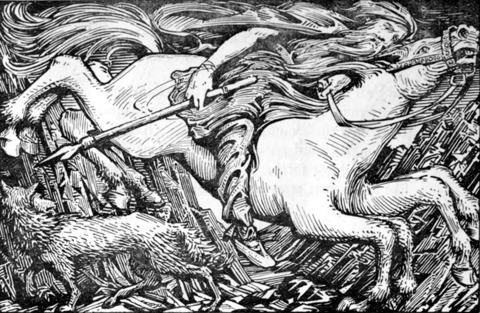
The cold underworld. Down and to the north, past a gold-roofed bridge and a gate that does not open twice, the hall where most of the Norse dead actually go.
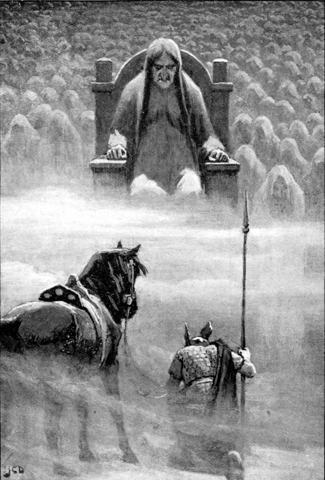
Queen of the Dead. Half living woman and half corpse, Loki's daughter rules the cold realm where those who die of sickness and age must go.
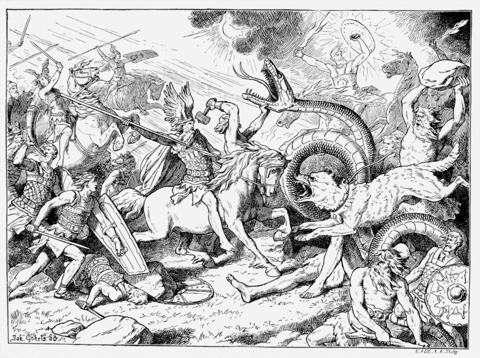
The Twilight of the Gods. The prophesied end: a killing winter, the breaking of every bond, a battle no one survives — and an earth that rises again.
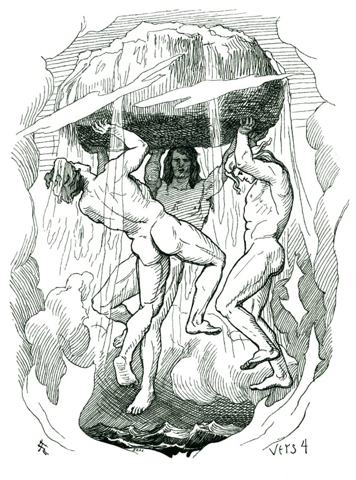
The middle enclosure. The human world, built from a murdered giant's body, fenced by his eyebrows, and ringed by a serpent that will one day let go of its tail.
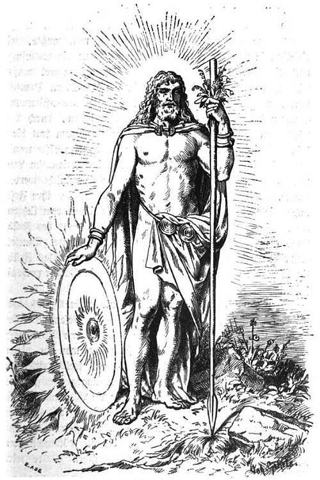
God of Light. The most beloved of the Aesir, made immune to all harm but one plant — and killed by it, which set the world's ending in motion.
Also mentioned inNiflheim
Sources & Further Reading
- 1.Poetic Edda — Voluspa (Codex Regius, 13th century).
- 2.Poetic Edda — Grimnismal (Codex Regius, 13th century).
- 3.Snorri Sturluson, Prose Edda — Gylfaginning (c. 1220).
- 4.Lindow, John. Norse Mythology — A Guide to the Gods, Heroes, Rituals, and Beliefs. Oxford University Press, 2001.
- 5.Simek, Rudolf. Dictionary of Northern Mythology. Trans. Angela Hall. D.S. Brewer, 1993.
- 6.Orchard, Andy. Cassell Dictionary of Norse Myth and Legend. Cassell, 1997.
- 7.Larrington, Carolyne (trans.). The Poetic Edda. Rev. ed., Oxford World's Classics, 2014.
- 8.Clunies Ross, Margaret. Prolonged Echoes — Old Norse Myths in Medieval Northern Society, vol. 1: The Myths. The Viking Collection 7. Odense University Press, 1994.
Spot an error or have a source to suggest? Write to info@viseterna.com. We cite primary sources and modern scholarship, and we correct fast.