
Muspelheim
The primordial fire-region of the south, older than the earth — home of Surtr and the sons of Muspell, present at the world's making and its burning.
Ragnarök, Emil Doepler, c. 1905 · Public domain · source
Older Than the Earth
Muspell — Snorri's fuller form is Muspellsheimr, "Muspell's home" — is the fire-region of Norse cosmology, and the poems treat it as older than the world it eventually burns. Voluspa says that before the sons of Bur raised up the lands, before the sun knew where its hall was, the sons of Muspell already had their own country 1. Whatever Muspell originally meant — the word's roots are disputed and no other Germanic language preserves it — the poets who used it were describing something that predates creation, not a district within it 4,5,6.
The name is usually given to the region and its inhabitants together. Surtr, the fire-giant who commands them at the end of the world, has his own entry; this one is about the country and the host, which the sources treat as older and larger than any single figure in it 3,5.
Fire at the Beginning
Snorri's creation account in Gylfaginning puts Muspellsheimr to work immediately. It is bright and burning, guarded at its border by Surtr with a flaming sword, and it sits at one edge of the primordial void Ginnungagap while the rime of Niflheim occupies the other. Sparks and glowing embers drift out of Muspell into the void, meet the frost coming the other way, and the meltwater of that collision becomes the giant Ymir and the cow Audhumbla, from whose licking the gods themselves descend 3. If the account is accurate to older tradition, Muspell is not only where the world ends — it is one of the two raw materials the world was built from 3,5.
Scholars treat this cosmogony with some caution. Snorri is a systematic thinker working from scattered Eddic lines centuries after the material was current belief, and the tidy binary of a fire-realm and an ice-realm meeting in a void may owe as much to his own sense of order as to inherited doctrine 5,6. What the Poetic Edda itself preserves is thinner: Muspell as an old country with a host of its own, not a fully diagrammed cosmological engine.
The Sons of Muspell
Where the sources agree, and agree vividly, is on what the "sons of Muspell" do at the end. Voluspa has them crossing the sea by ship, with Loki at the helm of Naglfar, while Asgard's rainbow bridge Bifrost breaks under the weight of the host riding over it — a detail Snorri repeats and elaborates, adding that nothing built by the gods can be relied on when Muspell's people come harrying 1,3,7. Vafthrudnismal names the battlefield they ride to, Vigrid, a hundred leagues on every side, where Surtr and "the sweet gods" will meet 2.
This is a host, not a solitary monster. The poems imagine an army with a homeland, arriving as a people rather than a single antagonist, which is part of why Ragnarok reads less like a duel and more like an invasion with its own logistics — a crossing, a march, a named field 1,2,3.
A Realm Defined by Its Border
Unlike Jotunheim or Helheim, Muspelheim has almost no interior described anywhere in the surviving corpus. No hall is named inside it, no individual besides Surtr is given a name or a voice, and no traveller's journey there survives the way Thor's trip to Utgard or Hermodr's ride to Hel does. What the sources give instead is a frontier: a sword-guarded border that keeps everyone else out until the one day it does not 3,5.
That absence of detail is itself informative. Turville-Petre reads the fire cosmology as at least partly shaped by the volcanic landscape of Iceland, where the poems were finally written down — a country whose settlers lived with real eruptions and real destruction by fire, and for whom a smouldering realm to the south needed no further description to feel true 6.
What the Nine Realms List Owes It
Modern popular lists of the Nine Realms place Muspelheim confidently alongside Asgard, Midgard and the rest, as though it always held equal rank. The medieval sources are looser: Muspell is named early and treated as ancient, but no surviving poem ever enumerates it as one world among nine, and the systematic geography is a modern convenience built on top of real but scattered lines 1,2,5. What is not in doubt is the role the poets gave it — the place fire comes from, at the start of things and at their ending, with nothing in between ever fully shown.
Continue Exploring
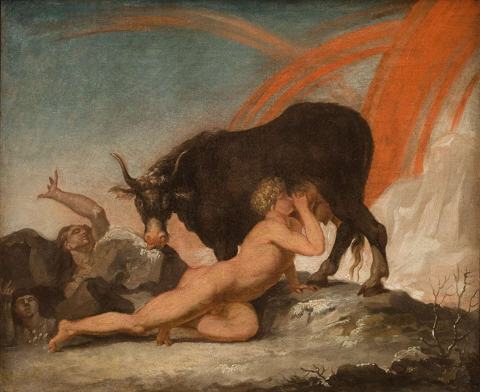
The primordial realm of frost and mist in the north — and, in Snorri's telling, confused ever after with the realm of Hel.
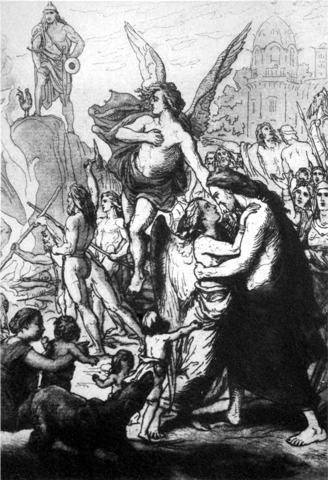
The stronghold of the AEsir. A walled citadel of halls at the top of the world tree, reached by the rainbow bridge and built on a bargain the gods broke.
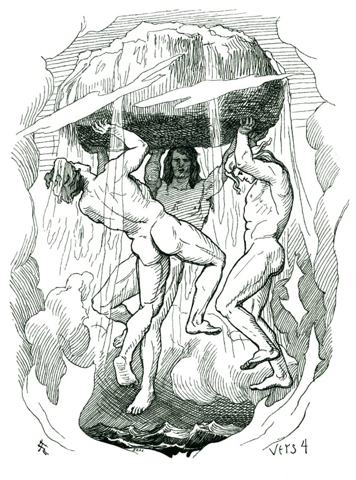
The middle enclosure. The human world, built from a murdered giant's body, fenced by his eyebrows, and ringed by a serpent that will one day let go of its tail.
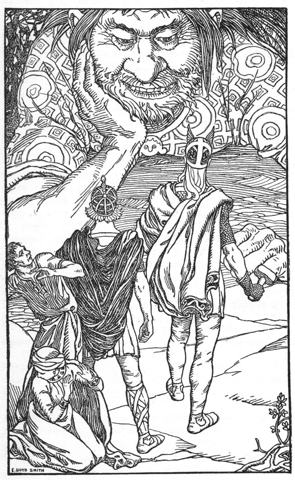
Land of the giants. The wild country east of the fence, older than the gods, holding the wisdom and the brides the AEsir keep going out to take.
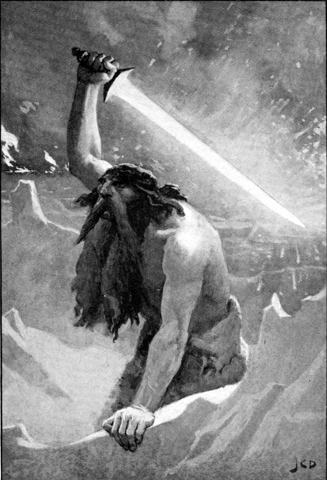
The Black One. The fire-giant who comes from the south at Ragnarok with a sword brighter than the sun, and burns the whole world to the ground behind him.
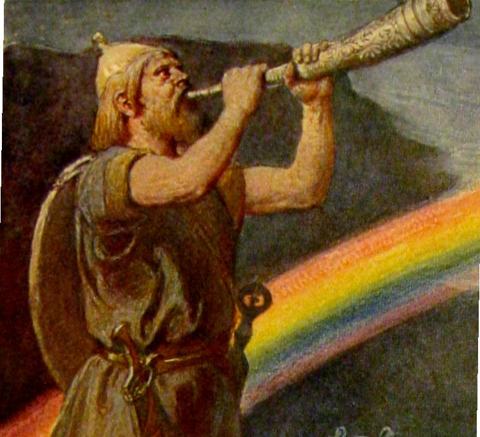
The burning rainbow bridge from earth to Asgard. Strongest thing ever built, guarded by Heimdall - and fated to shatter under the riders of Ragnarok.
Also mentioned inVanaheim
Sources & Further Reading
- 1.Poetic Edda — Voluspa (Codex Regius, 13th century).
- 2.Poetic Edda — Vafthrudnismal (Codex Regius, 13th century).
- 3.Snorri Sturluson, Prose Edda — Gylfaginning (c. 1220).
- 4.Lindow, John. Norse Mythology — A Guide to the Gods, Heroes, Rituals, and Beliefs. Oxford University Press, 2001.
- 5.Simek, Rudolf. Dictionary of Northern Mythology. Trans. Angela Hall. D.S. Brewer, 1993.
- 6.Turville-Petre, E.O.G. Myth and Religion of the North — The Religion of Ancient Scandinavia. Weidenfeld & Nicolson, 1964.
- 7.Larrington, Carolyne (trans.). The Poetic Edda. Rev. ed., Oxford World's Classics, 2014.
Spot an error or have a source to suggest? Write to info@viseterna.com. We cite primary sources and modern scholarship, and we correct fast.