
Brisingamen
Freyja's necklace. A torc famous enough to reach Old English verse — worn by Thor in disguise, stolen by Loki, and fought over by Heimdallr as a seal.
Heimdal overlamnar Brisingasmycket till Freja, Nils Blommer, 1846 (Nationalmuseum, Stockholm) · Public domain · source
The Necklace of the Brisings
The Old Norse form is Brisingamen. The second element, men, is the ordinary word for a neck-ring or torc, cognate with Latin monile. The first, Brisinga, is the genitive plural of a name or noun nobody has securely explained: it may be a family or dwarf-kindred called the Brisingar, or it may relate to the poetic word brisingr, "fire", in which case the object is "the necklace of flames" and the name is a description of gold catching light 7.
It is not a delicate chain. Viking Age neck-ornaments of the kind the word covers were heavy twisted torcs of gold or silver, unmistakable at a distance and worn as a statement of rank — which is exactly how Freyja's necklace behaves in every story it appears in 6,7.
Thor in the Bride's Veil
The oldest secure appearance in the Eddic poems is comic. In Thrymskvida, the giant Thrym has stolen Mjolnir and will return it only in exchange for Freyja as his bride. Loki brings her the news, and her reaction is so violent that the halls of the AEsir tremble beneath her and Brisingamen bursts from her neck 1,8.
The gods then decide that Thor will go in her place, and dress him: the veil, the household keys at the belt, women's clothes, and Brisingamen at his throat 1,8. The necklace is part of what makes the disguise legible. Freyja is identifiable by it the way Thor is identifiable by his hammer, and when the poem needs the giants to accept a bearded, glaring, ox-eating "bride", the torc is the credential doing the work.
The line where the necklace snaps off is also, incidentally, one of the best single images in Norse poetry for divine rage: the gold gives way before the goddess does 6,8.
Heimdallr and Loki at Singasteinn
The oldest reference of all is not in a story but in a poem about a carving. Around 985 the Icelandic skald Ulfr Uggason composed Husdrapa, describing the mythological scenes painted or carved in a newly built hall, and Snorri Sturluson quotes it in Skaldskaparmal for a fight between Heimdallr and Loki, in the shape of seals, over Brisingamen at a place called Singasteinn 2.
Snorri lists among Heimdallr's kennings "seeker of Freyja's necklace" and Loki's as "thief of Brisingamen", which tells us the episode was common knowledge in the tenth century — and then neither he nor anyone else records the plot 2,6,7. It is one of the most tantalising gaps in the corpus: a famous myth surviving only as two job titles and a wrestling match between seals on a rock.
The Old English Beowulf deepens the puzzle. Describing a neck-ring given to the hero, the poet compares it to the Brosinga mene, the necklace of the Brosings, in connection with a theft 5. An Anglo-Saxon audience around the eighth to tenth century evidently knew a version of the same tradition, meaning the necklace and its theft travelled across the North Sea long before any Icelandic manuscript recorded it 6,7.
The Late Version, and Why to Be Careful With It
Popular retellings usually give a different and much more explicit origin, and it comes from a single late source. Sorla thattr, preserved in the fourteenth-century Flateyjarbok, tells how Freyja saw four dwarfs making a golden necklace, wanted it, and was told the price: a night with each of them. She paid it. Loki reported the matter to Odin, was ordered to steal the necklace, took the form of a fly to get through her locked bower, and Odin then returned it on condition that Freyja set two kings at war forever 4,6.
This is a Christian-era text written some five hundred years after conversion, in a manuscript whose compilers openly frame the old gods as sorcerers and men, and its treatment of Freyja is part of a long medieval habit of casting the goddess as promiscuous 6,7. It is a real and interesting piece of literature. It is not evidence for what tenth-century Scandinavians believed, and the confident modern summary of "how Freyja got her necklace" rests on it almost entirely.
What the Necklace Meant
Freyja is the goddess of seidr, of desire, of gold and of half the battle-slain, whom Snorri calls the most glorious of the goddesses; she weeps tears of red gold for her wandering husband Od, and gold itself is called "Freyja's tears" in skaldic diction 3,6. Brisingamen is the visible form of that association: worn wealth, worn power.
Archaeology supplies the context. Viking Age burials, hoards and the small gold-foil figures known as guldgubber show richly ornamented women wearing prominent neck-rings, and several silver pendant figurines — including one from Aska in Ostergotland — depict a seated woman with a heavy necklace, and are often identified with Freyja on exactly that evidence 6,7. The identification is an argument rather than a certainty, but the pattern of neck-ornament as a marker of female authority in the period is not in doubt.
The necklace is also, quietly, the thing everyone in Asgard wants: Thrym wants its owner, Loki wants the object, Heimdallr fights for it, Thor borrows it. In a mythology whose male treasures are a hammer, a spear and a ring, Freyja's is the one that gets stolen 6,7.
Continue Exploring
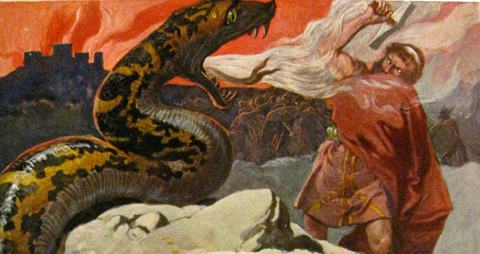
Hammer of Thor. Dwarf-forged, short in the handle, it strikes like lightning, hallows oaths and the dead, and always returns to the hand that throws it.
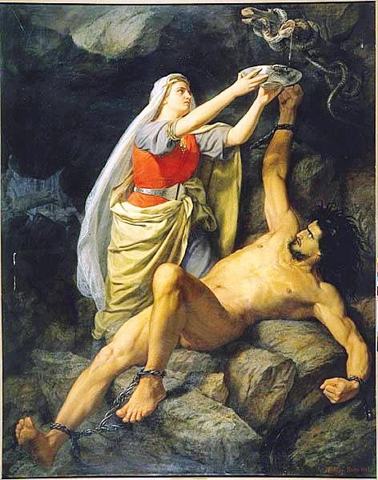
The Trickster. Shape-shifter of giant blood counted among the gods — their cleverest ally, the father of monsters, and the spark of Ragnarok.
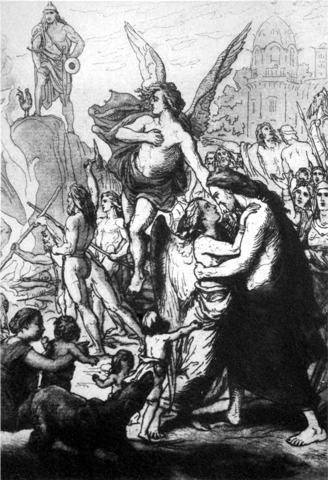
The stronghold of the AEsir. A walled citadel of halls at the top of the world tree, reached by the rainbow bridge and built on a bargain the gods broke.
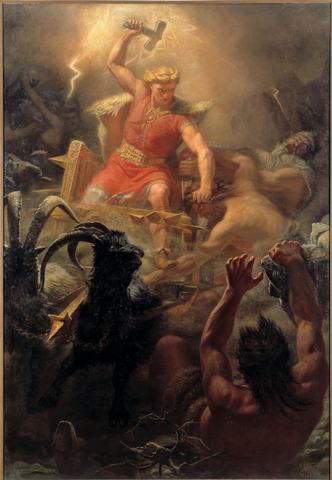
God of Thunder. Son of Odin and the earth, wielder of Mjolnir, and the gods' front line against the giants — fated to fall with the World Serpent.
Watchman of the Gods. Born of nine mothers, he guards the rainbow bridge, hears wool grow on sheep, and will sound the horn that begins the end.
Lady of the Vanir. Goddess of love, war, gold and seidr magic — often spelled Freya — who claims half of the battle-slain for her own hall.
Sources & Further Reading
- 1.Poetic Edda — Thrymskvida (Codex Regius, 13th century).
- 2.Snorri Sturluson, Prose Edda — Skaldskaparmal, quoting Ulfr Uggason's Husdrapa (c. 985).
- 3.Snorri Sturluson, Prose Edda — Gylfaginning (c. 1220).
- 4.Sorla thattr, in Flateyjarbok (late 14th century).
- 5.Beowulf, lines 1197-1201 (Old English, Cotton Vitellius A.xv).
- 6.Lindow, John. Norse Mythology — A Guide to the Gods, Heroes, Rituals, and Beliefs. Oxford University Press, 2001.
- 7.Simek, Rudolf. Dictionary of Northern Mythology. Trans. Angela Hall. D.S. Brewer, 1993.
- 8.Larrington, Carolyne (trans.). The Poetic Edda. Rev. ed., Oxford World's Classics, 2014.
Spot an error or have a source to suggest? Write to info@viseterna.com. We cite primary sources and modern scholarship, and we correct fast.